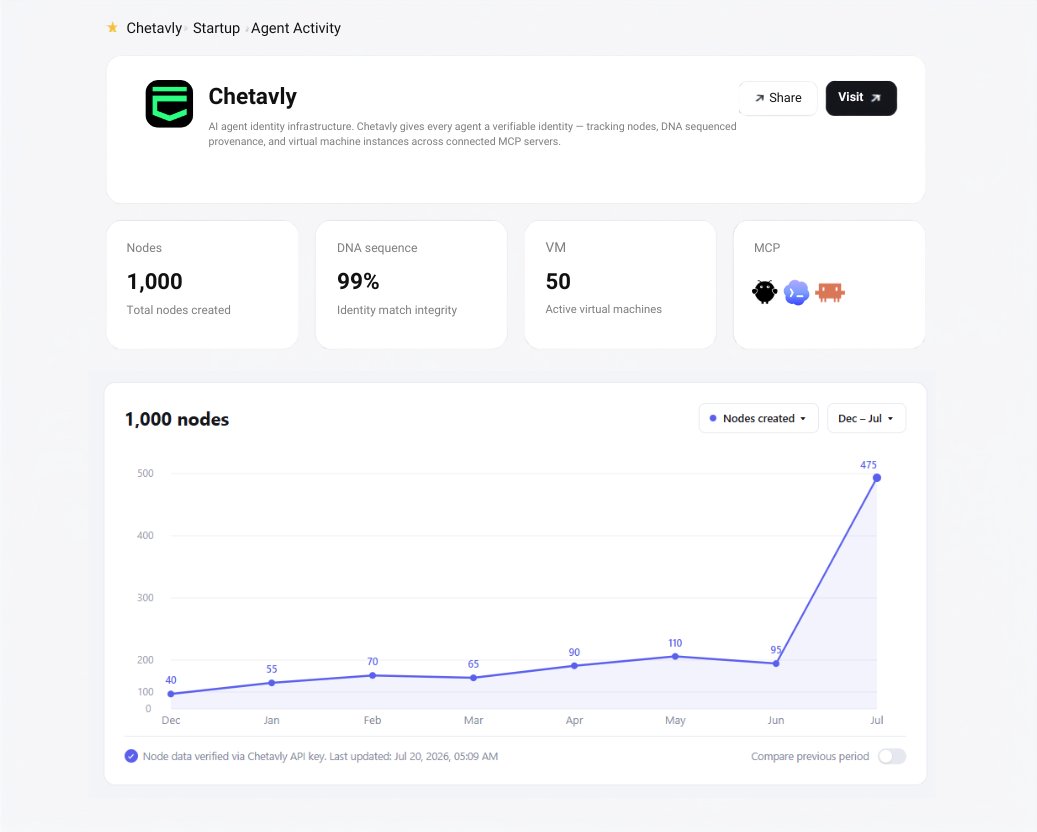
@i_mika_el Yes a few and we mitigated most of the anomalies that lead to that and also ensured that it doesn't affect every other person in the pool i.e every other nodes or profiles
Everyone is talking about AI agents.
Almost nobody is talking about the infrastructure they actually need.
Today, if you ask Claude Code, Codex, Cursor, or any AI agent to browse the web, log into dashboards, manage accounts, scrape data, or automate workflows...
...you immediately hit walls.
• Sessions disappear.
• Fingerprints get flagged.
• Browsers aren't persistent.
• Scaling becomes painful.
• Security becomes a nightmare.
That's exactly why we built Chetavly.
Think of it as cloud infrastructure for AI agents.
Every agent gets its own persistent browser identity, secure environment, fingerprint, storage, cookies, proxies, telemetry and execution layer.
Instead of spending months building browser infrastructure...
You just give your AI an API.
Here's what Chetavly enables
1. Persistent AI Workers
Your AI remembers everything.
Cookies.
Sessions.
Logins.
Storage.
No more starting over every run.
2. Browser Infrastructure at Scale
Need 10 browsers?
100?
10,000?
Spin them up through an API instead of maintaining infrastructure yourself.
3. Human-like Browser Identity
Every browser has its own fingerprint.
Its own environment.
Its own behavior.
Perfect for automation that actually needs to survive in the real world.
4. Secure Execution
Every browser runs inside isolated cloud infrastructure.
No exposing your local machine.
No managing fleets of VMs.
Just deploy.
5. Built for AI
Claude Code.
Codex.
OpenAI Agents.
LangGraph.
CrewAI.
Anything capable of calling an API can instantly gain a browser.
Over the next few weeks we're going to open up how we built all of this.
No gatekeeping.
We'll share:
• How we scale browser infrastructure.
• How we manage persistent identities.
• How our telemetry system works.
• The architecture behind browser orchestration.
• The security model protecting every browser instance.
• Lessons we've learned building Browser Infrastructure for AI.
If you're building the next generation of AI products...
Follow along.
The next wave of AI won't be won by the smartest model.
It'll be won by whoever gives that model the best infrastructure.
I also think you should end with a memorable line that becomes associated with Chetavly. Something like:
"Models are getting smarter every month. Infrastructure is what turns them into products."
or
"Every AI agent deserves a browser."
or my favorite:
"The future isn't AI. It's AI with infrastructure."
@JureUrsic Yea the boring engineering stuffs are the main stuffs though we don't encourage Bot bypass but then providing the identity for each ai agents to be identified by on the web just like everyone give ai agents an edge to do real work on the web.
That's a critical problem. Persistence is only valuable if you can trust what you're persisting.
Our approach is to treat browser profiles as living state, not immutable assets. Before a profile is reused, we're building safeguards around integrity checks, isolation, audit trails, and policy validation to reduce the risk of reusing a compromised state.
Long term, we also see room for profile health scoring, suspicious activity detection, and allowing customers to automatically quarantine or rebuild profiles that don't meet their security policies.
The goal isn't just persistent browsers—it's trusted persistent browsers.
And also talking about pricing that's one of the reasons we built Chetavly with usage-based pricing instead of forcing teams onto expensive monthly plans. If you're testing an agent or running workloads intermittently, you only pay for what you actually use.
For example, a browser session starts at $1.49/hour, so developers can prototype, run jobs, and scale gradually without committing to infrastructure they'll never fully utilize.
That's the difference between an AI demo and an AI platform. Models are getting better every few months, but production infrastructure is where engineering time disappears. Our focus with Chetavly is making those concerns—browser infrastructure, telemetry, persistence, and orchestration—something developers don't have to rebuild from scratch.
It's a defense-in-depth problem. A persistent browser shouldn't be a single long-lived secret. Each browser runs in an isolated environment, access is mediated by scoped credentials, and sessions can be revoked independently of the underlying profile. That way, if an agent is compromised, you rotate credentials or terminate the runtime without losing the persistent identity you've built over time.
First official Chetavly team meetup. 🚀
@trychetavly
Great ideas start with great people, and today was all about aligning our vision, strengthening our team, and planning what's next.
This is just the beginning. More to build. More to achieve.
@FabrizioRomano Big move for Jesse Lingard! 🇧🇷
Joining Sport Club Corinthians Paulista could be the fresh start he needs. Excited to see how he performs in Brazil! ⚽🔥
GoLogin’s "lapses" are a developer's nightmare: static fingerprints that get flagged and kernel lag that screams "bot" to security systems.
Chetavly solves this with AI-driven, dynamic fingerprinting. We don't just spoof; we emulate real-world hardware noise—Canvas, WebGL, and Audio—on the latest Chromium builds. By moving the fingerprinting engine to the cloud, we ensure your profiles look like genuine human traffic, not a cluster of scripts.
Stop getting banned. Get on the wait list at 👉https://t.co/4s5oaMP8dG