For those who just (re)discovered $NEAR:
- Mission is all people own their assets, data and power of choice
- Vision is AI is the frontend, markets/blockchain is the backend
- Privacy is fundamental and enables the mission
- NEAR Intents is universal, private markets routed already $30B, integrated across all of onchain ecosystem from Ledger to ZODL to Metamask to Trust to Brave
- NEAR AI is private AI powering end to end encrypted inference in Brave, Venice, and more
- More products across ecosystem are developing to leverage AI x markets
- Apps in Web3 that don’t want to limit themself to one chain’s users use Intents to enable seamless connect by users of any chain
- near(.)com brings this whole vision together into a consumer product making private unstoppable liquidity and (soon) AI seamless
If you are using onchain and private products you are probably using NEAR.
And if you are struggling onchain - try near(.)com for seamless experience.
NEAR operates one of the most mature and transparent cryptoeconomic systems in the industry.
With NEAR Intents all-time volume now over $19 billion, and NEAR AI powering workloads for major platforms like Venice, Brave, Abound, and more, NEAR is primed to capture value from the growth of both DeFi and the agent economy.
NEAR Intents are the privacy-preserving rails for connecting global liquidity and agentic commerce, with confidential volume growing steadily, support for new asset classes like RWAs, and a key role to play in large stablecoin swaps through the Stablecoin Transport Protocol.
Intents now routes value across 35+ chains, 135+ assets, and is integrated across major DeFi infrastructure, aggregators, and wallets. Over $1.5 billion in ZEC volume has moved across Intents. Since the fee switch went live at NEARCON, NEAR has generated over $8 million in revenue that is directed toward NEAR buybacks.
NEAR’s network fundamentals are designed to accelerate a deflationary economic flywheel through increased network usage and ecosystem growth. The network’s token supply is fully unlocked. The halving upgrade reduced maximum annual inflation by 50%. And core products are generating real, recurring revenue.
This is how NEAR becomes the foundation for the AI economy and the currency of agents.
In an agent economy, the infrastructure layer will capture the most value. Agents will converge on the infrastructure that settles at scale, reaches the most liquidity, and keeps their operations confidential. NEAR has been uniquely architected from the beginning to combine scalable settlement, cross-chain execution, privacy-preserving execution, and private inference all into a single protocol.
Very thoughtful piece from a man who’s been on the inside of TradFi for decades and has brought his wisdom and perspective to the intersection of TradFi and Ethereum at Sharplink. He is a voice of reason and a steady hand. He’s built an outstanding team that can weather the lulls and capitalize on the surges.
The institutional group at Consensys is doing the work: bringing Ethereum to major global financial market infrastructure hubs and major financial institutions.
TradFi keeps choosing Ethereum, but TradFi doesn't announce that they're going to announce something. TradFi comprehensively covers the bases and then launches.
So Joseph's steadfast outlook is very well informed. The surge is coming.
Short-term things being done to shift Ethereum toward native privacy:
* AA + FOCIL (makes privacy protocol txs, among many other things, first-class with strong inclusion guarantees)
* Keyed nonces: https://t.co/BeTJvFhxiV
* Access-layer work (Kohaku, private reads...)
"Every major AI platform — ChatGPT, Claude, Gemini, Grok, Perplexity — stores your conversations on centralized servers. That data can be reviewed, classified, subpoenaed, hacked, or sold. You're trusting the company, its employees, its vendors, and every government that asks.
Venice is architecturally different. Prompts are not stored server-side. Chat history lives in the user's browser. And as of March 18, 2026, Venice offers something no other AI platform does: verifiable encryption."
I was recently at Real World Crypto (that's crypto as in cryptography) and the associated side events, and one thing that struck me was that it was a clarifying experience in terms of understanding *what blockchains are for*.
We blockchain people (myself included) often have a tendency to start off from the perspective that we are Ethereum, and therefore we need to go around and find use cases for Ethereum - and generate arguments for why sticking Ethereum into all kinds of places is beneficial.
But recently I have been thinking from a different perspective. For a moment, let us forget that we are "the Ethereum community". Rather, we are maintainers of the Ethereum tool, and members of the {CROPS (censorship-resistant, open-source, private, secure) tech | sanctuary tech | non-corposlop tech | d/acc | ...} community. Going in with zero attachment to Ethereum specifically, and entering a context (like RWC) where there are people with in-principle aligned values but no blockchain baggage, can we re-derive from zero in what places Ethereum adds the most value?
From attending the events, the first answer that comes up is actually not what you think. It's not smart contracts, it's not even payments. It's what cryptographers call a "public bulletin board".
See, lots of cryptographic protocols - including secure online voting, secure software and website version control, certificate revocation... - all require some publicly writable and readable place where people can post blobs of data. This does not require any computation functionality. In fact, it does not directly require money - though it does _indirectly_ require money, because if you want permissionless anti-spam it has to be economic. The only thing it _fundamentally_ requires is data availability.
And it just so happened that Ethereum recently did an upgrade (PeerDAS) to increase the amount of data availability it provides by 2.3x, with a path to going another 10-100x higher!
Next, payments. Many protocols require payments for many reasons. Some things need to be charged for to reduce spam. Other things because they are services provided by someone who expends resources and needs to be compensated. If you want a permissionless API that does not get spammed to death, you need payments. And Ethereum + ZK payment channels (eg. https://t.co/1Q2Hqg0DZg ) is one of the best payment systems for APIs you can come up with.
If you are making a private and secure application (eg. a messenger, or many other things), and you do not want to let people to spam the system by creating a million accounts and then uploading a gigabyte-sized video on each one, you need sybil resistance, and if you care about security and privacy, you really should care about permissionless participation (ie. don't have mandatory phone number dependency). ETH payment as anti-sybil tool is a natural backstop in such use cases.
Finally, smart contracts. One major use case is _security deposits_: ETH put into lockboxes that provably get destroyed if a proof is submitted that the owner violated some protocol rule. Another is actually implementing things like ZK payment channels. A third is making it easy to have pointers to "digital objects" that represent some socially defined external entity (not necessarily an RWA!), and for those pointers to interact with each other.
*Technically*, for every use case other than use cases handling ETH itself, the smart contracts are "just a convenience": you could just use the chain as a bulletin board, and use ZK-SNARKs to provide the results of any computations over it. But in practice, standardizing such things is hard, and you get the most interoperability if you just take the same mechanism that enables programs to control ETH, and let other digital objects use it too.
And from here, we start getting into a huge number of potential applications, including all of the things happening in defi.
---
So yes, Ethereum has a lot of value, that you can see from first principles if you take a step back and see it purely as a technical tool: global shared memory.
I suspect that a big bottleneck to seeing more of this kind of usage is that the world has not yet updated to the fact that we are no longer in 2020-22, fees are now extremely low, and we have a much stronger scaling roadmap to make sure that they will continue to stay low, even if much higher levels of usage return. Infrastructure for not exposing fee volatility to users is much more mature (eg. one way to do this for many use cases is to just operate a blob publisher).
Ethereum blobs as a bulletin board, ETH as an asset and universal-backup means of payment, and Ethereum smart contracts as a shared programming layer, all make total sense as part of a decentralized, private and secure open source software stack. But we should continue to improve the Ethereum protocol and infrastructure so that it's actually effective in all of these situations.
I think it's healthy for us in the Ethereum world to have a more bold and open mindset to many things, particularly on the application layer and on how we see ourselves in the world.
We should not compromise on core properties: censorship resistance, open source, privacy, security (CROPS). We should not have "open mindedness" of the type that leaves people with no confidence of what security properties the L1 will still have one year from now. We should not ask ourselves questions like "do we really need light clients to be able to trustlessly verify correctness of the chain?". But especially on the layer of applications and Ethereum's interface to the world, we should be more willing to radically rethink various concepts and step outside our comfort zone.
This includes issues of technological direction, eg. "what if AI basically means that wallets as browser extensions and mobile extensions are dead within a year?"
One example last year was the shift to thinking about privacy as a first-class consideration, something we value equally to the other types of security. This implies a radically different Ethereum application stack, because the entire stack so far has not been built around privacy. Great, let's build a radically different Ethereum application stack!
An example this year is the growing work on the networking side of privacy, both inside the EF and outside.
It includes application-layer issues, eg. "what if the rest of defi is basically just universal futures markets on top of a good decentralized oracle and letting users self-organize on top of that?", and "what if the ideal decentralized oracle is just a SNARK over M-of-N small LLMs over zk-TLSes of some major news sites?"
(BTW this is interrelated with the AI issue: one consequence of AI is that it moves "applications" away from being discrete categories of behavior with discrete UIs, and more toward being a continuous space, so "build fewer apps and rely on users to self-organize around them" should inevitably expand as a pattern)
One example this year is rethinking from zero the role of L2s, and what kind of L2s are actually most synergistic and additive to Ethereum.
It also includes culture. This is a big part of "the whole milady thing" for myself, @AyaMiyagotchi and others. Yes, it's a silly meme. Yes, I find the political takes of some milady partisans cringe and sometimes outright bootlickerish (though other milady partisans are quite the opposite). But the core underlying subtext, the message behind the message, is: rip off the suit and tie. If you have your suit and tie on, be willing to grab the nearest wine glass and spill it all over your suit and tie, so you have no choice but to rip it off and reclaim your body's full flexibility and freedom. Actually imagine yourself doing this the next time you get invited to a richpeopleslop formal gala dinner. Take the preconception that you are "respectable", write it down on a piece of paper, crumble it up and burn it. The psychological baptism of doing this leads to the intellectual baptism of unlocking greater creativity and expanding overton windows.
For too long, our algorithm in Ethereum has been: we have this existing ecosystem, what's the logical next step to make it one step better? Now, our algorithm should be: we have this L1 that is amazing and will become more amazing, we have a growing array of tools, both those built within our ecosystem and outside it, what are the most valuable things to build, knowing what we know now? If YOU had to write the section of the 2014 Ethereum whitepaper that talked about applications, and take a first-principles perspective of what makes sense in defi, decentralized social, identity, and elsewhere, what would you write? At least take the step of marking all path-dependence concerns down to zero, pretend for a brief moment that the Ethereum chain today has exactly zero usage and you're the one suggesting or building the first apps, and see what comes out. Do this even if you're the one building today's existing apps. This is how Ethereum can grow back stronger.
Now, execution layer changes. I've already talked about account abstraction, multidimensional gas, BALs, and ZK-EVMs.
I've also talked here about a short-term EVM upgrade that I think will be super-valuable: a vectorized math precompile (basically, do 32-bit or potentially 64-bit operations on lists of numbers at the same time; in principle this could accelerate many hashes, STARK validation, FHE, lattice-based quantum-resistane signatures, and more by 8-64x); think "the GPU for the EVM". https://t.co/WikL7gJ5qg
Today I'll focus on two big things: state tree changes, and VM changes. State tree changes are in this roadmap. VM changes (ie. EVM -> RISC-V or something better) are longer-term and are still more non-consensus, but I have high conviction that it will become "the obvious thing to do" once state tree changes and the long-term state roadmap (see https://t.co/7nL9qOQYnm ) are finished, so I'll make my case for it here.
What these two have in common is:
* They are the big bottlenecks that we have to address if we want efficient proving (tree + VM are like >80%)
* They're basically mandatory for various client-side proving use cases
* They are "deep" changes that many shrink away from, thinking that it is more "pragmatic" to be incrementalist
I'll make the case for both.
# Binary trees
The state tree change (worked on by @gballet and many others) is https://t.co/ta5HwJkhvv, switching from the current hexary keccak MPT to a binary tree based on a more efficient hash function.
This has the following benefits:
* 4x shorter Merkle branches (because binary is 32*log(n) and hexary is 512*log(n)/4), which makes client-side branch verification more viable. This makes Helios, PIR and more 4x cheaper by data bandwidth
* Proving efficiency. 3-4x comes from shorter Merkle branches. On top of that, the hash function change: either blake3 [perhaps 3x vs keccak] or a Poseidon variant [100x, but more security work to be done]
* Client-side proving: if you want ZK applications that compose with the ethereum state, instead of making their own tree like today, then the ethereum state tree needs to be prover-friendly.
* Cheaper access for adjacent slots: the binary tree design groups together storage slots into "pages" (eg. 64-256 slots, so 2-8 kB). This allows storage to get the same efficiency benefits as code in terms of loading and editing lots of it at a time, both in raw execution and in the prover. The block header and the first ~1-4 kB of code and storage live in the same page. Many dapps today already load a lot of data from the first few storage slots, so this could save them >10k gas per tx
* Reduced variance in access depth (loads from big contracts vs small contracts)
* Binary trees are simpler
* Opportunity to add any metadata bits we end up needing for state expiry
Zooming out a bit, binary trees are an "omnibus" that allows us to take all of our learnings from the past ten years about what makes a good state tree, and actually apply them.
# VM changes
See also: https://t.co/NSRtzNYplH
One reason why the protocol gets uglier over time with more special cases is that people have a certain latent fear of "using the EVM". If a wallet feature, privacy protocol, or whatever else can be done without introducing this "big scary EVM thing", there's a noticeable sigh of relief. To me, this is very sad. Ethereum's whole point is its generality, and if the EVM is not good enough to actually meet the needs of that generality, then we should tackle the problem head-on, and make a better VM. This means:
* More efficient than EVM in raw execution, to the point where most precompiles become unnecessary
* More prover-efficient than EVM (today, provers are written in RISC-V, hence my proposal to just make the new VM be RISC-V)
* Client-side-prover friendly. You should be able to, client-side, make ZK-proofs about eg. what happens if your account gets called with a certain piece of data
* Maximum simplicity. A RISC-V interpreter is only a couple hundred lines of code, it's what a blockchain VM "should feel like"
This is still more speculative and non-consensus. Ethereum would certainly be *fine* if all we do is EVM + GPU. But a better VM can make Ethereum beautiful and great.
A possible deployment roadmap is:
1. NewVM (eg. RISC-V) only for precompiles: 80% of today's precompiles, plus many new ones, become blobs of NewVM code
2. Users get the ability to deploy NewVM contracts
3. EVM is retired and turns into a smart contract written in NewVM
EVM users experience full backwards compatibility except gas cost changes (which will be overshadowed by the next few years of scaling work). And we get a much more prover-efficient, simpler and cleaner protocol.
https://t.co/YGILZ13vMQ
Now, scaling.
There are two buckets here: short-term and long-term.
Short term scaling I've written about elsewhere. Basically:
* Block level access lists (coming in Glamsterdam) allow blocks to be verified in parallel.
* ePBS (coming in Glamsterdam) has many features, of which one is that it becomes safe to use a large fraction of each slot (instead of just a few hundred milliseconds) to verify a block
* Gas repricings ensure that gas costs of operations are aligned with the actual time it takes to execute them (plus other costs they impose). We're also taking early forays into multidimensional gas, which ensures that different resources are capped differently. Both allow us to take larger fractions of a slot to verify blocks, without fear of exceptional cases.
There is a multi-stage roadmap for multidimensional gas.
First, in Glamsterdam, we separate out "state creation" costs from "execution and calldata" costs. Today, an SSTORE that changes a slot from nonzero -> nonzero costs 5000 gas, an SSTORE that changes zero -> nonzero costs 20000. One of the Glamsterdam repricings greatly increases that extra amount (eg. to 60000); our goal doing this + gas limit increases is to scale execution capacity much more than we scale state size capacity, for reasons I've written before ( https://t.co/7nL9qOQYnm ). So in Glamsterdam, that SSTORE will charge 5000 "regular" gas and (eg.) 55000 "state creation gas".
State creation gas will NOT count toward the ~16 million tx gas cap, so creating large contracts (larger than today) will be possible.
One challenge is: how does this work in the EVM? The EVM opcodes (GAS, CALL...) all assume one dimension. Here is our approach. We maintain two invariants:
* If you make a call with X gas, that call will have X gas that's usable for "regular" OR "state creation" OR other future dimensions
* If you call the GAS opcode, it tells you you have Y gas, then you make a call with X gas, you still have at least Y-X gas, usable for any function, _after_ the call to do any post-operations
What we do is, we create N+1 "dimensions" of gas, where by default N=1 (state creation), and the extra dimension we call "reservoir". EVM execution by default consumes the "specialized" dimensions if it can, and otherwise it consumes from reservoir. So eg. if you have (100000 state creation gas, 100000 reservoir), then if you use SSTORE to create new state three times, your remaining gas goes (100000, 100000) -> (45000, 95000) -> (0, 80000) -> (0, 20000). GAS returns reservoir. CALL passes along the specified gas amount from the reservoir, plus _all_ non-reservoir gas.
Later, we switch to multi-dimensional *pricing*, where different dimensions can have different floating gas prices. This gives us long-term economic sustainability and optimality (see https://t.co/KiiDugo4OA ). The reservoir mechanism solves the sub-call problem at the end of that article.
Now, for long-term scaling, there are two parts: ZK-EVM, and blobs.
For blobs, the plan is to continue to iterate on PeerDAS, and get it to an eventual end-state where it can ideally handle ~8 MB/sec of data. Enough for Ethereum's needs, not attempting to be some kind of global data layer. Today, blobs are for L2s. In the future, the plan is for Ethereum block data to directly go into blobs. This is necessary to enable someone to validate a hyperscaled Ethereum chain without personally downloading and re-executing it: ZK-SNARKs remove the need to re-execute, and PeerDAS on blobs lets you verify availability without personally downloading.
For ZK-EVM, the goal is to step up our "comfort" relying on it in stages:
* Clients that let you participate as an attester with ZK-EVMs will exist in 2026. They will not be safe enough to allow the network to run on them, but eg. 5% of the network relying on them will be ok. (If the ZK-EVM breaks, you *will not* be slashed, you'll just have a risk of building on an invalid block and losing revenue)
* In 2027, we'll start recommending for a larger minority of the network to run on ZK-EVMs, and at the same time full focus will be on formally verifying, maximizing their security, etc. Even 20% of the network running ZK-EVMs will let us greatly increase the gaslimit, because it allows gas limits to greatly increase while having a cheap path for solo stakers, who are under 20% anyway.
* When ready, we move to 3-of-5 mandatory proving. For a block to be valid, it would need to contain 3 of 5 types of proofs from different proof systems. By this point, we would expect that all nodes (except nodes that need to do indexing) will rely on ZK-EVM proofs.
* Keep improving the ZK-EVM, and make it as robust, formally verified, etc as possible. This will also start to involve any VM change efforts (eg. RISC-V)
https://t.co/NQ3JFLe8Gd
Now, the quantum resistance roadmap.
Today, four things in Ethereum are quantum-vulnerable:
* consensus-layer BLS signatures
* data availability (KZG commitments+proofs)
* EOA signatures (ECDSA)
* Application-layer ZK proofs (KZG or groth16)
We can tackle these step by step:
## Consensus-layer signatures
Lean consensus includes fully replacing BLS signatures with hash-based signatures (some variant of Winternitz), and using STARKs to do aggregation.
Before lean finality, we stand a good chance of getting the Lean available chain. This also involves hash-based signatures, but there are much fewer signatures (eg. 256-1024 per slot), so we do not need STARKs for aggregation.
One important thing upstream of this is choosing the hash function. This may be "Ethereum's last hash function", so it's important to choose wisely. Conventional hashes are too slow, and the most aggressive forms of Poseidon have taken hits on their security analysis recently. Likely options are:
* Poseidon2 plus extra rounds, potentially non-arithmetic layers (eg. Monolith) mixed in
* Poseidon1 (the older version of Poseidon, not vulnerable to any of the recent attacks on Poseidon2, but 2x slower)
* BLAKE3 or similar (take the most efficient conventional hash we know)
## Data availability
Today, we rely pretty heavily on KZG for erasure coding. We could move to STARKs, but this has two problems:
1. If we want to do 2D DAS, then our current setup for this relies on the "linearity" property of KZG commitments; with STARKs we don't have that. However, our current thinking is that it should be sufficient given our scale targets to just max out 1D DAS (ie. PeerDAS). Ethereum is taking a more conservative posture, it's not trying to be a high-scale data layer for the world.
2. We need proofs that erasure coded blobs are correctly constructed. KZG does this "for free". STARKs can substitute, but a STARK is ... bigger than a blob. So you need recursive starks (though there's also alternative techniques, that have their own tradeoffs). This is okay, but the logistics of this get harder if you want to support distributed blob selection.
Summary: it's manageable, but there's a lot of engineering work to do.
## EOA signatures
Here, the answer is clear: we add native AA (see https://t.co/YD9nIpsxcC ), so that we get first-class accounts that can use any signature algorithm.
However, to make this work, we also need quantum-resistant signature algorithms to actually be viable. ECDSA signature verification costs 3000 gas. Quantum-resistant signatures are ... much much larger and heavier to verify.
We know of quantum-resistant hash-based signatures that are in the ~200k gas range to verify.
We also know of lattice-based quantum-resistant signatures. Today, these are extremely inefficient to verify. However, there is work on vectorized math precompiles, that let you perform operations (+, *, %, dot product, also NTT / butterfly permutations) that are at the core of lattice math, and also STARKs. This could greatly reduce the gas cost of lattice-based signatures to a similar range, and potentially go even lower.
The long-term fix is protocol-layer recursive signature and proof aggregation, which could reduce these gas overheads to near-zero.
## Proofs
Today, a ZK-SNARK costs ~300-500k gas. A quantum-resistant STARK is more like 10m gas. The latter is unacceptable for privacy protocols, L2s, and other users of proofs.
The solution again is protocol-layer recursive signature and proof aggregation. So let's talk about what this is.
In EIP-8141, transactions have the ability to include a "validation frame", during which signature verifications and similar operations are supposed to happen. Validation frames cannot access the outside world, they can only look at their calldata and return a value, and nothing else can look at their calldata. This is designed so that it's possible to replace any validation frame (and its calldata) with a STARK that verifies it (potentially a single STARK for all the validation frames in a block).
This way, a block could "contain" a thousand validation frames, each of which contains either a 3 kB signature or even a 256 kB proof, but that 3-256 MB (and the computation needed to verify it) would never come onchain. Instead, it would all get replaced by a proof verifying that the computation is correct.
Potentially, this proving does not even need to be done by the block builder. Instead, I envision that it happens at mempool layer: every 500ms, each node could pass along the new valid transactions that it has seen, along with a proof verifying that they are all valid (including having validation frames that match their stated effects). The overhead is static: only one proof per 500ms. Here's a post where I talk about this:
https://t.co/rAUSJjW7WL
https://t.co/EtXpkaDll5
Two years ago, I wrote this post on the possible areas that I see for ethereum + AI intersections: https://t.co/y8G3MD5APF
This is a topic that many people are excited about, but where I always worry that we think about the two from completely separate philosophical perspectives.
I am reminded of Toly's recent tweet that I should "work on AGI". I appreciate the compliment, for him to think that I am capable of contributing to such a lofty thing. However, I get this feeling that the frame of "work on AGI" itself contains an error: it is fundamentally undifferentiated, and has the connotation of "do the thing that, if you don't do it, someone else will do anyway two months later; the main difference is that you get to be the one at the top" (though this may not have been Toly's intention). It would be like describing Ethereum as "working in finance" or "working on computing".
To me, Ethereum, and my own view of how our civilization should do AGI, are precisely about choosing a positive direction rather than embracing undifferentiated acceleration of the arrow, and also I think it's actually important to integrate the crypto and AI perspectives.
I want an AI future where:
* We foster human freedom and empowerment (ie. we avoid both humans being relegated to retirement by AIs, and permanently stripped of power by human power structures that become impossible to surpass or escape)
* The world does not blow up (both "classic" superintelligent AI doom, and more chaotic scenarios from various forms of offense outpacing defense, cf. the four defense quadrants from the d/acc posts)
In the long term, this may involve crazy things like humans uploading or merging with AI, for those who want to be able to keep up with highly intelligent entities that can think a million times faster on silicon substrate. In the shorter term, it involves much more "ordinary" ideas, but still ideas that require deep rethinking compared to previous computing paradigms.
So now, my updated view, which definitely focuses on that shorter term, and where Ethereum plays an important role but is only one piece of a bigger puzzle:
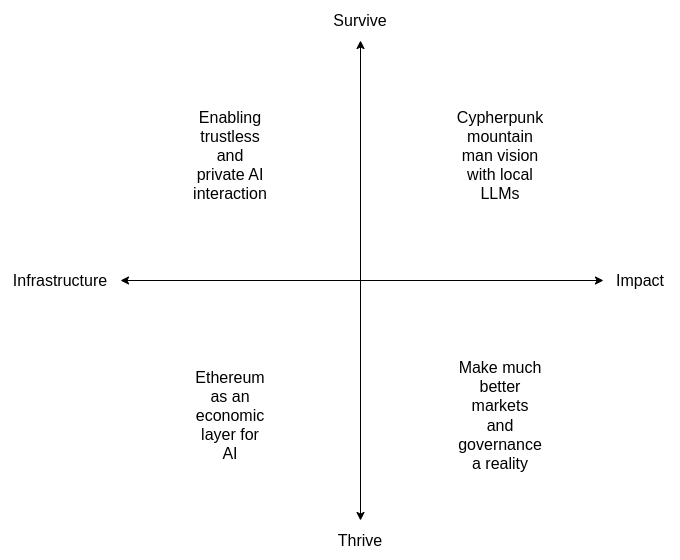
# Building tooling to make more trustless and/or private interaction with AIs possible.
This includes:
* Local LLM tooling
* ZK-payment for API calls (so you can call remote models without linking your identity from call to call)
* Ongoing work into cryptographic ways to improve AI privacy
* Client-side verification of cryptographic proofs, TEE attestations, and any other forms of server-side assurance
Basically, the kinds of things we might also build for non-LLM compute (see eg. my ethereum privacy roadmap from a year ago https://t.co/KdsQbpIkF9 ), but for LLM calls as the compute we are protecting.
# Ethereum as an economic layer for AI-related interactions
This includes:
* API calls
* Bots hiring bots
* Security deposits, potentially eventually more complicated contraptions like onchain dispute resolution
* ERC-8004, AI reputation ideas
The goal here is to enable AIs to interact economically, which makes viable more decentralized AI architectures (as opposed to non-economic coordination between AIs that are all designed and run by one organization "in-house"). Economies not for the sake of economies, but to enable more decentralized authority.
# Make the cypherpunk "mountain man" vision a reality
Basically, take the vision that cypherpunk radicals have always dreamed of (don't trust; verify everything), that has been nonviable in reality because humans are never actually going to verify all the code ourselves. Now, we can finally make that vision happen, with LLMs doing the hard parts.
This includes:
* Interacting with ethereum apps without needing third party UIs
* Having a local model propose transactions for you on its own
* Having a local model verify transactions created by dapp UIs
* Local smart contract auditing, and assistance interpreting the meaning of FV proofs provided by others
* Verifying trust models of applications and protocols
# Make much better markets and governance a reality
Prediction and decision markets, decentralized governance, quadratic voting, combinatorial auctions, universal barter economy, and all kinds of constructions are all beautiful in theory, but have been greatly hampered in reality by one big constraint: limits to human attention and decision-making power.
LLMs remove that limitation, and massively scale human judgement. Hence, we can revisit all of those ideas.
These are all things that Ethereum can help to make a reality. They are also ideas that are in the d/acc spirit: enabling decentralized cooperation, and improving defense. We can revisit the best ideas from 2014, and add on top many more new and better ones, and with AI (and ZK) we have a whole new set of tools to make them come to life.
We can describe the above as a 2x2 chart. There's a lot to build!
There have recently been some discussions on the ongoing role of L2s in the Ethereum ecosystem, especially in the face of two facts:
* L2s' progress to stage 2 (and, secondarily, on interop) has been far slower and more difficult than originally expected
* L1 itself is scaling, fees are very low, and gaslimits are projected to increase greatly in 2026
Both of these facts, for their own separate reasons, mean that the original vision of L2s and their role in Ethereum no longer makes sense, and we need a new path.
First, let us recap the original vision. Ethereum needs to scale. The definition of "Ethereum scaling" is the existence of large quantities of block space that is backed by the full faith and credit of Ethereum - that is, block space where, if you do things (including with ETH) inside that block space, your activities are guaranteed to be valid, uncensored, unreverted, untouched, as long as Ethereum itself functions. If you create a 10000 TPS EVM where its connection to L1 is mediated by a multisig bridge, then you are not scaling Ethereum.
This vision no longer makes sense. L1 does not need L2s to be "branded shards", because L1 is itself scaling. And L2s are not able or willing to satisfy the properties that a true "branded shard" would require. I've even seen at least one explicitly saying that they may never want to go beyond stage 1, not just for technical reasons around ZK-EVM safety, but also because their customers' regulatory needs require them to have ultimate control. This may be doing the right thing for your customers. But it should be obvious that if you are doing this, then you are not "scaling Ethereum" in the sense meant by the rollup-centric roadmap. But that's fine! it's fine because Ethereum itself is now scaling directly on L1, with large planned increases to its gas limit this year and the years ahead.
We should stop thinking about L2s as literally being "branded shards" of Ethereum, with the social status and responsibilities that this entails. Instead, we can think of L2s as being a full spectrum, which includes both chains backed by the full faith and credit of Ethereum with various unique properties (eg. not just EVM), as well as a whole array of options at different levels of connection to Ethereum, that each person (or bot) is free to care about or not care about depending on their needs.
What would I do today if I were an L2?
* Identify a value add other than "scaling". Examples: (i) non-EVM specialized features/VMs around privacy, (ii) efficiency specialized around a particular application, (iii) truly extreme levels of scaling that even a greatly expanded L1 will not do, (iv) a totally different design for non-financial applications, eg. social, identity, AI, (v) ultra-low-latency and other sequencing properties, (vi) maybe built-in oracles or decentralized dispute resolution or other "non-computationally-verifiable" features
* Be stage 1 at the minimum (otherwise you really are just a separate L1 with a bridge, and you should just call yourself that) if you're doing things with ETH or other ethereum-issued assets
* Support maximum interoperability with Ethereum, though this will differ for each one (eg. what if you're not EVM, or even not financial?)
From Ethereum's side, over the past few months I've become more convinced of the value of the native rollup precompile, particuarly once we have enshrined ZK-EVM proofs that we need anyway to scale L1. This is a precompile that verifies a ZK-EVM proof, and it's "part of Ethereum", so (i) it auto-upgrades along with Ethereum, and (ii) if the precompile has a bug, Ethereum will hard-fork to fix the bug.
The native rollup precompile would make full, security-council-free, EVM verification accessible. We should spend much more time working out how to design it in such a way that if your L2 is "EVM plus other stuff", then the native rollup precompile would verify the EVM, and you only have to bring your own prover for the "other stuff" (eg. Stylus). This might involve a canonical way of exposing a lookup table between contract call inputs and outputs, and letting you provide your own values to the lookup table (that you would prove separately).
This would make it easy to have safe, strong, trustless interoperability with Ethereum. It also enables synchronous composability (see: https://t.co/9jy6v1X6Fw and https://t.co/gZmu3YjebM ). And from there, it's each L2's choice exactly what they want to build. Don't just "extend L1", figure out something new to add.
This of course means that some will add things that are trust-dependent, or backdoored, or otherwise insecure; this is unavoidable in a permissionless ecosystem where developers have freedom. Our job should make to make it clear to users what guarantees they have, and to build up the strongest Ethereum that we can.
Today marks an inflection in the Ethereum Foundation's long-term quantum strategy.
We've formed a new Post Quantum (PQ) team, led by the brilliant Thomas Coratger (@tcoratger). Joining him is Emile, one of the world-class talents behind leanVM. leanVM is the cryptographic cornerstone of our entire post-quantum strategy.
After years of quiet R&D, EF management has officially declared PQ security a top strategic priority. Our journey began in 2019, with the "Eth3.0 Quantum Security" presentation at StarkWare Sessions. Since 2024, PQ has been central to the @leanEthereum vision. The pace of PQ engineering breakthroughs since then has been nothing short of phenomenal.
It's now 2026, timelines are accelerating. Time to go full PQ:
→ PQ ACD: Antonio Sanso (@asanso) kicks off a bi-weekly All Core Devs PQ transactions breakout call next month. These sessions focus on user-facing security, covering dedicated precompiles, account abstraction, and longer-term transaction signature aggregation with leanVM.
→ PQ foundations: Today we are announcing a $1M Poseidon Prize to harden the Poseidon hash function. We are betting big on hash-based cryptography to enjoy the strongest and leanest cryptographic foundations. Check out our other $1M PQ initiative, the Proximity Prize.
→ PQ devnets: Multi-client PQ consensus devnets are live! Shoutout to pioneers @zeamETH, @ReamLabs, @PierTwo_com, @geanclient, @ethlambda_lean, as well as established consensus teams Lighthouse, Grandine, and soon Prysm. This incredible teamwork is coordinated by @corcoranwill via weekly PQ interop calls.
→ PQ workshops: Building on last year's PQ workshop in Cambridge (see photo), the EF is hosting another 3-day PQ event in October. Top experts from around the world will convene. In addition, a PQ day is set for March 29 in Cannes just ahead of EthCC.
→ PQ FV and AI: Last week Alex Hicks (@alexanderlhicks) ran a specialised maths AI for 8 hours, at a $200 cost. It one-shotted a formal proof one of the hardest lemmas in the foundations of hash-based snarks. Mind-blowing. Applied cryptography will never be the same.
→ PQ roadmap: A comprehensive breakdown of the EF's proposed PQ strategy will be shared soon™ on pq[.]ethereum[.]org. The roadmap targets a full transition in coming years with zero loss of funds and zero downtime. Stay tuned :)
→ PQ education: The ZKPodcast (@zeroknowledgefm) is producing a 6-part video series on Ethereum's PQ strategy. EF Enterprise Acceleration is also preparing material for enterprises and nation-states. Finally, Ethereum is now represented on the PQ advisory board that Coinbase announced yesterday.
Believe in something. Believe in PQ security.
2026 is the year we take back lost ground in computing self-sovereignty.
But this applies far beyond the blockchain world.
In 2025, I made two major changes to the software I use:
* Switched almost fully to https://t.co/ZIKj4U5XFM (open source encrypted decentralized docs)
* Switched decisively to Signal as primary messenger (away from Telegram). Also installed Simplex and Session.
This year changes I've made are:
* Google Maps -> OpenStreetMap https://t.co/Xm0pad5nh9, OrganicMaps https://t.co/yvbwXqEPwo is the best mobile app I've seen for it. Not just open source but also privacy-preserving because local, which is important because it's good to reduce the number of apps/places/people who know anything about your physical location
* Gmail -> Protonmail (though ultimately, the best thing is to use proper encrypted messengers outright)
* Prioritizing decentralized social media (see my previous post)
Also continuing to explore local LLM setups. This is one area that still needs a lot of work in "the last mile": lots of amazing local models, including CPU and even phone-friendly ones, exist, but they're not well-integrated, eg. there isn't a good "google translate equivalent" UI that plugs into local LLMs, transcription / audio input, search over personal docs, comfyui is great but we need photoshop-style UX (I'm sure for each of those items people will link me to various github repos in the replies, but *the whole problem* is that it's "various github repos" and not one-stop-shop). Also I don't want to keep ollama always running because that makes my laptop consume 35 W. So still a way to go, but it's made huge progress - a year ago even most of the local models did not yet exist!
Ideally we push as far as we can with local LLMs, using specialized fine-tuned models to make up for small param count where possible, and then for the heavy-usage stuff we can stack (i) per-query zkp payment, (ii) TEEs, (iii) local query filtering (eg. have a small model automatically remove sensitive details from docs before you push them up to big models), basically combine all the imperfect things to do a best-effort, though ultimately ideally we figure out ultra-efficient FHE.
Sending all your data to third party centralized services is unnecessary. We have the tools to do much less of that. We should continue to build and improve, and much more actively use them.
(btw I really think @SimpleXChat should lowercase the X in their name. An N-dimensional triangle is a much cooler thing to be named after than "simple twitter")
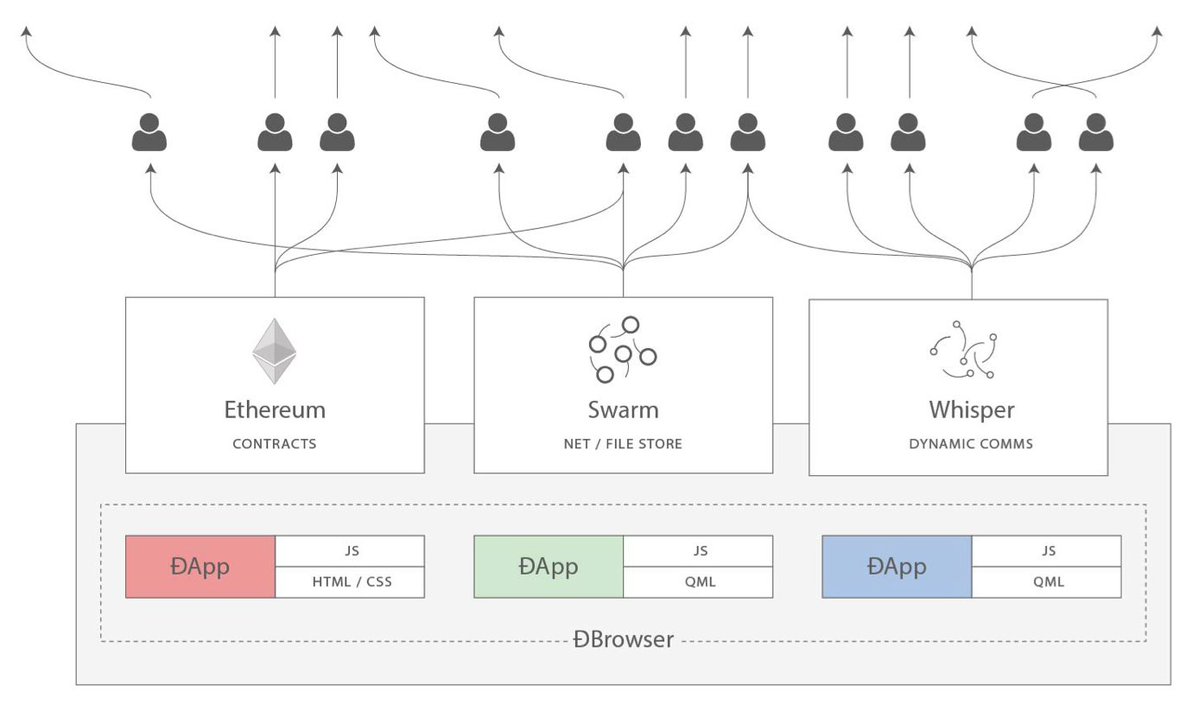
In 2014, there was a vision: you can have permissionless, decentralized applications that could support finance, social media, ride sharing, governing organizations, crowdfunding, potentially create an entire alternative web, all on the backs of a suite of technologies.
Ethereum: the blockchain. The world computer that could give any application its shared memory.
Whisper: the data layer. Messages too expensive for a blockchain, that do no need consensus.
Swarm: the storage layer. Store files for long-term access.
Over the last five years, this core vision has at times become obscured, with various "metas" and "narratives" at various times taking center stage. But the core vision has never died. And in fact, the core technologies behind it are only growing stronger.
Ethereum is now proof of stake. Ethereum is now scaling, it is now cheap, and it is on track to get more scalable and cheaper thanks to the power of ZK-EVMs. Thanks to ZK-EVM + PeerDAS, the "sharding" vision is effectively being realized. And L2s can give additional and different kinds of gains in speed on top.
Whisper is now Waku ( https://t.co/uj5h9iSpIL ), and already powers many applications (eg. https://t.co/owlo5yoS68, https://t.co/hDizYCFjuq just to name two I use). Even outside of Waku, the quality of decentralized messaging has increased. Fileverse (decentralized Google Docs and Sheets alternative: https://t.co/ZIKj4U5pQe ) has seen massive gains in usability over the past year.
IPFS is now highly performant and robust as a decentralized way of retrieving files, though IPFS alone does not solve the storage problem. Hence, there is still room to improve there.
All of the prerequisites for the original web3 vision are here, in full force, and are continuing to get stronger over the next few years. Hence, it's time to buidl, and buidl decentralized.
Fileverse is an excellent example of the right way to do things:
* It uses Ethereum and Gnosis Chain for what they are good for: names, accounts and permissioning, document registration
* It uses decentralized messaging and file storage to store documents and propagate changes to documents
* The application passes the walkaway test: https://t.co/xO1dNLlnhf (even if Fileverse disappears, you can still retrieve them and even keep editing them with the open source UI)
This is what we mean by "build a hammer that is a tool you buy once and it's yours, not a corposlop AI dishwasher that requires you to register for a google account and charges a subscription fee per month for extra washing modes, and probably spies on you and stops working if you get politically disfavored by a foreign country".
If you think this criticism of corposlop is hyperbolic, well turns out, it's literally a concatenation of these three:
* https://t.co/GBNaXOa454
* https://t.co/saD3cNp4Ae
* https://t.co/skoJ58vbqz
In 2014, decentralized applications were toys, hundreds of times more difficult to use in web2. In 2026, fileverse is now usable enough that I regularly write documents in it and send them to other people to collaborate. The decentralized renaissance is coming, and you can be part of making it happen.
I agree with maybe 60% of this, but one bit that is particularly important to highlight is the explicit separation between what the poster calls "the open web" (really, the corposlop web), and "the sovereign web".
https://t.co/w7Vtbn7uFt
This is a distinction I did not realize until recently, and I must admit the bitcoin maximalists were far ahead: a big part of their resistance to ICOs, tokens other than bitcoin, arbitrary financial applications, etc was precisely about keeping bitcoin "sovereign" and not "corposlop". The big error that many of them made was trying to achieve this goal with either government crackdowns or user disempowerment (keeping bitcoin script limited, and rejecting many categories of applications entirely), but their fear was real.
So what is corposlop? In essence, it is the combination of three things:
* Corporate optimization power
* An aura of respectableness of being a company with sleek polished branding
* Behavior that the exact opposite of respectable, because that's what's needed to maximize profit
Corposlop includes things like:
* Social media that maximizes dopamine, outrage, other methods of short-term engagement, at the expense of long-term value and fulfillment
* Needless mass data collection from users, often followed by managing it carelessly or even casually selling it to third parties
* Walled gardens charging monopolistic high fees and actively preventing people from even linking to other platforms
* Hollywood releasing the 7th sequel to some tired franchise, because that's the most risk-averse thing to do
* Every corporation that rallied around slogans of diversity and equity and the need to overturn society to fight racism in 2020, and then publicly mocked those causes for engagement in 2025
This is all digital corposlop; there are big and important analogues to this in the physical world too.
Corposlop is soulless: trend-following homogeneity that is both evil and lame https://t.co/FZwqwujAGb
These are things that appear to serve the user, but actually disempower the user.
I have many qualms with Apple, but aside from their monopolistic practices, they actually have many non-corposlop traits. They serve users not by constantly asking "what do users want this quarter", but by having an opinionated long-term vision. They have a strong emphasis on privacy. They resist and create trends rather than following them. I just wish they could take the brave step of ending their monopolistic practices and switch to an open source first strategy. It may damage their market cap, but man must live for something higher than market caps.
Zac from Aztec was also early to recognize the importance of this, with a post that is on the whole very pro-freedom, but at the same time does not shrink back from labeling what is essentially corposlop a primary enemy, even when it does not violate the libertarian non-aggression principle.
https://t.co/PsbySLhLWU
In 2000, the understanding of "sovereignty" largely focused on avoiding the iron fist of government. Today, "sovereignty" also means securing your digital privacy through cryptography, and securing your own mind from corporate mind warfare trying to extract your attention and your dollars. It also means doing things because you believe in them, and declaring independence from the homogenizing and soul-sucking concept of "the meta".
These are the kinds of tools that we should build more of. Build tools like:
* Privacy-preserving local-first applications that minimize dependence on and data leaks to third parties
* Social media platforms and tools that let the user take control of what content they see. Appeal to people's long-term goals, not short-term impulses
* Financial tools that help users grow their wealth, and do not encourage 50x leverage or sports betting or taking out a loan to pay for a burrito
* AI tools that are maximally open and privacy and local-friendly, and that maximize productivity from merging the power of human and bot, rather than encouraging the user to sit back and let the bot do all the work, so they learn nothing
* Applications, companies, and physical environments that take an opinionated view on the kind of world they want to see, and have an opinionated culture
* DAOs that can support organizations and communities that steadfastly pursue a unique objective, and do not all get captured by the same groups. Privacy-preserving and non-tokenholder-driven voting can help here
Be sovereign. Reject corposlop. Believe in somETHing.