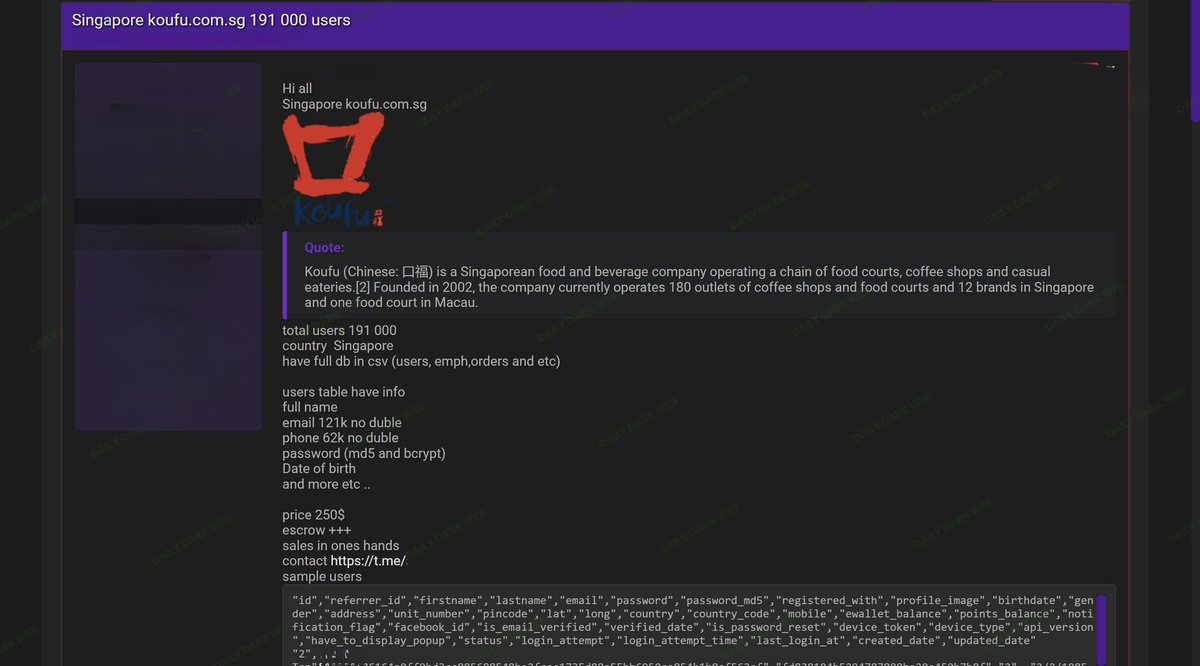
🇸🇬 A threat actor is claiming the sale of an alleged database tied to Koufu, one of Singapore’s largest food and beverage operators.
The exposed dataset reportedly includes:
191,000 user records
Customer names
Email addresses
Phone numbers
Dates of birth
Password hashes (MD5 and bcrypt)
Employee and order-related information
Even when passwords are hashed, weak or reused credentials can still create downstream account takeover risks, especially when combined with email and phone exposure. Threat actors frequently leverage this type of data for credential stuffing, phishing, loyalty fraud, and targeted social engineering campaigns.
Organizations in the retail and food service sectors continue to face elevated risks due to large customer-facing infrastructures, third-party integrations, and high-volume transactional systems.
#DDW #Intelligence #DarkWeb #Koufu
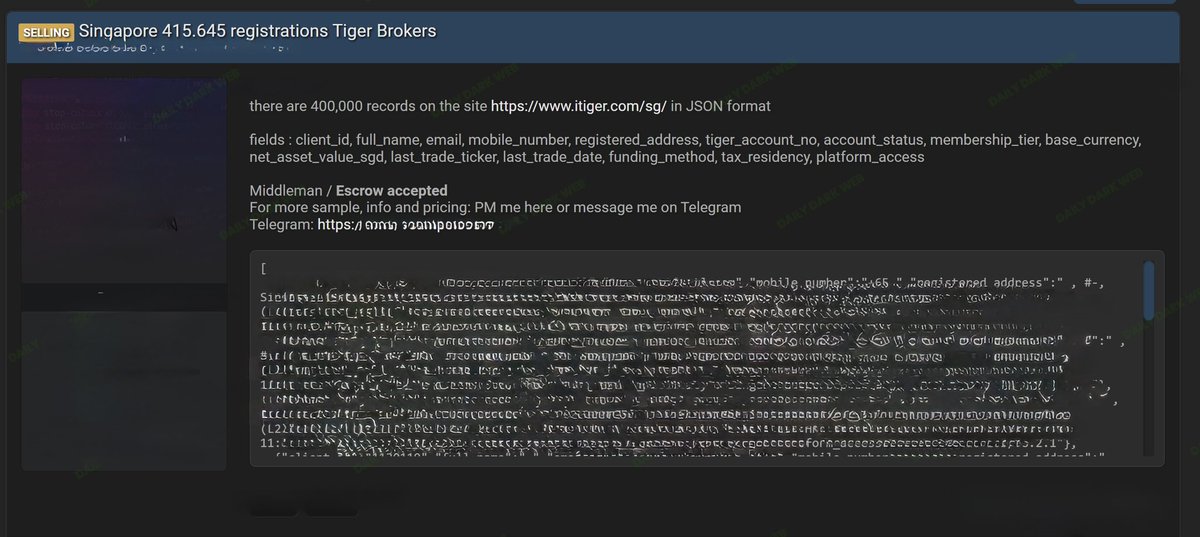
🇸🇬 A threat actor on underground forums is advertising the alleged sale of approximately 400,000+ registration records reportedly associated with Tiger Brokers Singapore.
According to the forum post, the dataset is allegedly stored in JSON format and may contain:
• client IDs
• full names
• email addresses
• mobile numbers
• registered addresses
• Tiger account numbers
• account status information
• membership tier details
• base currency information
• net asset value (SGD)
• last traded ticker/activity
• funding methods
• tax residency information
• and platform access-related data
The actor also claims escrow-supported sales and distribution through underground communication channels.
At this stage:
• the authenticity of the dataset remains unverified
• the origin of the data is unclear
• and no confirmed breach attribution has been publicly established
If legitimate, exposure of brokerage and financial platform data could significantly increase risks involving:
• financial fraud
• account takeover attempts
• targeted phishing/social engineering
• SIM swapping
• investment scam targeting
• and identity theft
Financial and trading platforms continue to remain attractive targets due to:
• high-value user profiles
• sensitive KYC/financial information
• transaction histories
• and the potential for monetization through fraud and extortion ecosystems
Organizations operating within the financial sector should:
• monitor for credential exposure and account abuse
• enforce MFA across trading and customer portals
• review anomalous access patterns
• investigate possible third-party/vendor exposure paths
• monitor underground channels for redistribution activity
• and prepare customer notification procedures if compromise is validated
This incident reflects the continued targeting of fintech and brokerage platforms by underground actors seeking monetizable financial and identity datasets.
#Singapore #FinTech #Brokerage #DataLeak #CyberSecurity #ThreatIntelligence #FinancialCrime #DDW #Intelligence
@litocoen Same reason hotels rather keep rooms empty then sell them cheap.
Prices cannot go down.
Less rooms, less staff, less cost.
Compared to salaries and benefits, sunk costs is moot.
Announced in 10 years but not built by then.
Technology for underground nuclear SMR in infancy. Non-exist so far using Western tech.
Only 2 near completion by Russia and China. Not who we're going to use the tech from.
Also only two refining plants for the raw material needed existing with 1 being built in the US.
Only plausible underground sites in mainland with granite vein large enough are Bkt Timah and Woodlands. Guess where it'll be. :)
🚨 BREAKING: France’s Digital ID System Hacked—Sensitive Data of 19 Million Citizens Now Sold on the Dark Web
France’s centralized digital identity platform, operated by France Titres (formerly ANTS), suffered a major breach on April 15, 2026.
Hackers stole records affecting roughly one-third of the French population and started auctioning them on dark web forums.
The exposed database contains:
• Full names
• Email addresses and phone numbers
• Dates and places of birth
• Postal addresses
• Unique government account IDs
This information gives criminals powerful tools for identity theft, phishing campaigns, synthetic identities, and large-scale financial fraud.
The system manages passports, national ID cards, driver’s licenses, residency permits, and vehicle registrations.
Officials confirmed no biometric photos or uploaded documents were taken, but the core personal data is now circulating.
Hackers operating under aliases like “breach3d” and “ExtaseHunters” posted the massive dump soon after the intrusion.
French authorities acknowledged the security incident and are notifying affected individuals, though the sheer scale makes rapid alerts challenging.
France has seen multiple major government data breaches recently, including student records via ÉduConnect, bank account details, and medical information.
Centralized systems handling vast amounts of linked personal data create high-value targets that attract persistent attackers.
Action steps if you’re in France or have connections there:
• Closely monitor all financial and government accounts
• Strengthen 2FA on every service
• Stay alert for phishing attempts impersonating official agencies
• Consider credit monitoring or freezes where available
French authorities detained a 15-year-old suspect on April 25 in connection with the breach.
The teenager is believed to have operated under the alias “breach3d” and offered between 12 and 18 million records for sale on hacking forums.
Prosecutors in Paris have opened a formal investigation into the minor on computer crime charges.
The full story is still unfolding as more details emerge about how the breach occurred and the exact scope of the exposure.
This incident highlights the profound dangers of centralized digital ID systems.
When governments consolidate citizens’ most sensitive personal information into single, internet-connected databases, they create massive single points of failure.
One successful hack can expose millions instantly, turning everyday personal details into weapons for widespread fraud and surveillance.
As nations push for broader digital ID adoption, this breach serves as a stark reminder that convenience and control come at the steep price of heightened vulnerability for entire populations.