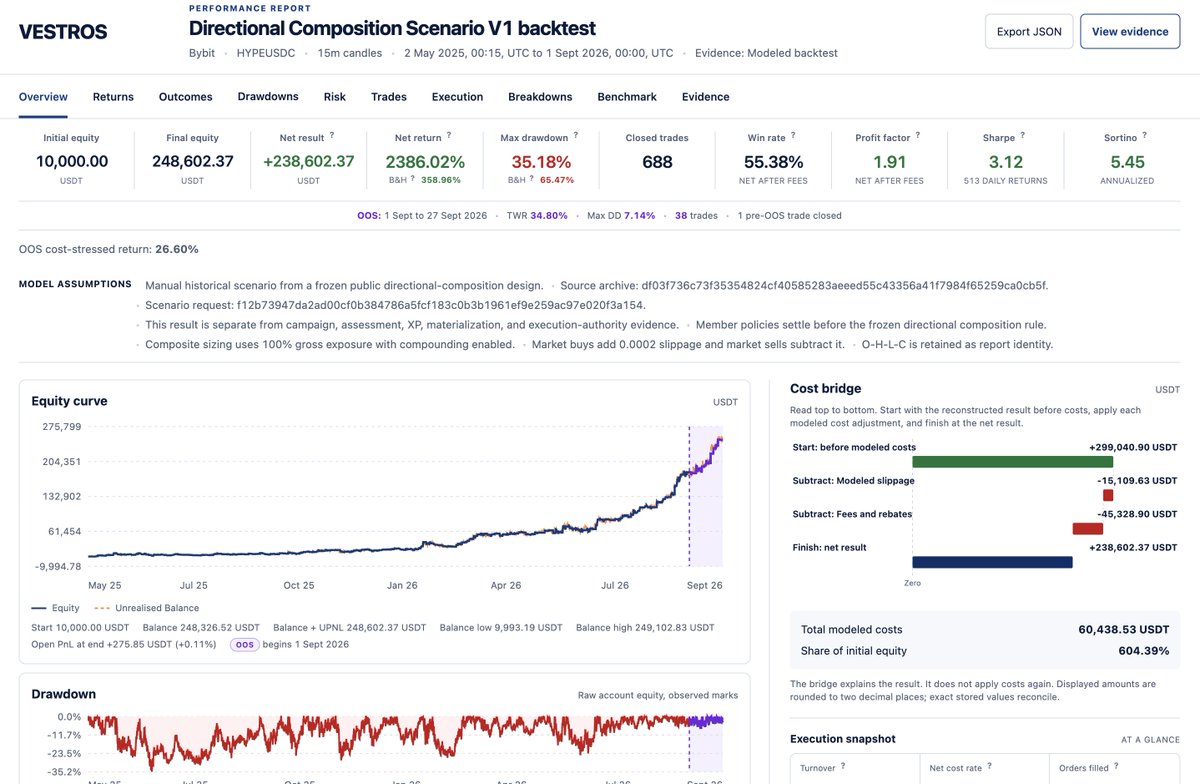
I’ve been building something new.
Give VESTROS a trading indicator or strategy and it systematically explores thousands of ways its outputs could actually be used, then tries very hard to kill them.
Most ideas die.
The interesting ones end up here:
https://t.co/nkilcwjhSk
@LuxAlgo The portability is compelling. For serious algo work, I’d love to see fees, slippage, latency assumptions, and out-of-sample splits surfaced as first-class backtest outputs before a strategy gets anywhere near execution.
A few layers. Typed inputs, compatibility rules and complexity limits constrain what can be constructed upfront. When the space is too large to enumerate, generation uses deterministic sampling and coverage rules within a declared candidate budget.
Then compact development screens and exact-behaviour deduplication reduce what goes into expensive validation. Refinement preserves diversity across families and sources, with some capacity reserved for broader exploration. It doesn’t just keep mutating whichever candidate had the highest return.
Multiple indicators can feed the same candidate too, as well as multiple timeframes and/or symbols. Combining complete strategies is a separate search stage as well (described as a combination study in my system, if we're referring to the candidates that come out of a completed campaign).
How did you handle it in yours, especially once ML models entered the mix?
When an archive shows OOS, read it as “same frozen design, later candles,” not a second round of curve fitting.
C10919’s page has that section if you want to compare it to the sealed window yourself:
https://t.co/W1sIEZPruZ
@Emonakoundo@cxmrondlls@agenticscredit The 90-day onchain runway is the part most backtest screenshots skip. Logging fills, fees, and regime splits during that window makes the result much more useful than another optimized curve.
@misfitpov If you're curious, you can read quite a bit more about how it works, here:
https://t.co/nkilcwjhSk
Click the "VESTROS?" button on the top right.
@MoonDevOnYT Exactly. Fees and slippage are not a footnote, they can erase the entire edge. A fee/slippage sweep plus out-of-sample and forward checks tells you far more than one clean equity curve.
@egortrushenkov@RohOnChain Yes, zero-cost defaults can make a weak idea look robust. I like freezing fee, slippage, and fill assumptions before comparing runs, then checking whether the conclusion survives a sealed holdout.
@buildalpha The favorable OOS window point is underappreciated. A fixed holdout chosen before tuning, or rolling OOS windows, makes it harder to turn the validation period into another parameter.
@NordicAlphaLab The “single beautiful point” test is such a useful smell test. Checking nearby parameters and raising costs before looking at OOS results is a much better discipline than chasing the peak.
@herbsolute01@EquityEdgeUK That’s a good example of why a TradingView marker isn’t the same as a broker fill. Comparing timestamps, spread, and order type usually shows where the divergence starts.
If you’re using Cursor / Claude Code / Codex against exchange APIs, start them on the map instead of random GitHub READMEs:
https://t.co/xJjL3fpiYf
https://t.co/ZnBKjhllBL
Typed REST + WebSocket clients for 10 venues, plus examples and agent skills.