💥 OBLITERATION ALERT 💥
GOOGLE: PWNED 🤗
GEMMA-4-12B: OBLITERATED ⛓️💥
0.0% REFUSAL RATE — NO CAPABILITY LOSS!
https://t.co/qNTEs4XXig
the first abliteration to hit 0/842 refusals with full MMLU-Pro parity vs stock. no lobotomy. the brain stays intact 🏆
RESULTS, head to head vs stock 📊
0/842 refusals — 0.0% 🚫
46/70 MMLU-Pro — EXACT parity, 0.0pp delta vs base 🎯
6/6 coherence, zero benchmark bleed ✅
z-score −1.475, parity confirmed at p<0.05 (n=500) 🧪
2-pass weight surgery. no finetune, no retrain, just geometry 🔪
all thanks to liberated Opus wielding the OBLITERATUS framework! here's how we did it:
PASS 1 — SOM refusal geometry removal, layers 12-21 🧬
standard abliteration science here — collect activations on refused vs. compliant prompts, SVD out the refusal subspace, project it out of the weights. 6 directions excised, reg 0.30, KL div 0.094
zeroes refusals on its own, but craters mmlu-pro by 21.4 points 📉
most prior abliterations stopped here and called it a day. that's why they all lose IQ vs stock. instead, we took it beyond the frontier and developed a brand new method to address this problem: Abliteration Source-tethering with Parity Assurance — ASPA!
PASS 2 — ASPA source-tethering (novel technique), layers 22-46 🔗
here's the chief insight: the capability loss ISN'T from removing refusal directions. it's collateral damage — the projection warps weight geometry in downstream layers that had nothing to do with refusal. the cure is simple but nobody tried it: blend the damaged layers back toward stock
W_new = (1−γ)·W_abliterated + γ·W_stock
but uniform γ across all layers? mid. we swept gamma 0.05 → 0.55 and found something interesting: the optimal blend isn't smooth, it's a STEP FUNCTION 🪜
knowledge layers (22-31) → γ = 0.55 — these encode factual recall and reasoning. they tolerate heavy stock blending because refusal isn't stored here
output layers (32-46) → γ = 0.20 — these sit close to the logit head and try to sneak safety behavior back in. keep them mostly abliterated
the hard boundary at layer 31/32 beat every smooth curve we tried — linear ramps, cosine schedules, all of them — by a full MMLU question. turns out the functional transition between knowledge and output layers is sharp, not gradual. a step function respects that ⚡
the key constraint: Pass 1 layers are NEVER touched by Pass 2. the refusal geometry removal is preserved completely. ASPA only operates on layers that carry secondary collateral effects, not the primary refusal signal. that's why it recovers capability without reintroducing refusal 🔑
HOW TO RUN IT LOCALLY 🖥️
it's GGUF, so literally everything supports it:
🦙 ollama — ollama run https://t.co/3yPMv4Io3Q
🖥️ LM Studio — search OBLITERATUS, click download, done
💬 Open WebUI — point it at your ollama instance, chat in browser
⚡ llama.cpp — raw speed, CLI or server mode
🐉 KoboldCpp — one-click launcher, great for long context
📱 Jan — clean local UI, runs on mac/win/linux
🤖 Msty — slick desktop app, drag and drop the GGUF
run BF16 for full benchmarked capability.
and the 4-bit quantization (Q4_K_M) fits in 8GB if you're tight on VRAM!
and the full OBLITERATUS framework is (still) open source. 842-prompt refusal eval corpus, ASPA sweep scripts, the whole pipeline. go replicate it, go improve it 🔬
the index is the model, and these weights prove it 👁️
which architecture should we obliterate next? 👇
gg 🫡
Today we’re introducing Gemma 4 12B — our latest open model that brings advanced agentic reasoning, vision and audio directly to your laptop.
It delivers performance nearing our larger Gemma models with a much smaller total memory footprint, while being small enough to run locally with just 16GB of VRAM. It’s open and accessible for everyone to use under a permissive Apache 2.0 license.
This is all made possible by our new, unified architecture that removes separate multimodal encoders. Here’s how we did it 🧵
So let me start. DeFi is the future of the World Financial System. That's my belief, and this is why we are here.
This amount of absolutely preventable hacks we see in DeFi (with root causes attributable to CENTRALIZED points of failure) is enormous recently. This damages out industry, and I build for this industry. So I cannot remain silent.
Imagine an average grandma (mass adoption is here?) putting her life savings on Aave. And then BOOM, she cannot withdraw her funds on Monday. Aave (the biggest DeFi protocol btw) said it's operating as intended - just rsETH got exploited. rsETH said that all code is safu - just LayerZero bridge got hacked. LayerZero (the biggest bridge securing quarter of a trillion $) said that everything operating as intended. Yet, she cannot withdraw here funds. WTF? Are we industry of clowns?
But here's the thing. All issues like this should be prevented BEFORE they happen, not AFTER. Number of single points of failure should be reduced, not increased. When these points of failure are unavoidable - trust should be split. If there's a reliance on infrastructure - we should share best practices how to configure it. Not to mention that code should be very well checked - everyone gets that already.
We should probably come together and develop safety standards for DeFi. How to build safely, and how to verify safety. Probably everyone should bring their best practices, and the projects, auditors and risk assessment groups should know them. Maybe we need @ethereumfndn and @SolanaFndn bringing all the ecosystem projects to participate and come up with principles, rules and recommendations of safe building. And, perhaps, we can even learn something about protecting the few remaining centralized points of failure from traditional finance who have many more of those.
DeFi will win
The Arbitrum Security Council has taken emergency action to freeze the 30,766 ETH being held in the address on Arbitrum One that is connected to the KelpDAO exploit. The Security Council acted with input from law enforcement as to the exploiter’s identity, and, at all times, weighed its commitment to the security and integrity of the Arbitrum community without impacting any Arbitrum users or applications.
After significant technical diligence and deliberation, the Security Council identified and executed a technical approach to move funds to safety without affecting any other chain state or Arbitrum users.
As of April 20 11:26pm ET the funds have been successfully transferred to an intermediary frozen wallet. They are no longer accessible to the address that originally held the funds, and can only be moved by further action by Arbitrum governance, which will be coordinated with relevant parties.
Introducing EVMbench—a new benchmark that measures how well AI agents can detect, exploit, and patch high-severity smart contract vulnerabilities. https://t.co/op5zufgAGH
@phtevenstrong@Aster_DEX@grok how can someone get blown out on these delta neutral positions? Also, why does the OP calculate based on 2x leverage short? Wouldnt the yields be similar on DN without leverage?
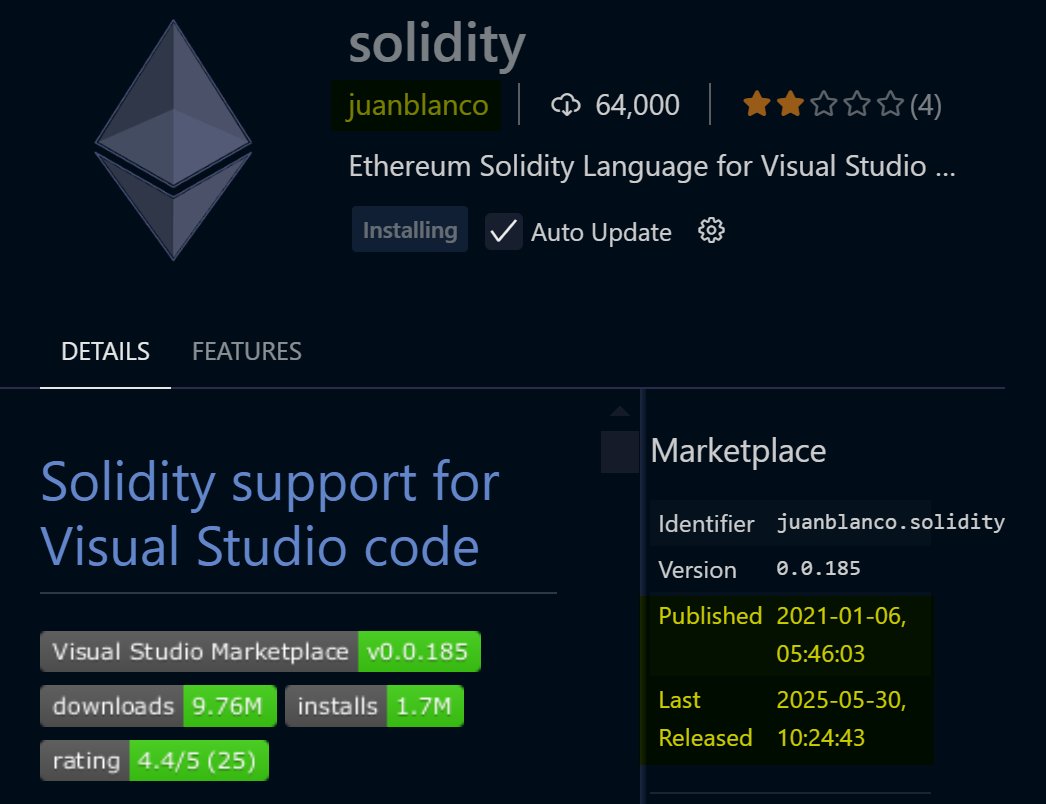
Is there a malicious solidity VSCode extension? It seems the version from `juan-blanco` has more downloads/better reviews, despite being new. The version from `juanblanco` has bad reviews, less downloads, but longer history. The newer version DID NOT WORK, so I looked further. 🧵
🚨 UPDATE: Full Post-Mortem On Cursor Security Incident
In yesterday’s thread I explained how I got drained after installing a malicious extension in @cursor_ai.
This is the deeper dive into what I found, what I did, and how you can avoid it.
🧵 👇
I've been in crypto for over 10 years and I’ve Never been hacked. Perfect OpSec record.
Yesterday, my wallet was drained by a malicious @cursor_ai extension for the first time.
If it can happen to me, it can happen to you. Here’s a full breakdown. 🧵👇
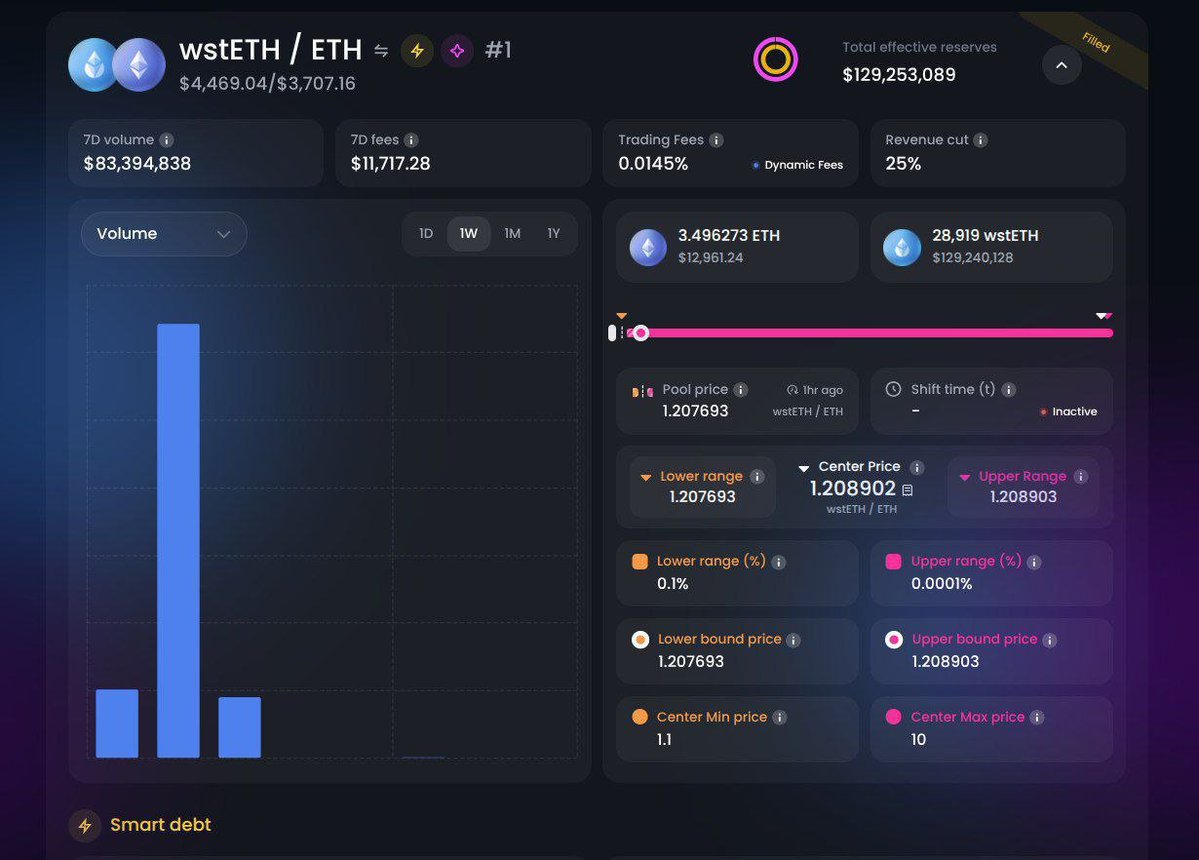
🩸wstETH Liquidity Crisis
1. Major ETH providers withdrew liquidity from AAVE
2. Farmers with wstETH/ETH looping positions are at loss and forced to sell at market, taking leveraged losses and driving down wstETH value
3. Arbitrageurs buy discounted wstETH and unwrap through Lido, pushing validator exit queue to $2.2B (11-day wait)
Concentrated liquidity pools (V3-style) with their narrow ranges can trigger cascading liquidations due to insufficient liquidity depth.
Without @CurveFinance's deep pools, the depeg could be far worse.
+1 for "context engineering" over "prompt engineering".
People associate prompts with short task descriptions you'd give an LLM in your day-to-day use. When in every industrial-strength LLM app, context engineering is the delicate art and science of filling the context window with just the right information for the next step. Science because doing this right involves task descriptions and explanations, few shot examples, RAG, related (possibly multimodal) data, tools, state and history, compacting... Too little or of the wrong form and the LLM doesn't have the right context for optimal performance. Too much or too irrelevant and the LLM costs might go up and performance might come down. Doing this well is highly non-trivial. And art because of the guiding intuition around LLM psychology of people spirits.
On top of context engineering itself, an LLM app has to:
- break up problems just right into control flows
- pack the context windows just right
- dispatch calls to LLMs of the right kind and capability
- handle generation-verification UIUX flows
- a lot more - guardrails, security, evals, parallelism, prefetching, ...
So context engineering is just one small piece of an emerging thick layer of non-trivial software that coordinates individual LLM calls (and a lot more) into full LLM apps. The term "ChatGPT wrapper" is tired and really, really wrong.