The median salary today is $65,000.
In 1970 it was $8,500.
Looks like progress.
Until you measure it in gold.
1970: 236 ounces
2026: 15 ounces
Your grandparents earned 221 more ounces of real money every year for the same work.
Dollars lost.
Hard money didn’t.
Most people think money is “real” like gravity or oxygen.
It isn’t.
Without humans, gold is just metal.
Bitcoin is dormant code.
Dollars are worthless paper.
Money only exists because humans collectively agree something can store value and coordinate trade.
That’s it.
That’s the entire game.
Gold won for centuries because it had the best monetary properties.
Bitcoin improves on those properties for a digital civilization.
The history of money is the history of humans upgrading coordination technology.
And Bitcoin may be the biggest upgrade yet.
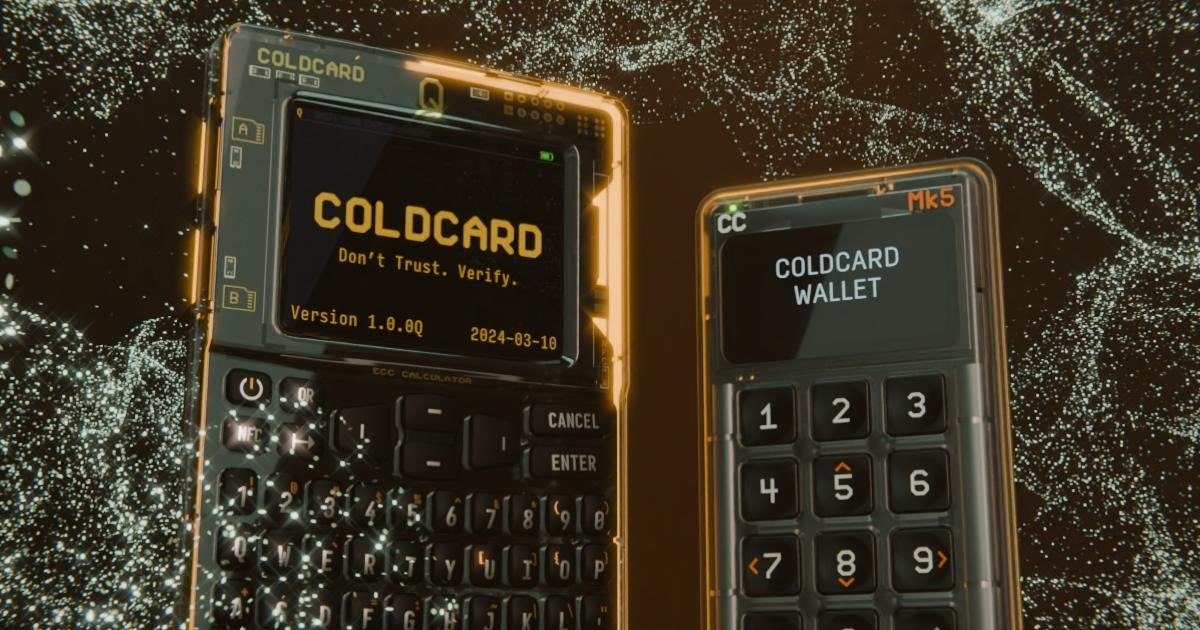
The Coldcard bug explained in simple terms:
Normally, a hardware wallet generates your 12 word seed phrase using true randomness.
Think of it like a lottery with roughly 340 undecillion possible tickets (that’s a 340 followed by 36 zeros). Every ticket has an equal chance of being picked, making the odds of guessing your seed essentially zero.
The bug didn’t shorten the 2,048-word BIP-39 word list. It changed how the wallet picked the words.
Instead of choosing from the entire lottery, the wallet kept picking from the same tiny corner because the “random” numbers were partially predictable from things like the device’s ID and timing.
Imagine that instead of 340 undecillion possible combinations, your wallet accidentally chose from only a few billion. That’s still a huge number, but astronomically smaller than what Bitcoin’s security is designed to provide.
Your seed phrase still looked completely normal. The words came from the same 2,048-word list. Nothing looked suspicious.
But for an attacker, the search space became millions of trillions of trillions of times smaller.
After the automobile, people still rode horses for a while.
After the locomotive, people still carried coal in wheelbarrows.
After the smart phone, people still used land lines
But eventually, the best technology became ubiquitous.
Same with Bitcoin and the US dollar.
We’re watching the same story unfold today with Bitcoin and the US Dollar.
Full thoughts with @Benzinga in the comments.
Bitcoin isn't real! It's not physical!
Yeah? Neither is the number seven, but I bet you'd notice if your bank balance dropped by seven figures.
Let me break the spell for you: money has never been "real."
Money is a collective hallucination—a social construct we all agree to pretend exists so we don't have to barter chickens for dental work.
Gold wasn't money because it fell from heaven with "LEGAL TENDER" stamped on it.
We picked gold because it was the least-bad physical object that checked the boxes:
- Scarce
- Durable
- Divisible
- Portable
- Verifiable
It was the analog solution to our shared idea.
But here's the thing about analog: it's slow, heavy, and requires armed guards.
And here's the thing about humans: we engineer better tools.
We went from abacus to iPhone. From carrier pigeons to satellites.
From gold bars locked in vaults to Bitcoin—verified by thermodynamics, secured by energy, and transmitted at the speed of light.
Bitcoin is the digital versioin of money. Just like X is the digital version of town hall.
Gold was the best we could do for many centuries.
Bitcoin is what we can do now that we have cryptography, distributed consensus, and proof-of-work anchored in physics.
Your grandpa trusted gold because he could hold it.
You trust Bitcoin because you can verify it.
One required faith in a metal. The other requires faith in math.
Guess which one has never been debased, diluted, or confiscated by executive order?
The concept of money is a human mental construct.
Always has been. Always will be.
The only question is: do you want your construct built on scarcity enforced by governments—or scarcity enforced by code?
Gold was monetary technology for the industrial age. Bitcoin is monetary technology for the information age.
Welcome to the upgrade.
LAWRENCE LEPARD: "If Bitcoin goes to zero, fine... There's no way I'm abandoning this movement because I believe the movement's more than just about making money. The movement's about fixing the goddamn money, which is really broken and has ruined our world."
"If you see something that you know will make the world a better place, it's incumbent upon all of us to try and convince our neighbors. Because this is how good ideas spread."
@LawrenceLepard
Every Bitcoin bear market has looked different.
One thing hasn't.
The floor keeps rising.
2015: $176
2018: $3,185
2022: $15,758
2026 (so far): $58,532
Most investors spend their time trying to predict the next top.
I spend mine studying the floor.
Because wealth compounds from where you accumulate—not where you sell.
This week's Bitcoin Intelligence Report explains why I believe the most important trend in Bitcoin isn't the ceiling.
It's the rising floor.
Read Issue #019: https://t.co/YbYLPikGUh�
⚡️The signal here is extraordinary.
Gold spent five thousand years becoming the default store of value.
Bitcoin reached comparable household penetration in less than two decades.
That is not normal adoption.
That is civilizational compression.
Every monetary transition begins the same way.
First, the new money is mocked.
Then it is tolerated.
Then it becomes a speculation.
Then it becomes a savings vehicle.
Then institutions adopt it.
Then states incorporate it.
Then children assume it was always there.
Bitcoin has already crossed the hardest threshold.
It has entered household memory.
That matters more than price.
A person who owns Bitcoin thinks differently about money forever. They begin questioning inflation, monetary expansion, sovereign debt, custody, settlement, and scarcity. They stop treating money as invisible infrastructure and start seeing it as a technology competing with other technologies.
That cognitive shift compounds across generations.
Gold required vaults, transport, authentication, and physical custody. Bitcoin requires a phone, a hardware wallet, or an ETF. Distribution friction collapsed from tons to bytes.
That is why adoption is accelerating.
Gold is analog scarcity.
Bitcoin is digital scarcity.
Every generation tends to adopt the monetary technology native to its own information environment.
The older generation trusts atoms.
The younger generation trusts mathematics.
The deeper pattern is that Bitcoin is slowly replacing gold’s role in private consciousness long before it replaces gold’s role in sovereign reserves.
That sequence matters.
People change first.
Institutions follow.
States arrive last.
The market still frames Bitcoin as a risk asset because it trades every second.
History will probably remember it as the first globally native monetary network.
The deepest realization is this.
Money is collective memory.
Gold stored memory in matter.
Bitcoin stores memory in consensus.
Both solve the same problem.
One belongs to the industrial age.
The other belongs to the computational age.
That is why this chart matters far beyond investing.
It suggests an entire generation is choosing a different answer to one of civilization’s oldest questions:
What should preserve human effort across time?
That question built empires.
It is being answered again.
🚨JUST IN: STRIKE LAUNCHES BITCOIN-BACKED LOANS THAT CANNOT BE LIQUIDATED
Jack Mallers' Strike is offering loans against Bitcoin where the collateral is never sold, even if BTC drops 80%, as long as payments stay current.
"You never have to sell your Bitcoin."