I agree with Dr Spellberg !
A recurring pattern across the new guidelines is the repeated issuance of strong recommendations based on very low certainty evidence, with RCTs often downplayed in favor of observational data—seen across multiple recommendations.
For example, the 1-hour antibiotic recommendation in sepsis without shock persists despite RCTs showing no mortality benefit, with trials like PHANTASi effectively discounted while observational studies are prioritized. Another example is pre-hospital antibiotic recommendations, which similarly extrapolate beyond the studied populations—notably, even the largest RCT (PHANTASi), which showed no mortality benefit across illness severities, appears to have been discounted, while smaller trials and observational data were emphasized—making some recommendations seem more speculative than evidence-based.
It’s worrying that the SSC continues to double down on opinion-based recommendations, despite repeated RCTs showing prior guidance was likely wrong. The approach feels more about defending prior positions than learning from what the evidence actually shows, raising serious concerns about potential harm to patients without sepsis, as well as those with sepsis without shock. This pattern also reflects an absence of humility in acknowledging uncertainty when revisiting prior guidance in light of new evidence.
How does the panel justify prioritizing lower-quality observational data over robust RCT evidence, and what underpins maintaining these strong recommendations despite clear evidence gaps?”
At some point, I realized I was mistaking the ability to cite guidelines for understanding.
That shift is subtle - and dangerous.
In a new essay, Borrowed Authority, I explore how external recommendations can quietly displace clinical reasoning.
https://t.co/eSHD51syC8
2 other points. 1) If you think you can moderate harm of creating a care standard absent data by calling it a "suggestion" not a recommendation, or issuing a "guidance" not a "guideline", I got some ocean-front property in Kansas Id like to sell you. Pure performative semantics.
@DrSateeshPCCM@emireles_c@ArielG_RRT@Vent_Busters@DrMiguelIbarra1 You could increase the PS. Cycling is calculated from the peak flow achieved through pressure support. If PS is low to start with, then the cycle will be early. So increasing the PS, will increase the peak flow, hence cycling will also be delayed. Hope it helps
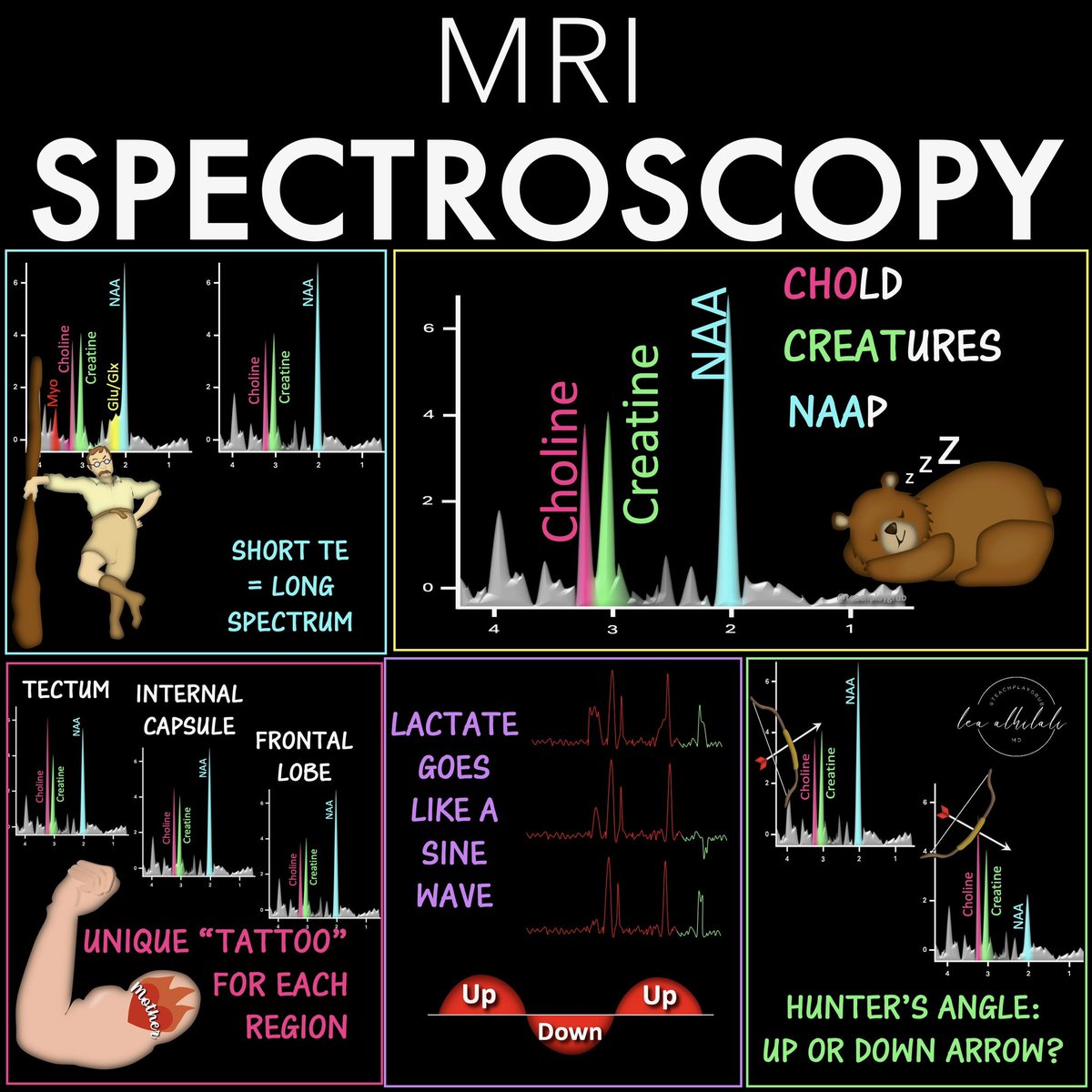
Tired of always speculating about MR spectroscopy?
If you've ever looked at an MR spectroscopy & thought: "I have no idea what I’m looking at!"--then this cheat sheet is for you!
Here are the 5 basic rules you need so you can understand the spectrum of basic spectroscopy!
(1) First you need to know the peaks.
—3 main peaks: Choline, Creatine, NAA
—Remember the order bc a spectrum looks like mountain peaks & it is cold in the mountains. And CHOld CREATures NAp or hibernate in the mountains
(2) Hunter’s angle:
—Most people know that the peaks of the spectrum should go up at you move lateral, called Hunter’s angle
—Most bad things reverse Hunter’s angle
—Ask yourself: Is my arrow pointed up to shoot into the air at the enemy (good) or is point to the ground where it will hit the dirt (bad)
(3) TE & spectrum length are inversely related
—Spectroscopy follows the rule: speak softly & carry a big stick.
—Short TE = long spectrum, lots of extra peaks for glutamate/glycine, myoinsitol
—Long TE = short spectrum, mainly the basic 3 peaks
(4) Each region has its own unique signature
—Each brain region has its own unique composition of compounds that might alter Hunter’s angle a bit, but not reverse it
—Need a control in contralateral normal brain so compare apples to apples
(5)Lactate peak goes like a sine wave
—Lactate peak represents anerobic metabolism—sign of cells in trouble
—It’s at 1.3ppm. Remember this bc 13 is an unlucky number & lactate is an unlucky sign!
—It’s like a sine wave: up at short TE (35), down at intermediate TE (144), and up again at long TE (244)
—You can use this flipping to better visualize the lactate peak
—You can remember it’s down in the middle TE bc when you’re caught in the middle, you’re down & out
Just remember these tricks & you will be spectacular at basic spectroscopy!
17/M, CKD-V, non oliguric, for 2 years, refused HD, now presented with encephalopathy. Urea was 640 mg/dl.
#MedTwitter#Nephrology
"What is the highest urea you have seen in clinical practice?"
''What is the highest urea reported ever?''
A patient on PRVC has a set VTi of 400 with Ppeak well within limits, but when the same patient is switched to VC-AC and same VTi of 400, Ppeak is crazy high... What is the reason behind? 🙃 @ArielG_RRT@GkuhnRRT
@WilliamAird4 There is no significant difference in the occurrence of events in CKD, irrespective of the agent used. So very well may lean towards Apixaban, hoping observational studies don't err. 🤞
@WilliamAird4 https://t.co/F99h1vdy37
Cmax has remained more or less similar irrespective of renal impairment, but had linear AUC relationship corresponding to renal impairment. Theoretically, alteration in dosing of apixa should address this.