$TSUBO is live
CA: 0x6c25b56137d0734b58b15ab742046deeb1e019cd
About Tsubo Protocol
Tsubo turns idle city space into onchain rights. Rooftops, rooms, walls and land become ERC-1155 rights with a defined scope, purpose and period, verified, traded and settled in native ETH.
▸ 7 contracts live on Ethereum mainnet
▸ Buy, sell and rent rights
▸ Revenue shared from real ETH deposits
▸ Bundle rights into baskets or split them into fractions
This is the only official CA. Always verify it here or at https://t.co/EcrBJBh4EB before buying.
Put every square meter to work.
A token can represent a defined right. The surrounding contracts determine how that right is recorded, transferred, held, and settled.
Tsubo’s Ethereum mainnet architecture contains seven protocol contracts:
• UrbanAssetRegistry : asset records and verification lifecycle.
• UrbanRightToken : defined usage and revenue-right tokens.
• UrbanMarketplace : eligible rights trading with native ETH.
• RevenueVault : accounting and claims for ETH actually deposited.
• BasketVault : custody-backed grouping of eligible rights.
• FractionVault : fixed-ratio shares backed by eligible revenue-right tokens.
• RentalEscrow : prepaid, time-limited use of eligible usage rights.
Together, these mechanisms let users explore different ways to use and compose rights not just buy a token and hope its price rises.
Tsubo uses @curvegridinc MultiBaas to query contract activity and present onchain records in the application.
RevenueVault deployment proof: https://t.co/et1W2bsCYs
Explore the mechanisms in the demo: https://t.co/P04D7csXKc
Revenue claims depend on actual deposits, not promised yields. Deployment is not an independent security audit or proof of legal property ownership.
For RWA builders and curious users: which mechanism would you explore first markets, baskets, fractions, or temporary usage?
You shouldn’t need to sign a transaction just to understand a product.
Tsubo separates exploration, learning, and onchain actions.
Start without connecting a wallet:
• Browse spaces on the map. • Open an asset’s description and proposed mechanism. • Check its current status. • Inspect the registration transaction.
Then use the wallet-free demo to explore marketplace purchases, revenue claims, and basket composition with simulated activity.
The benefit is simple: understand the process before committing real funds.
For wallet connectivity, Tsubo uses @reown_ AppKit, with @WalletConnect connectivity available through that integration. Connecting a wallet is not the same as approving a transaction always review the request before signing.
The marketplace contract is deployed on Ethereum mainnet: https://t.co/p4aJjnzZAY
Explore public records: https://t.co/LijVe69ZMP
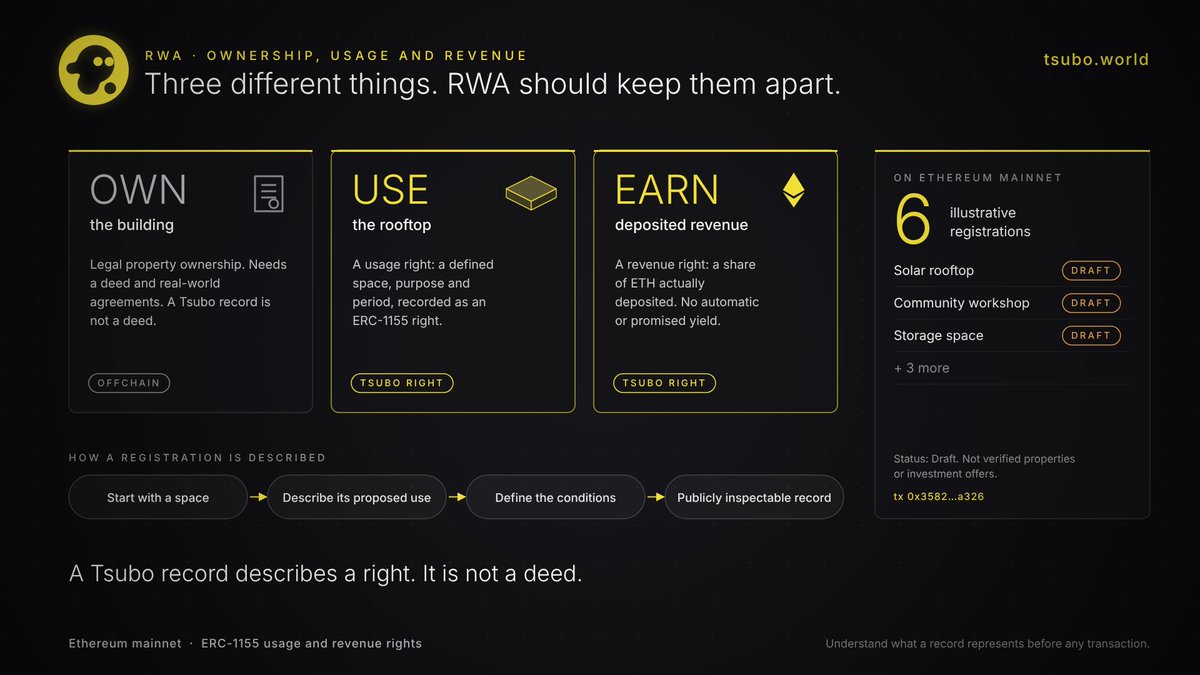
Owning a building, using its rooftop, and receiving a share of deposited revenue are three different things.
RWA products should make those distinctions clear.
Tsubo explores how spaces can be represented through defined usage and revenue rights on Ethereum @ethereum.
Start with a space. Describe its proposed use. Define the relevant conditions. Make the registration publicly inspectable.
Six illustrative projects are now registered on Ethereum mainnet from a solar rooftop to a community workshop and storage space. Each includes a description explaining its proposed mechanism.
Why does this matter?
Because users should understand what a record represents before considering any transaction not discover the limitations afterward.
Inspect a registration: https://t.co/z4PRjV7MVk
Explore the map: https://t.co/LijVe69ZMP
These are real onchain registrations with illustrative project data. They remain Draft not verified properties or investment offers.
What space would you model first?
Tokenized RWAs went from ~$6.6B to $30B+ distributed onchain in a year (via @RWA_xyz data). 📈
Most of it is paper: treasuries, funds, stocks.
The physical city is still the biggest untouched category.
Tsubo makes urban space programmable, one square meter at a time. Live on Ethereum.
Early is a position.
Real RWA means real rules.
On Tsubo:
▸ Every right is verified before it can trade
▸ Every right has a scope, a purpose and an end date
▸ Revenue is paid only from ETH actually deposited
▸ No promised APY. No made-up yield.
Not a token pretending to be a building. A right that says exactly what it is.
7 contracts live on @ethereum mainnet.
$TSUBO is live
CA: 0x6c25b56137d0734b58b15ab742046deeb1e019cd
About Tsubo Protocol
Tsubo turns idle city space into onchain rights. Rooftops, rooms, walls and land become ERC-1155 rights with a defined scope, purpose and period, verified, traded and settled in native ETH.
▸ 7 contracts live on Ethereum mainnet
▸ Buy, sell and rent rights
▸ Revenue shared from real ETH deposits
▸ Bundle rights into baskets or split them into fractions
This is the only official CA. Always verify it here or at https://t.co/EcrBJBh4EB before buying.
Put every square meter to work.
@GlowFND uses tokens to build solar farms. ☀️
Tsubo starts at the rooftop. $TSUBO
A roof becomes a revenue right. Backers buy units in ETH. When the project deposits revenue, holders claim their share.
Energy is going onchain. The space it sits on should too.
RWA should start with clear rights not just another token.
What can a space be used for? For how long? Who receives its revenue?
Explore how Tsubo models these questions: browse the map, inspect six onchain showcases, and read each project’s proposed mechanism.
Explore: https://t.co/LijVe69ZMP
Real Ethereum registrations.
What can you do with Tsubo? $TSUBO
☀️ Rooftop solar
An owner issues revenue rights for a solar roof. Backers buy units in ETH and claim their share when revenue is deposited.
📦 Storage rooms
An empty room becomes a usage right for a fixed period, listed at a fixed price.
🔑 Rentals
Lend an exclusive usage right for a few days. Rent is prepaid in ETH, and the right stays in escrow.
🧺 Baskets
Bundle 2–8 revenue rights into one backed position, like a basket of solar rooftops.
✂️ Fractions
Split a right into smaller shares so more people can hold a piece.
🔁 Resale
List your units anytime on the market.
Every square meter can do something. Tsubo puts it onchain.
What is Tsubo Protocol? $TSUBO
A building is one asset. But it holds many uses: a rooftop, a room, a wall, the land around it.
Tsubo separates the space from the rights attached to it.
Each right is an ERC-1155 token that defines:
▸ Where: rooftop, interior, wall, land or the whole asset
▸ What for: solar, storage, parking, a pop-up
▸ How long: a set start and end date
▸ What you get: the right to use it, or a share of its revenue
Rights are verified before they trade, bought with native ETH, and revenue is paid only from ETH actually deposited.
7 contracts live on Ethereum mainnet.
Not a deed. A clear, onchain right.
🌐 https://t.co/EcrBJBh4EB
@VitalikButerin says Ethereum is heading toward more transactions, lower costs and better privacy.
Here's what that unlocks for cities.
Picture an empty rooftop in Tokyo. The owner issues 1,000 revenue units for a solar project on Tsubo.
▸ A verifier approves the asset and the right
▸ Backers buy units in native ETH, in one transaction
▸ The project goes active once it's operating
▸ 1 ETH of revenue is deposited, and someone holding 100 units claims about 0.1 ETH
No middlemen. No spreadsheets. Just a roof, a right and Ethereum.
When onchain gets cheap enough, every square meter can work.
🌐 https://t.co/EcrBJBgwP3
Behind Tsubo: 7 Contracts Deployed on Ethereum Mainnet
RWA needs more than a token. It needs clear asset records, defined rights, payment mechanisms, and transparent accounting.
Here are the seven contracts behind Tsubo’s Ethereum mainnet deployment with direct deployment transaction links.
1. UrbanAssetRegistry — Asset records
Stores asset references and metadata, with a verification lifecycle. Registering an asset does not establish legal property ownership.
https://t.co/ICh7v61fn7
2. UrbanRightToken — Defined rights
Represents defined usage and revenue rights through ERC-1155 tokens, with lifecycle and transfer controls. These are not property deeds.
https://t.co/DwI8X7MLXB
3. UrbanMarketplace — ETH trading
Supports fixed-price listings and purchases of eligible rights, including secondary trading, settled in native ETH.
https://t.co/p4aJjnzZAY
4. RevenueVault — Deposits and claims
Accounts for ETH actually deposited against eligible rights and enables holder claims. It does not generate or guarantee returns.
https://t.co/et1W2bsCYs
5. BasketVault — Rights composition
Holds eligible underlying rights in custody and issues basket shares, supporting redemption and revenue distribution.
https://t.co/RmWCgRlsYL
6. FractionVault — Custody-backed fractions
Creates fixed-ratio shares backed by eligible revenue-right tokens held in custody, with redemption and revenue-claim mechanisms.
https://t.co/VeII4Zo9tQ
7. RentalEscrow — Temporary use
Escrows eligible usage-right tokens for prepaid, time-limited rentals. Early return does not provide a refund. This is not collateral lending.
https://t.co/QJcgZmgyDG
Network: Ethereum mainnet
Settlement: Native ETH
Deployment evidence: All seven creation transactions succeeded, and deployed code is present at the recorded addresses.
RWA should start with clear rights not just another token.
What can a space be used for? For how long? Who receives its revenue?
Explore how Tsubo models these questions: browse the map, inspect six onchain showcases, and read each project’s proposed mechanism.
Explore: https://t.co/LijVe69ZMP
Real Ethereum registrations.
Six new Tsubo showcase assets are now registered on Ethereum mainnet, each with a description explaining its proposed mechanism.
Onchain proof for each registration:
Marunouchi Solar Roof https://t.co/z4PRjV7MVk
Kanda Community Workshop https://t.co/vXaEENOBEr
Nihonbashi Courtyard Market https://t.co/zq9QQWgJnr
Kyobashi Mobility Hub https://t.co/aEZxsOFsoN
Hatchobori Storage Studio https://t.co/rmfWwd2U4v
Ginza Creative Wall https://t.co/iDHfxpL7iR
Built to help users explore Tsubo’s mechanisms through publicly inspectable examples.
$31B of real-world assets distributed onchain, up from ~$6.6B a year ago.
Now imagine the next wave isn't another fund. It's the rooftop above you. 坪
Tsubo puts urban space rights on Ethereum: verified before they trade, bought in native ETH, revenue claimed only from real deposits.
RWA started with paper. Next comes the city.
Speed: won. Next: security.
That's the right order.
Tsubo puts real-world rights on Ethereum: rooftops, rooms and land, each with a scope, a purpose and a period. Rights that need to settle cheaply and stay correct for years.
Building the city layer on the chain that keeps getting faster and safer
Cheaper, faster Ethereum isn't only about DeFi.
When transactions get cheap, small things become worth putting onchain.
One rooftop. One storage room. One parking bay for 30 days.
That's what Tsubo is building on Ethereum mainnet: urban space as ERC-1155 rights, settled in native ETH.
Scale makes the city programmable.
Vitalik: What Will Ethereum Look Like in Two Years?
On October 6, 2026, Ethereum co-founder Vitalik Buterin @VitalikButerin said at OKX NOW @okx in Singapore that Ethereum will support a large number of transactions in two years, with lower costs, better privacy, and deeper integration between AI and onchain applications.
He suggested that both trading counterparties and application developers could be bots. Traditional applications might even cease to exist, with bots posting offers directly onchain and users' AI agents interpreting those offers and identifying suitable trading opportunities.
Tokenization started with treasuries and funds.
The next frontier is right above your head. 坪
Rooftops, empty rooms, idle lots. Most city space sits unused, and none of it is onchain yet.
Tsubo turns that space into ERC-1155 rights with a scope, a purpose and a period. Live on Ethereum mainnet, settled in native ETH.
RWA, but for the city itself. @RWAwatchlist_ 🏙️
Love this framing from @GlowFND. ☀️
BTC built mining machines. GLW builds solar panels.
Tsubo turns the space underneath into rights. 坪
One rooftop becomes a revenue right on Ethereum. Backers buy units in ETH, and holders claim their share when revenue is deposited.
Tokens can build infrastructure. They can also organize who gets to use it.
Every square meter, onchain. 🏙️
Bitcoin used tokens (BTC) to build millions of mining machines.
Glow uses tokens (GLW) to build millions of solar panels.
Glow Control (GCTL) directs where solar gets built and GLW emissions flow.
An ecosystem powered by people to help power people who need it most.
"Programmable $V4 tokens for programmable cities."
$TSUBO is Live on @ProgrammableHQ , the garden of customizable tokens built on Uniswap v4.
Tsubo makes urban space programmable: rooftops, rooms and land become onchain rights with their own scope, period and revenue rules.
Programmable makes tokens programmable: modules and hooks that shape how a coin behaves.
Same belief, two layers. Code should define what an asset can do.
Proud to grow with the Programmable ecosystem.
$TSUBO is live
CA: 0x6c25b56137d0734b58b15ab742046deeb1e019cd
About Tsubo Protocol
Tsubo turns idle city space into onchain rights. Rooftops, rooms, walls and land become ERC-1155 rights with a defined scope, purpose and period, verified, traded and settled in native ETH.
▸ 7 contracts live on Ethereum mainnet
▸ Buy, sell and rent rights
▸ Revenue shared from real ETH deposits
▸ Bundle rights into baskets or split them into fractions
This is the only official CA. Always verify it here or at https://t.co/EcrBJBh4EB before buying.
Put every square meter to work.
What is Tsubo Protocol? $TSUBO
A building is one asset. But it holds many uses: a rooftop, a room, a wall, the land around it.
Tsubo separates the space from the rights attached to it.
Each right is an ERC-1155 token that defines:
▸ Where: rooftop, interior, wall, land or the whole asset
▸ What for: solar, storage, parking, a pop-up
▸ How long: a set start and end date
▸ What you get: the right to use it, or a share of its revenue
Rights are verified before they trade, bought with native ETH, and revenue is paid only from ETH actually deposited.
7 contracts live on Ethereum mainnet.
Not a deed. A clear, onchain right.
🌐 https://t.co/EcrBJBh4EB
$TSUBO is live
CA: 0x6c25b56137d0734b58b15ab742046deeb1e019cd
About Tsubo Protocol
Tsubo turns idle city space into onchain rights. Rooftops, rooms, walls and land become ERC-1155 rights with a defined scope, purpose and period, verified, traded and settled in native ETH.
▸ 7 contracts live on Ethereum mainnet
▸ Buy, sell and rent rights
▸ Revenue shared from real ETH deposits
▸ Bundle rights into baskets or split them into fractions
This is the only official CA. Always verify it here or at https://t.co/EcrBJBh4EB before buying.
Put every square meter to work.