A new FBC Securities half-year economic report identifies the South African migration crisis as a key downside risk to Zimbabwe’s external inflow outlook.
Read full story:
https://t.co/hNYH7ZF1FA
Here’s what Old Mutual Zim plans to build next:
📌 The Grange Lifestyle Estate: A US$46.2 million mixed-use development in Harare with residential, retail, restaurants, gym, car showroom, medical centre and office park. Civil works have already started
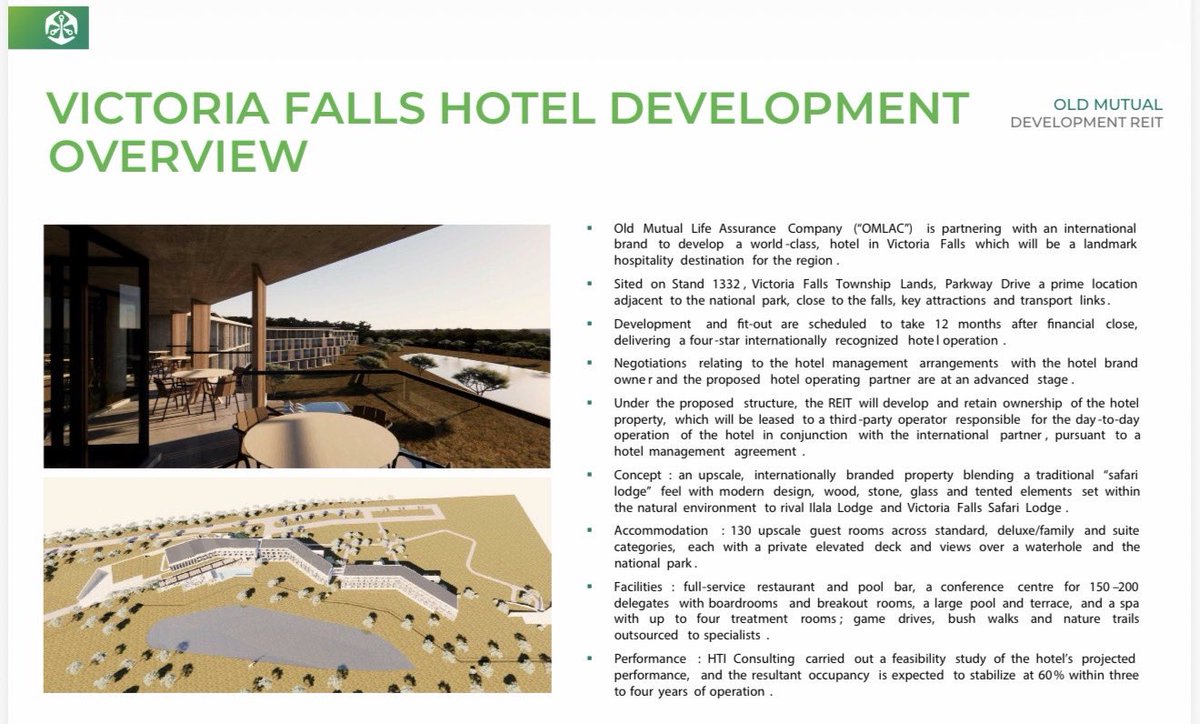
📌 Victoria Falls hotel: Old Mutual says it is ‘partnering with an international brand’ for a new 130-room hotel near Vic Falls.
📌 Borrowdale: A mixed-use precinct featuring offices, retail, apartments, and a five-star hotel with a conference centre.
The projects are part of Old Mutual’s planned Development REIT, which will develop and own income-generating property assets.
@IsheSvosve@UTD_rgz@CrimeWatchZW I think the point he was trying to make ndeyekuti, parking on Saturdays is free until 1300hrs so why would they bill them a $1 to park until 1345hrs.
Old Mutual is planning to list a Development REIT (D-REIT) on the VFEX.
• Target Raise: US$46.2M private placement ahead of listing to launch The Grange project.
• Prescribed Asset Status: Granted at fund level—a huge draw for institutional capital seeking compliant, hard-currency growth.
• VFEX Listing: Built for USD tax efficiency & capital mobility.
The Asset Strategy:
• Greenfield Upside: Capitalizing new commercial builds at The Grange (lifestyle, medical, office).
• Cash Flow Stabilizers: Anchored by operational, income-generating assets like Borrowdale Office Park to buffer build-phase risk.
The first small town to be affected is Musina, which grew and developed because of the business that came with the Zimbabweans.
Now its a ghost town, all businesses closed.
March and March should come and do business here
@JacintaNgobese
#dandarostreets A business owner in Spartan has reportedly closed his company after dismissing undocumented foreign workers, allegedly refusing to hire and train South African employees.
The move sparked a confrontation with members of the March and March Movement, who urged him to reopen the business and employ local residents.
Follow our WhatsApp Channel:
https://t.co/cYTwWjTjpb
This is exactly what we watched unfold in Zimbabwe right before Mugabe seized the farms. History is repeating itself in South Africa and the warning signs are impossible to ignore. Wake up before it’s too late 🇬🇷🇿🇦. ..
A cash-based economy is not the hallmark of a modern economy. It is often a symptom of shallow financial markets, low trust in the banking system and limited access to credit.
Developed economies are built on three pillars: savings, credit and investment. Savings provide banks with the funds to lend, credit finances productive assets such as homes, factories and businesses, and investment drives long-term economic growth.
When people boast that houses were built entirely with cash, they may be celebrating resilience rather than economic progress. In a well-functioning financial system, home ownership is largely financed through long-term mortgages because credit enables households to spread the cost of major investments over time while preserving liquidity for other productive uses.
The depth of a country’s credit market is one of the clearest indicators of financial-sector maturity. Strong credit growth reflects confidence in banks, stable property rights, predictable inflation and a healthy intermediation process between savers and borrowers. An economy where almost every major purchase is made in cash is not necessarily stronger; it often signals that financial intermediation has broken down.
The real measure of economic progress is not how much cash changes hands, but how effectively a country transforms savings into productive credit that creates wealth, jobs and sustainable growth.