I'm excited to announce the release of my Online Jinja2 Parser - J2Live!
Give it a try here: https://t.co/6dmkRnHbJN
Blog post with overview of the tool: https://t.co/AdK7dSgYCv
#Python#Jinja2#NetDevOps
When I joined Deutsche Bank, I didn’t pretend I worked for a tech company—I worked for a financial institution. At Lockheed Martin, I wasn’t just in tech—I was in the business of national defense. At PwC, I wasn’t part of an IT consultancy—I was embedded in an audit-first culture.
In each of these environments, my job title didn’t define my approach—the business mission did.
As a technologist and consultant, I’ve learned that success doesn’t come from applying the same playbook everywhere. It comes from aligning with the business DNA. At PwC, tech consulting served audit. At Lockheed, HUD contracts still lived in the shadow of aerospace and defense. You don’t reshape the company around your skills—you reshape your skills around the company’s mission.
If you're in tech, but working in another industry—remember: context is everything.
The release of DeepSeek R1 really shook things up last week! Today, @ahl and @bcantrill will be joined by Andy Hock and @draecomino from @cerebras to talk about their experiences with R1 -- and the future of AI disruption. Join them, 5p Pacific! https://t.co/YThZwg14zF
An interesting take on the "real" uv performance 🧐
When pip installs a Python package, it precompiles its source into bytecode so that the consequent start of a Python program is faster.
It turns out that uv disables this compilation by default. When enabled, it's still faster than pip, but the difference becomes a little less stunning.
By the way, for containerized Python applications, you always want to set UV_COMPILE_BYTECODE=1 because a better container startup performance is likely much more important than shaving off a few seconds from the build step.
Source: https://t.co/OTYSszd25I
P.S. pythonspeed[.com] has a great collection of posts on all things Python in Docker. Do recommend.
Here it is: @swardley and I are writing a book about Moldable Development. And we are writing it in public 👇
This is not an opinion book written in the spur of the moment. It's an overview of research and development that spans some 15 years done together with my colleagues at @feenkcom. While Simon and I are the ones doing the writing, and even if I was the one that coined the initial idea, the result that today we call Moldable Development is very much the work of a collective.
Now, the writing itself is the result of Simon and I exploring for more than a year different ways to explain the method and its implications. And yes, we guided much of the conversation through Wardley Maps. Lots of them. The first installment we just published offers a glimpse of the result. More to come.
Oh, and writing is hard. So, please do let us know what you think of what we are writing. It helps with the morale.
People, the Internet Architecture Board is hosting a workshop on the Next Era of Network Management Operations! It's been 20+ years since RFC3535 that gave us NETCONF & YANG + later RESTCONF etc.
You operate a network? PLXZ to fill in questionnaire https://t.co/jHNprs0N6t
1/5 Our most recent study just upladed to bioRxiv for free download.
"Metabolic and Cellular Differences Between Sedentary and Active Individuals at Rest and During Exercise".
https://t.co/CdH1APuyiT
Just arrived today, after over a year of work with @davidban77 & @chadell0, Modern Network Observability! So very excited that the effort put in to the book is now available. Thank you @BradfordHaas for the tech review, and forewards from @ericchou + @damgarros.
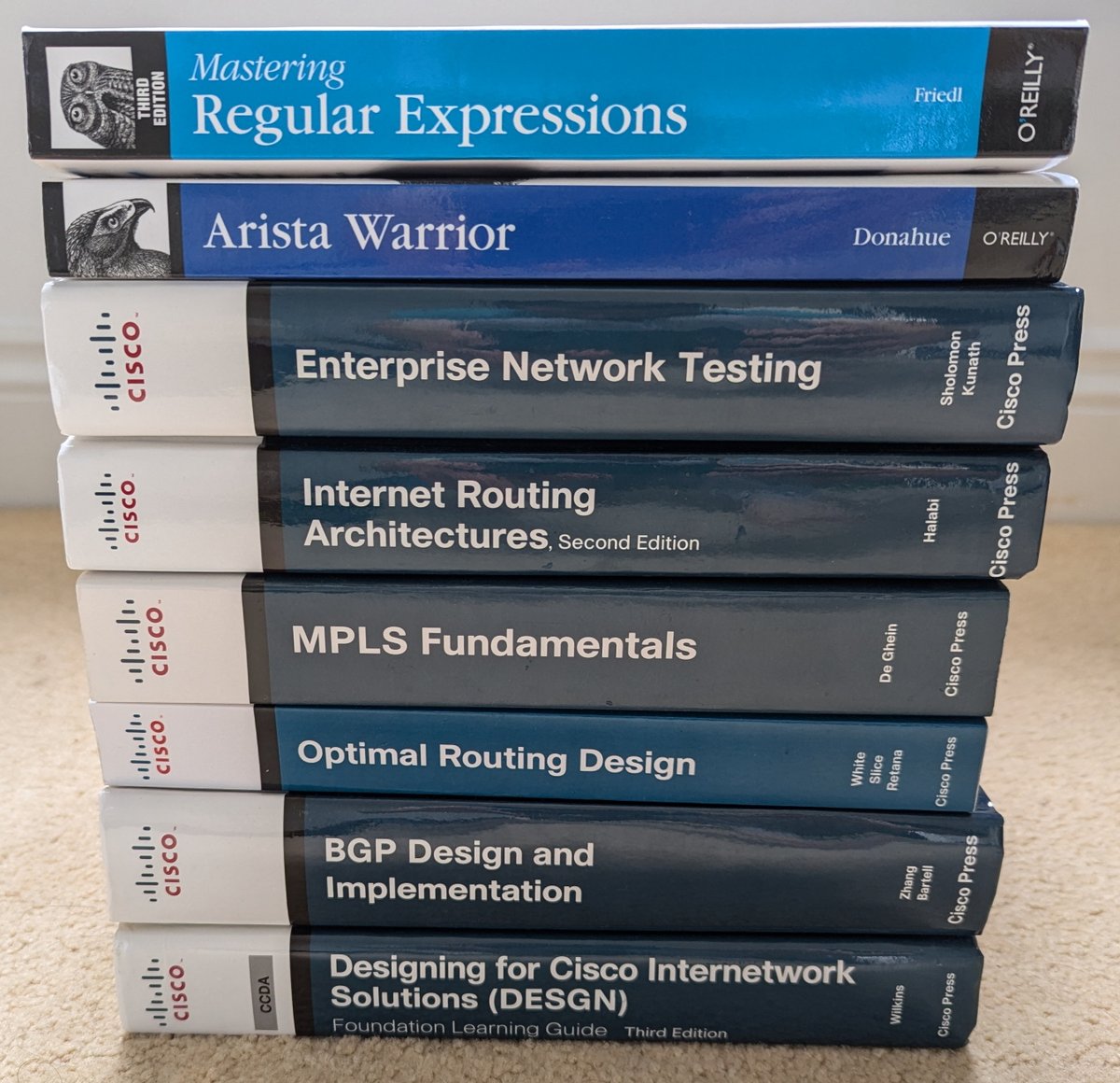
Changed my DM settings so anyone can msg me now. Pick up in person preferable but can post within the UK. Sending outside the UK would cost more than a new book I'm afraid. If interested, send me DM with the title.
Do you want to learn improved decision making, enhanced problem solving, increased personal and professional growth, and better interpersonal skills?
Then watch our intriguing conversation with @mbushong about cognitive bias, a mental shortcut that influences our thinking and decision-making, leading us to process information in a selective and subjective manner, often resulting in inaccurate or irrational judgments.
https://t.co/QjaJdHAppc
On Monday, @RajaXg joined @bcantrill and me to answer a question sent in from a listener: what's are the differences between a CPU, GPU, FPGA, and ASIC?
https://t.co/MozjxwkE27
My new book, Building Resilient Distributed Systems, is now available in early access form @OReillyMedia. A few chapters are available at this stage, ahead of the planned publication in August next year. You can find out more about the book here: https://t.co/3YEYjQzgA8
Woah, this Hacker News thread on my Postgres memory guide got a lot of traction. Oddly enough, much of the discussion is delving into the consequences of UUIDs. 😂
https://t.co/aoIEDX9KOa




![iximiuz's tweet photo. An interesting take on the "real" uv performance 🧐
When pip installs a Python package, it precompiles its source into bytecode so that the consequent start of a Python program is faster.
It turns out that uv disables this compilation by default. When enabled, it's still faster than pip, but the difference becomes a little less stunning.
By the way, for containerized Python applications, you always want to set UV_COMPILE_BYTECODE=1 because a better container startup performance is likely much more important than shaving off a few seconds from the build step.
Source: https://t.co/OTYSszd25I
P.S. pythonspeed[.com] has a great collection of posts on all things Python in Docker. Do recommend.](https://pbs.twimg.com/media/GiX1VclXoAAE2i-.png)