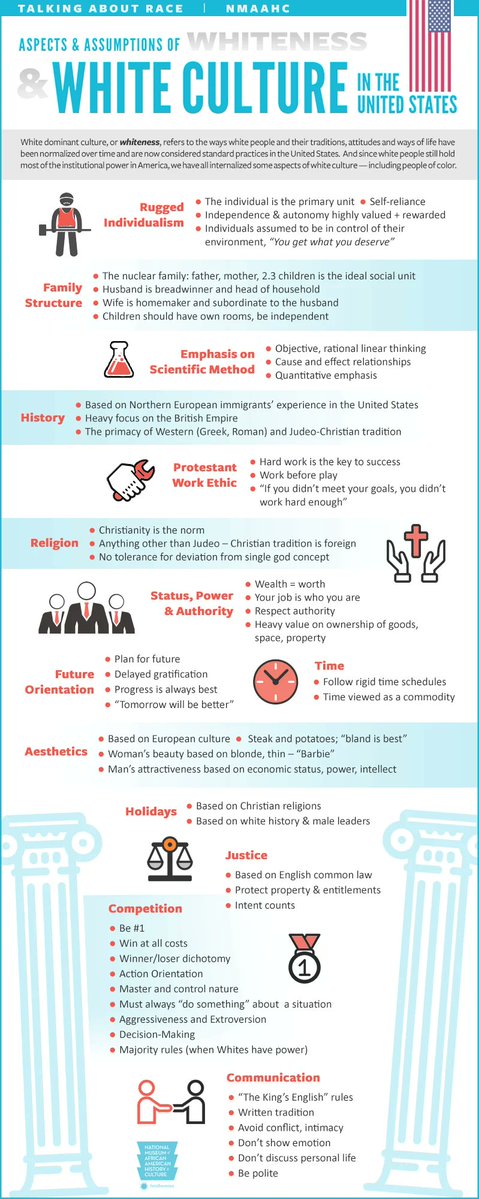
Here's something truly funny in the darkest possible manner.
The "unflattering" traits listed as characteristic of white culture—even white supremacy culture—by institutions such as the Smithsonian share one fundamental psychological feature in common:
They are all indications of—are you ready for it—the Big Five trait conscientiousness.
Conscientiousness is the best known personality predictor of life success after general cognitive ability (otherwise known as intelligence).
So this means that the idiot leftists who developed and promoted such material proclaim their antiracism by insisting that the very trait most associated with productivity, reliability, diligence, and success is a flaw, unique to white people.
Hard work is key to success.
Work before play.
Delayed gratification.
Future orientation.
Planning.
Punctuality.
Self-reliance.
Respect for authority.
Pure conscientiousness.
"Yo--those n-words shore are lazee..."
Sincerely,
The Democratic Socialists of America
You can't make this stuff up.
In truth, by the way, racial differences in the major personality traits are negligible.
Each Tesla is an inference computer on wheels. When charging on the Supercharger Network with FSD idle, it can take on distributed AI workloads from xAI, likely Grok Build, and potentially other AI hyperscaler customers.
Therefore, the red dots you see form a distributed AI data center.
Few understand this; you should. Tesla is undervalued.
Instead of looking for a needle in a haystack, just buy the entire AI haystack.
Compute: $NVDA, $AMD, $MU, $ASML, $TSM
Networking: $ANET
Power and cooling: $CEG, $BE, $VRT
Data: $MDB, $ORCL
Control layer: $PLTR
Security: $CRWD
Observation: $DDOG
Cloud infrastructure: $GOOG, $AMZN, $MSFT, $ORCL
Jordan Peterson warned how a brain that stops reading eventually loses the ability to think deeply on a topic:
1. Reading for pleasure has always been a minority occupation. Most people don't read. Of those who do, few buy books. Of those who buy books, even fewer read difficult ones. That's not changing and that's exactly why it's your advantage.
2. Books are not like photographs. A photograph is a click. A book is a portrait layered, worked over, and built with depth. No other medium lets you think, rethink, and go deeper the way a book does.
3. YouTube and podcasts are not the enemy of reading. They are extensions of it. A great podcast can carry the same value as a great book. Peterson treats them as complements, not competition.
4. The real revolution of podcasts is found time. You can't read while driving or doing the dishes. But you can listen. All that dead time, commuting, cooking, exercising is now a university education available to anyone with a phone.
5. Long-form attention is not dead. Joe Rogan does three-hour podcasts. Peterson's lectures run two hours. Millions watch them to the end. People don't have fragmented attention spans. They have low-quality inputs.
6. When Peterson's YouTube views crossed one million, he didn't celebrate immediately. He sat with it. He thought: a million is a lot. If you sold a million books, you'd do the touchdown dance. He realized something massive was happening.
7. YouTube isn't cute cat videos. Peterson saw it for what it actually is, the invention of the printing press, version two. For the first time in human history, the spoken word has the same reach and the same duration as a book.
8. The people who learn the fastest are the ones willing to look like fools at the start. Peterson felt like a fool when he first lectured, first practiced therapy, first uploaded to YouTube. He did it anyway.
9. Most smart people dismiss new media. When journalists called Peterson's colleagues, they'd say things like "they always get it wrong." Peterson picked up the phone, had the conversation, and let the chips fall. That single habit changed everything.
10. The fool is the precursor to the savior. Carl Jung said it. Peterson lived it. You cannot advance without first being willing to look incompetent. Safety keeps you comfortable. It doesn't keep you growing.
11. Reading makes your thinking slower in the best possible way. It forces you to sit with one idea long enough to actually understand it. Social media gives you 100 ideas in 15 minutes. Books give you one idea that actually stays.
12. The brain is not built for passive consumption. Short-form reels don't educate deeply. They stimulate rapidly and leave nothing behind. Your brain needs time to process, observe, and emerge in an experience.
13. If you can truly read, you can read faster than you can listen. That makes reading the highest-leverage input activity available. Not everyone has the patience for it which is exactly why those who do get ahead.
14. The people watching two-hour lectures are not bored. They are hungry. There is a massive market for demanding, high-quality, difficult content. Most creators refuse to make it because they're afraid of losing easy engagement.
15. Peterson's point is not that podcasts are bad or that books are dying. It's that the tools for becoming genuinely educated have never been more accessible and most people still choose not to use them.
Elon Musk: "The studies I’ve seen show the suicide risk doesn’t drop after medical transition in kids—it triples. And many people don’t know there are deaths on the operating table from these procedures that almost never get reported."
Jordan Peterson on Elon Musk:
“Musk isn’t just a creative genius. He’s also an extremely conscientious engineer… probably one person in a hundred million — maybe even a billion.”
He described Musk as this rare combination: hyper-creative and hyper-conscientious. The kind of engineer who doesn’t just have ideas — he understands how to build them out of atoms.
That level of drive comes with a heavy mental load — the “storm” Musk himself has talked about.
We often romanticize genius without seeing the real price that comes with it.
I’ve always found it fascinating how the people who move the world the most usually carry the heaviest internal load.
What do you think — isn’t it impressive how Elon Musk carries that burden while still pushing humanity forward with SpaceX, Tesla, and so much more?
I am still trapped on the same SSRI I was prescribed at 7 years old because every attempt to come off has resulted in severe, debilitating withdrawal....
At 23 years old, I decided I wanted to come off antidepressants. Despite having been on them virtually my entire life — throughout my childhood and brain development — my doctor tapered me off in just 6 weeks, following the same outdated and dangerous guidance many doctors still use today.
What followed was a severe full-body neurological crisis: nonstop physical, cognitive and psychological suffering unlike anything I knew a human being could endure.
When I went back to my doctor and told him I was in withdrawal, I was told antidepressant withdrawal “doesn’t exist,” that symptoms of “discontinuation syndrome” are “mild and only last two weeks,” and that what I was experiencing was proof I needed the drugs
After months of torturous suffering and countless emergency room visits, I had no choice but to reinstate the antidepressant. But even after reinstating, the neurological damage from the rapid, doctor-directed taper did not go away.
That is why the term “withdrawal” is often deeply misleading. For many people, coming off antidepressants can trigger a devastating neurological injury that persists for years.
I still do not feel normal. I am intermittently bedridden, and even as I type this, my brain feels like it is on fire.
I genuinely do not remember what happiness, love, or emotional connection are supposed to feel like anymore. So much of my cognition, personality, creativity, and ability to access my mind the way I once could feels altered or gone. Some days the suffering becomes so overwhelming that I genuinely do not know how much longer I can continue living in this condition.
Today, at 30 years old, I am still on the same medication I was prescribed as a child. I desperately want to come off, but every attempt has caused severe, debilitating withdrawal that has made it physically impossible.
#MentalHealthMonth #NobodyToldMe #medicationinjury #HHS #HealingJourney #overmedicalization #SSRI