Khan Abdul Ghaffar Khan's Contributions to the Indian Freedom Struggle:
Political Contributions:
Founding and Leadership of Khudai Khidmatgar (Servants of God): In 1929, Khan founded this nonviolent resistance movement, mobilizing over 100,000 Pashtuns to oppose British rule through civil disobedience, boycotts, and non-cooperation. They faced brutal crackdowns but remained steadfast, influencing the political landscape of the North-West Frontier Province.
Pioneering Nonviolent Resistance in the Frontier: Khan, dubbed "Frontier Gandhi" for his adherence to nonviolence, inspired and mobilized the Pashtuns, traditionally known for their warrior culture, to embrace nonviolent resistance. This significantly impacted the strategies of the Indian National Congress and the overall movement.
Advocating for Hindu-Muslim Unity: Khan actively promoted unity and cooperation between Hindus and Muslims, challenging the divisive policies of the British Raj. He organized joint campaigns and addressed interfaith gatherings, countering the seeds of communal discord sown by the colonial government.
Campaigning for Pashtun Autonomy: While advocating for Indian independence, Khan also championed the rights and autonomy of the Pashtun people. He envisioned a free India where all communities, including the Pashtuns, could enjoy self-determination and cultural preservation.
Social and Educational Contributions:
Promoting Pashtun Education: Khan established the Pakhtun Zalmi Educational Society, opening schools and colleges across the region to provide quality education, particularly for girls, who were traditionally denied access. He believed education was key to social upliftment and empowerment.
Championing Pashtun Culture and Language: Khan actively promoted Pashtun language and literature, establishing libraries and cultural centers. He saw cultural preservation as crucial for maintaining Pashtun identity and resisting assimilation into the dominant colonial culture.
Advocating for Women's Rights: Khan challenged traditional gender norms and advocated for women's education, participation in politics, and equal rights. He encouraged women to join the Khudai Khidmatgar and actively participate in the struggle for freedom.
Promoting Nonviolent Social Change: Khan's commitment to nonviolence extended beyond political resistance. He advocated for resolving social and economic conflicts through peaceful means, promoting tolerance and understanding within Pashtun society.
Examples:
The Peshawar massacre of 1930, where the Khudai Khidmatgar faced brutal police repression without retaliation, became a powerful symbol of nonviolent resistance.
Khan's close association with Gandhi and the Indian National Congress fostered collaboration and unity within the freedom movement.
His establishment of the Sarhaddi Gandhara Khudai Khidmatgar School for Girls in 1937 challenged traditional gender barriers and empowered women through education.
Khan's opposition to the partition of India in 1947, based on his vision of a united and secular nation, reflected his commitment to Hindu-Muslim unity.
Additional Points:
Khan's legacy transcends the Indian independence struggle, inspiring future generations of Pashtun activists and reformers.
His commitment to nonviolence, social justice, and cultural preservation continues to be relevant in the contemporary context.
Despite facing imprisonment and exile, Khan remained unwavering in his dedication to freedom and social progress.
List of Associations:
Indian National Congress
Khudai Khidmatgar
Pakhtun Zalmi Educational Society
Anjuman-i-Islah (Reform Society)
Newspapers:
Khudai Khidmatgar Gazette
Zama
Pashtun
Azad
Books:
My Life and Struggle (Khan's autobiography)
Badshah Khan and the North-West Frontier (by M.K. Gandhi)
"There are many causes that I am prepared to die for but no causes that I am prepared to kill for."
Remembering Mahatma Gandhi the evening before his 154th birthday. Gandhi was nominated for the #NobelPeacePrize on 12 occasions.
Read more: https://t.co/Q3cniIiZG9
On the occasion of coronation of Tsar Nicholas II, in 1896 thousands of people died in stampede took place while the festivities were going on. Despite this, Tsar continued the feasts and in 1917 the Romonov Dynasty abolished forever from Russia.
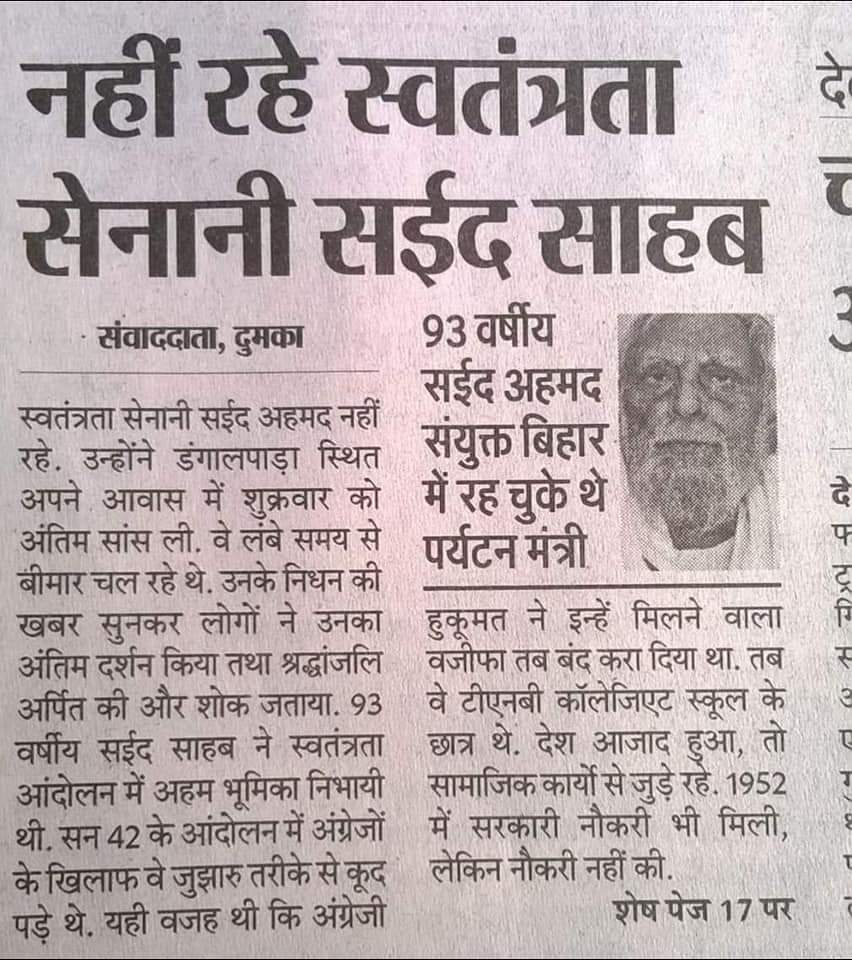
#महागामा विधानसभा से 2बार विधायक व संयुक्त बिहार में पर्यटन मंत्री रह चुके तथा #अंग्रेजो_भारत_छोड़ो आंदोलन में मात्र 14वर्ष की आयु में शामिल होकर भारत को आजादी दिलाने में अहम भूमिका निभाने वाले #स्वतंत्रता_सेनानी मरहूम #सईद_अहमद की 8वीं यौमे वफात पर खिराज-ए-अकीदत पेश करता हूं।
Rohini is perhaps the first festival of #jharkhand. It is a festival of sowing seeds in the field. Farmers starts sowing seeds from this day but there is no dance or song like other tribal festivals but just a few rituals.
@HemantSorenJMM@MinOfCultureGoI@incredibleindia
Here are some facts about the Moors in Europe: They ruled Spain and Portugal 754 years before the fall of the Mali Empire.
1. The Moors brought a wide variety of new fruits and vegetables to Europe. The Moors brought many new fruits and vegetables to Spain and Europe that