@rfleury What are the the supported formats? I wanted to display a grey-scale 8-bit image but I can't figure out how to do it since there is no documentation. Also you can just put anything in the format field and it will take it without reporting any error. Thanks!
Found Beej's Guide to C Programming! For those who don't know, Beej is a cracked old timer who's done a ton of tech guides over the years. This one alone can probably bring you to expert-level in C. Check it out!
It's finally here.
https://t.co/kGnQwNvwiP
Explains how I learned Vulkan and wrote a small game engine with it in 3 months.
It's huge. Hopefully you'll find it useful. :)
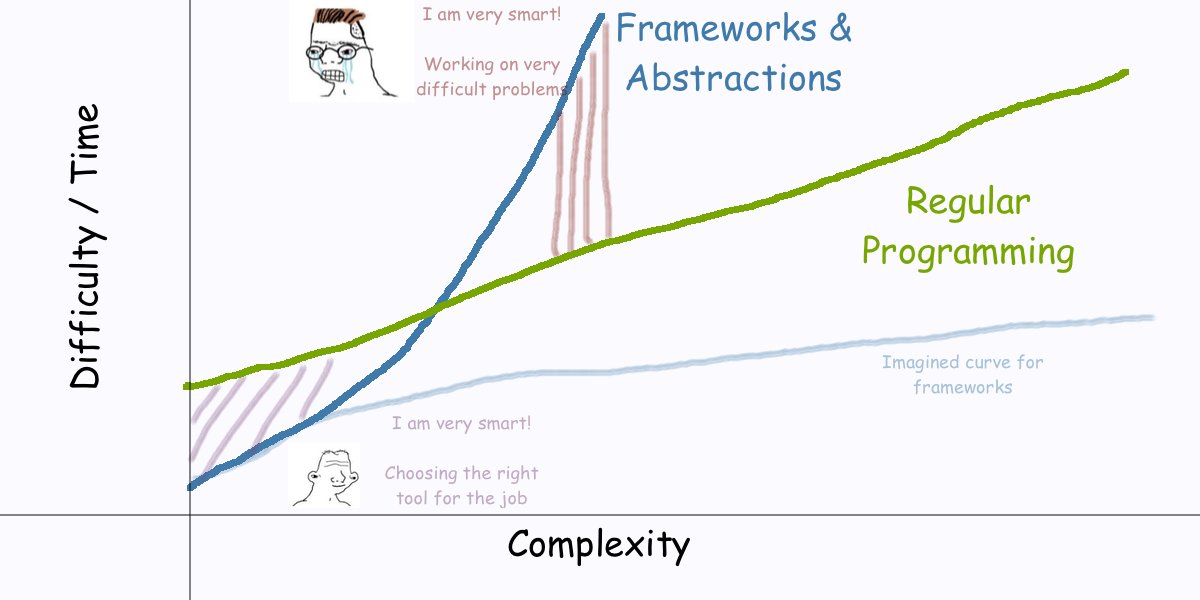
Most frameworks make it easy to solve simple problems, but they also make it much more difficult than necessary to solve problems of increasing complexity.
Beginners are attracted by how easy it is to achieve the simple things, and they imagine this ease of work will extend all the way into difficult and complicated problems.
This almost never happens. Instead, as complexity increases, issues and stumbling blocks start to come up seemingly out of nowhere.
This is not just aribtrary, nor is it a "skill issue" for the makers of the framework.
The defining feature of most frameworks and abstractions is that you do not think about the details.
That's their selling point: look how much you can get done without thinking!
On the other hand, the defining feature of the more complicated problems is that they require control over the details.
Any frameworok that promises to free you from thinking about the details will by definition make it impossible to solve complex problems, unless it also exposes the underlying building blocks so that you can arrange them in different ways than what the default higher level layers of the framework provides for you.
The Ancient Roman Empire employed a unique method in constructing their concrete, which possessed the remarkable ability to self-repair. Comprehensive research conducted by teams from MIT and Harvard has unveiled the ingenious approach adopted by Roman engineers.
Their investigations revealed that the Romans incorporated a calcium-rich mineral deposit known as "lime clast" into their concrete mixture. This distinct ingredient, absent in contemporary concrete structures, bestowed upon their creations the capacity to autonomously mend cracks.
To validate their hypothesis, they manufactured two concrete samples. The first was prepared by incorporating the ancient lime clast, as observed in historical constructions, while the second sample followed contemporary construction methods.
Intentionally, they induced cracks in both samples and subjected them to water exposure. After a span of two weeks, the concrete derived from the Roman mixture exhibited a remarkable self-healing ability, while the other sample remained persistently cracked.
Disney's BRDF explorer, released almost 11 years ago, was a great tool to study BRDFs, scanned and analytical. It is still available but it is a bit of an effort to compile it: https://t.co/9GXs2HCy2R. Fortunately there are good alternatives online https://t.co/E5VX2fPUKC. 1/5
@marco_castorina@GabrielSassone
Reading your book, and enjoying it so far :)
Found a small mistake in page 67
For the main queue TRANSFER_BIT is not needed
The spec says that both GRAPHICS and COMPUTE already imply that it's TRANSFER capable. So that flag might not be reported.
@marco_castorina@GabrielSassone Quoting the spec:
"Thus, if the capabilities of a queue family include VK_QUEUE_GRAPHICS_BIT or VK_QUEUE_COMPUTE_BIT, then reporting
the VK_QUEUE_TRANSFER_BIT capability separately for that queue family is optional."