strong men creates C language.
C creates goodtimes.
goodtimes creates python, python creates ai, ai creates vibe coding, vibe coding creates weak men, weak men creates bad times, bad times creates strong men
@securezer0@XPredicter Is your “cross book arb” mean cross between different market of same match (like buy all home, away and draw with sum price < 1)?
🇺🇸 CHIẾN THẮNG LỊCH SỬ CHO CRYPTO TẠI MỸ 🧾
Cả 3 dự luật lớn về crypto vừa được Hạ viện thông qua, trong đó GENIUS Act sẽ được trình lên bàn Tổng thống Trump để trở thành đạo luật crypto lớn đầu tiên trong lịch sử nước Mỹ.
Dù những ngày qua đầy kịch tính, cả hai đảng đã bất ngờ đồng thuận cao trong các cuộc bỏ phiếu:
📌 CLARITY Act: Thông qua với tỷ lệ 294–134, có 78 nghị sĩ Dân chủ ủng hộ
📌 GENIUS Act: Thông qua với tỷ lệ 308–122, có 102 nghị sĩ Dân chủ đồng ý
📌 Anti-CBDC Act: Thông qua sát sao với tỷ lệ 219–210, chỉ có 2 nghị sĩ Dân chủ ủng hộ
🖊️ GENIUS Act sẽ được ký chính thức tại Nhà Trắng vào chiều mai, kết thúc một “Tuần lễ Crypto” không làm mọi người thất vọng.
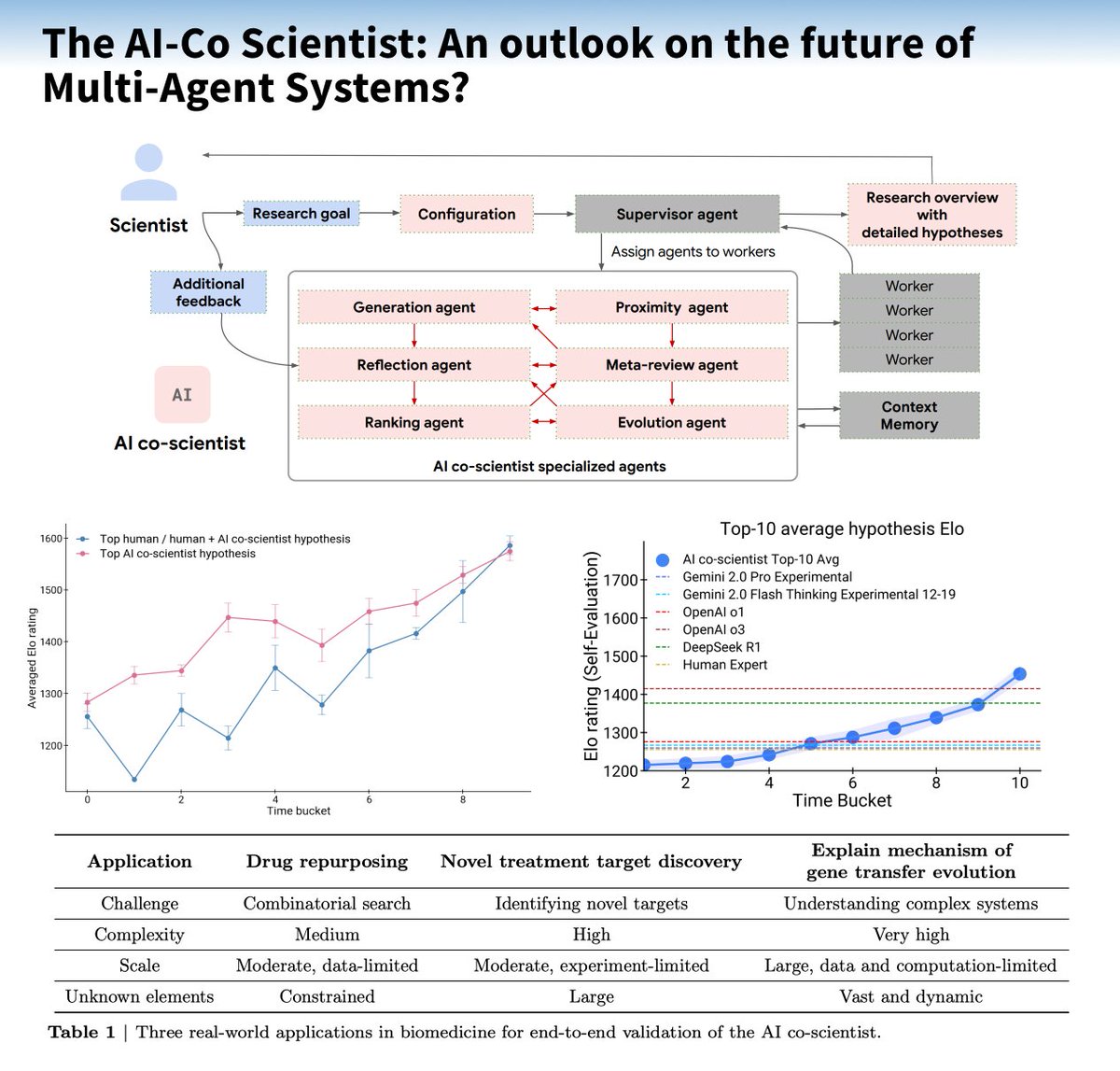
The AI-Co Scientist paper dropped! The @GoogleAI -Co Scientist is a Multi-Agent System build with @GoogleDeepMind Gemini 2.0 designed to generate scientific hypotheses through generate, debate, and evolve approach combining specialized agents and reasoning. The 80 page long paper includes prompts, example outputs and full reports generated by the AI-Co Scientist. 👀
Agents:
> Supervisor Agent: Orchestrates the research process, assigns tasks to agents, allocates resources to other agents based on the research plan.
> Generation Agent: Creates initial research hypotheses by exploring literature, simulated debates, and identifies testable assumptions.
> Reflection Agent: Reviews hypotheses (peer review), assesses correctness, quality, novelty, and potential to explain existing observations, with different review types.
> Ranking Agent: Creates pairwise comparisons of hypotheses (tournament-style), using simulated debates to create a Elo rating
> Evolution Agent: Refines best hypotheses by grounding them in literature, improving coherence/feasibility, combining ideas and exploring "out-of-the-box" thinking.
> Proximity Agent: Groups similar hypotheses to optimize exploration diversity.
> Meta-review Agent: Synthesizes insights from all reviews, identifies patterns, optimizes other agents' performance, and creates report
Implementation:
1️⃣ Scientist provides a research goal, e.g., "Find AML drug candidates".
2️⃣ Supervisor Agent parses the research goal and creates a structured research plan.
3️⃣ Generation Agent explores literature and engages in simulated debates to generate initial hypotheses.
4️⃣ Reflection Agent identifies weaknesses via 6 review types (e.g., deep verification).
5️⃣ Ranking Agent creates pairwise Elo tournaments through AI debates.
6️⃣ Evolution Agent refines the top-ranked hypotheses.
7️⃣ Meta-review Agent generates overview report and shares it with the Scientist.
8️⃣ Scientist provides feedback, adds hypotheses for the next iteration.
Insights:
🧠 Powered by Google Deepmind Gemini 2.0 models
💡 Using Thinking/Reasoning Model boosted hypothesis quality by 300+ Elo points
📈 Specialized agents, mimicking the scientific method, imporved hypothesis generation
🔄 Self-improving loop: Meta-review feedback increased hypothesis novelty scores by 27%
👥 Expert-in-the-loop design allows scientists to refine goals and provide feedback
📝 Design of the prompts are a significant factor for performance
👀 Paper includes prompts, example outputs and full reports generated
🦠 Rediscovered (in 2 days) a bacterial gene transfer mechanism (took 10 years of manual) -> not sure thats a fair comparison
First 11 chapters of RLHF Book have v0 draft done. Should be quick useful now.
Next:
* Crafting more blog content into future topics,
* DPO+ chapter,
* Meeting with publishers to get wheels turning on physical copies,
* Cleaning & cohesiveness
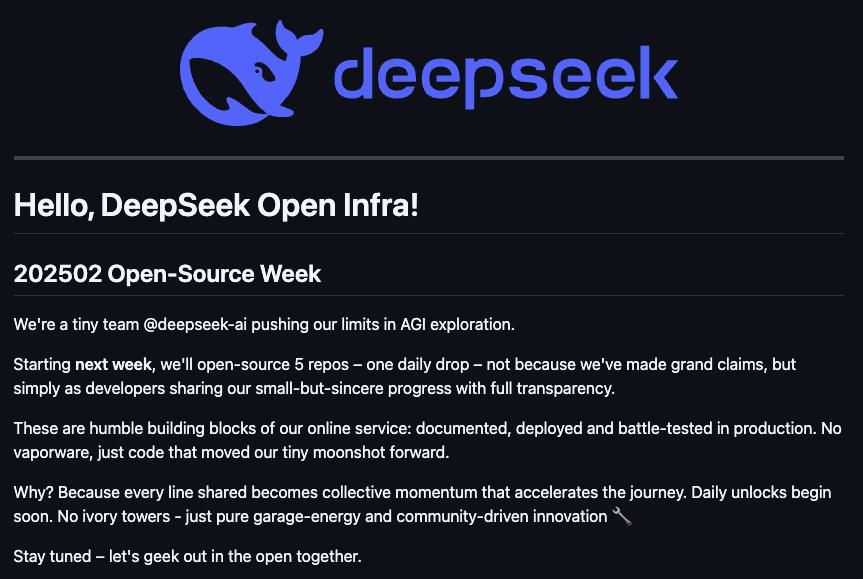
A team at @deepseek_ai plans to open-source 5 repositories next week, one per day. Focused on infrastructure and building blocks of their online services.
Distillation has been on the news (!) due to @deepseek_ai. The paper https://t.co/fRbFdfoHT1 was actually rejected from NeurIPS 2014 due to lack of novelty 🧐 (true-ish), and lack of impact 🙃.
Thanks reviewer#2 (literally), and thanks for @arxiv!
@geoffreyhinton@JeffDean
It is of paramount importance that the management of a research lab be composed of reputable scientists.
Their main jobs are to:
1. Identify, recruit, and retain brilliant and creative people.
2. Give them the environment, resources, and freedom to do their best work.
3. Identify promising research directions (often coming from the researchers themselves) and invest resources in them. Put the scientists in charge and get out of the way.
4. Be really good at detecting BS, not necessarily because scientists are dishonest, but often because they are self-deluded. It's easy to think you've invented the best thing since sliced bread. Encouraging publications and open sourcing is a way to use the research community to help distinguish good work from not-so-good work.
5. Inspire researchers to work on research projects that have ambitious goals. It's too easy and less risky to work on valuable improvements that are incremental.
6. Evaluate people in ways that don't overly focus on short-term impact and simple metrics (e.g. number of publications). Use your judgment. That's why you get paid the big bucks.
7. Insulate rogue-but-promising projects from the scrutiny of upper management. A watched pot never boils. Planned innovation and 6-months milestones never bring breakthroughs.
You can't do any of this cat herding jobs unless you are an experienced, talented, and reputable scientist with a research record that buys you at least some legitimacy in the eyes of the scientists in your organization.
Can you help our BG-Bunny find its home? 🐰 🕳️
RT and follow @bitgetglobal
Comment your answer below to stand a chance to win 500 $BGB 😍
🚨T&C apply: https://t.co/60emWptB3W
#HappyEaster#EasterGiveaway#Easter#Spring