We are excited to announce our latest edited book: AI-Driven Decision-Making in Finance. CRC Press - TaylorFrancis group (1st edition)
Bagis, B. (2026). AI-Driven Decision-Making in Finance, CRC Press - Taylor & Francis Group: Boca Raton. ISBN 9781003656463 https://t.co/Z2LyKnBw6d.
The book brings together practical and analytical perspectives, examining how artificial intelligence and digital transformation are reshaping financial decision-making, risk management and governance.
Promotional page: https://t.co/kALynVpZUd
BREAKING: US data center construction spending surged +57% YoY in July, to a record annualized rate of $75 billion.
This follows a +46% YoY increase in June and marks the largest YoY increase since mid-2025.
Since the start of 2021, US data center construction spending has soared +$66 billion, or +717%.
Since the end of 2023 alone, data center construction has risen +$51 billion.
Over the same period, all other private construction spending, including houses, shopping centers, and offices, has declined -$120 billion.
The AI investment wave is accelerating.
Bitcoin'in felsefesi ile çelişen ama büyük miktarlar için güvenliği artıran bir gelişme. Bitcoin giderek kurumsallaşırken aracısızlık iddiası da zayıflıyor. Fiyata uzun vadede pozitif yansır.
BlackRock cut the minimum bitcoin needed to swap into its spot ETF, IBIT, from $25 million to $1 million, making it far easier for whales to ditch self-custody for a regulated alternative amid rising crypto crime.
Get the full picture in Crypto Daybook Americas, CoinDesk's daily markets briefing presented by @Realfi_co.
New research from @DAcemogluMIT, @davidautor and co-authors finds that lower birth rates have not slowed economic growth over the past 70 years, and in fact have increased productivity per worker.
Read more on Substack: https://t.co/2Yt5wNccgK
⚡️Really appreciate this.
These are exactly the questions worth asking, because they force the idea past the slogan.
When we call Bitcoin “property,” we do not mean real property in the legal sense of land or real estate.
We mean a scarce, transferable claim that can be exclusively controlled and independently verified by the network. In that economic sense, Bitcoin is absolutely an asset.
And Bitcoin does not need to be “redeemed” for dollars to have value. Dollars are simply one unit people use to quote its price. Gold does not derive its value from redeemability into dollars either. If the dollar became worthless, the BTC/USD price would stop telling you anything useful. You would measure Bitcoin against goods, energy, wages, land, other currencies, or whatever monetary unit still carried information.
The internet and electricity questions are more important. If your government cuts off your internet access, your ability to use Bitcoin can be impaired. Your ownership does not disappear. Once you regain access to the network through any functioning connection, the same keys still control the same coins. If electricity disappeared globally for an extended period, Bitcoin would stop functioning, but at that point nearly every modern financial system, communications network, payment rail, and much of civilization’s infrastructure would be failing too.
Quantum computing is a legitimate long-term engineering problem, and Bitcoin will eventually have to migrate toward quantum-resistant cryptography before a machine capable of breaking current assumptions exists.
So none of these questions invalidate the thesis. They clarify what Bitcoin actually is.
Its value comes from a globally shared monetary network where scarcity, ownership, and transfer can be verified without requiring a central issuer to honor a redemption promise.
That is the breakthrough.
The first-ever measured silicon numbers for @NVIDIA Vera Rubin NVL72 showed 10x more tokens per megawatt than Blackwell.
No projections. Real results from live hardware.
The full methodology, why matched interactivity is the honest way to compare a reasoning model, and more: https://t.co/d0u9W6RixK
Data Center Finansmanında yeni bir aşama:
GPU'lar değer kaybının öngürülebilirliğinin düşük olması sebebiyle teminat olarak kullanışlı değilken Jensen bankalara bir değer kaybı sigortası sunuyor.
Data centerlar kurumsal yatırımcılar için daha kolay yatırım yapılabilir olacak.
The plant that enriched weapons-grade uranium for America's Cold War arsenal is becoming the largest AI data centre on Earth. Japan is paying for the power, the federal government still owns the land, and the chip supplier may guarantee the tenant's rent.
The scarcest input in AI is no longer chips or electricity. It is someone creditworthy enough to promise to pay for them.
OpenAI has no investment grade rating, so Nvidia is reportedly in talks to guarantee 250 billion dollars of its lease and debt. Nvidia's entire disclosed guarantee book is 3.5 billion.
If demand softens, the lease, the orders and the collateral all weaken together.
Scott Galloway just explained why China doesn’t need to build better AI than America. It only needs to make American AI worthless.
Galloway: “I think China is beginning to engage in what I’ll call AI dumping.”
Not competing. Dumping.
It’s the term economists use for flooding a foreign market with below-cost goods until the domestic industry collapses.
Galloway: “They’re going to have a series of open-weight models. About a third of corporations now are supposedly using Chinese lightweight open-weight models that are cheaper.”
Not better. Cheaper.
A third of corporations. Already.
China isn’t trying to out-innovate Silicon Valley. It’s trying to collapse the economics beneath it.
Price warfare at the infrastructure layer.
Galloway: “If I were Xi, I would just dump cheap AI into the US market.”
This playbook is old. China ran it with steel. Ran it with solar. Ran it with semiconductors.
Flood a market with a cheaper version until the domestic industry can’t sustain itself.
AI is next.
Galloway: “The moment large corporations start announcing they’re disengaging these multi-million dollar site licenses with Anthropic or OpenAI, they’re using these inexpensive Chinese models…”
One CFO after another decides the Chinese model at a fraction of the cost is good enough.
Not better. Good enough.
“Good enough” at a lower price has killed more market leaders than any superior product ever has.
Galloway: “…and the market realizes that there’s no way they can justify these incredible valuations, I think the US market crashes.”
Not because the technology failed.
Because the business model did.
American AI companies are valued on the assumption that corporations will pay premium prices for premium models.
China’s whole strategy is to make that assumption false.
Galloway: “40% of the S&P now is directly or tangentially related to this giant bet America’s making on AI.”
40% of the S&P. Tied to one sector.
Galloway: “The majority of GDP growth over the last two years has come from AI CapEx.”
The majority of GDP growth. From one source.
America didn’t diversify its future. It concentrated everything into a single bet, then left that bet undefended.
Galloway: “If that slows down, we are immediately in a recession.”
Immediately. Not gradually. Not over quarters.
The distance between AI boom and American recession is one procurement decision.
America built the most advanced AI on Earth and forgot to build an economy that survives someone selling it cheaper.
The threat to American AI was never that China would build something smarter.
It was that China would build something cheaper, and American corporations would choose the price.
China’s real weapon isn’t Chinese technology. It’s American capitalism.
The same rational self-interest that built the AI industry will dismantle it the moment a cheaper alternative appears. The market has no patriotism. Only price sensitivity.
The technology race was never the real race.
The real race was always whether America could turn its AI dominance into something that survives being undercut.
America hasn’t even started running it.
China already has.
Good morning, Asia. While you were sleeping, one of our most-read stories was about Google burning through cash for the first time since going public decades ago as it raised its spending forecast for AI infrastructure. https://t.co/mYimix2GWy
AI yarışının en büyük riski teknoloji değil, finansman tarafında. Yoğun kullanım ve ilgiye rağmen gelir tarafındaki beklentiler gerçekleşmezse bilanço dışı yükümlülükler ciddi bir risk unsuru olabilir.
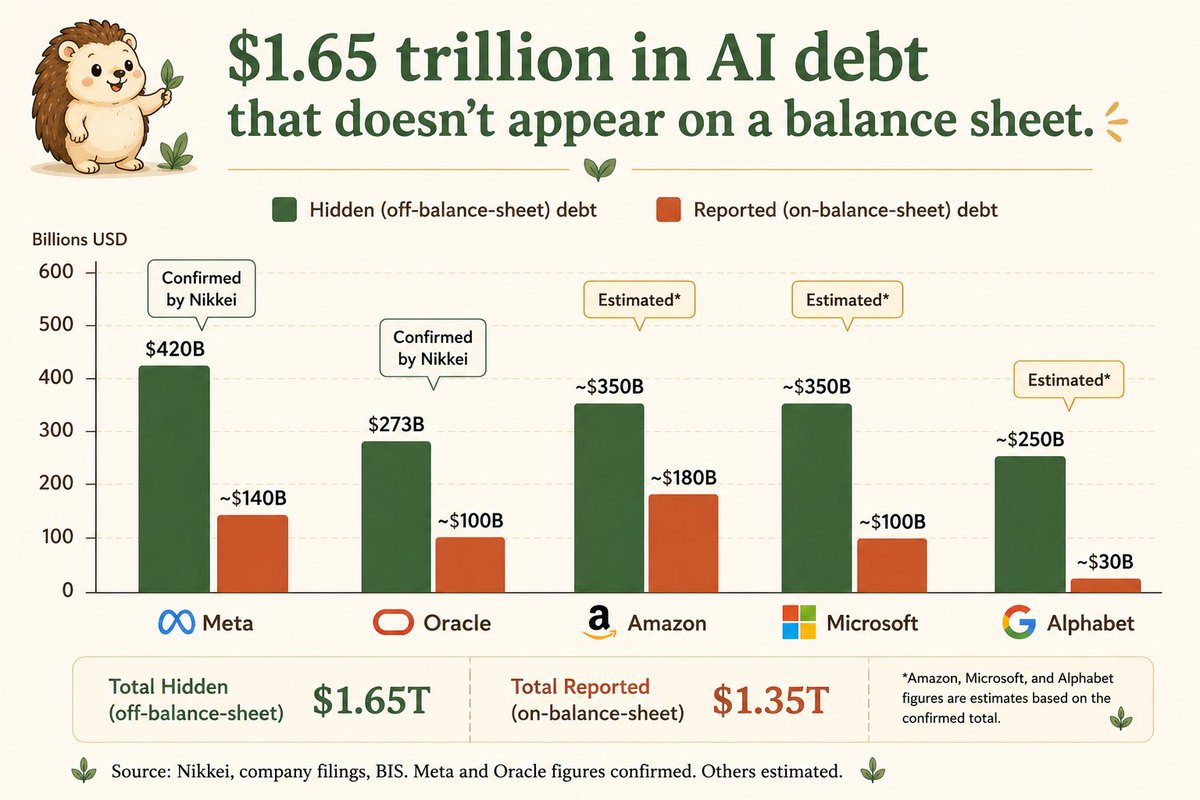
🦔A Nikkei investigation found that Alphabet, Microsoft, Amazon, Meta, and Oracle have $1.65 trillion in debt that doesn't appear on their balance sheets, more than the $1.35 trillion they officially report. These are GPU contracts, data center leases, and joint ventures that don't count as debt under accounting rules until the facilities go live. Meta's hidden debt is $420 billion, triple its reported debt. Oracle's grew 30-fold in four years. All five declined to comment.
My Take
Nikkei examined the actual filings and put a number on something the BIS already flagged as "shadow borrowing" back in March. These companies owe more off their balance sheets than on them, and the accounting rules let them keep it that way until the data centers go live. That's legal, but it means investors looking at quarterly earnings this week are seeing less than half the picture.
Four of these five report earnings in the next two weeks. The reported debt will look manageable. The $1.65 trillion in footnotes won't make the headlines. But when those data centers start operating, the leases hit the books all at once. If AI demand comes in below projections, those facilities get marked down and the losses land on the investors and insurance policyholders who funded the construction through private credit and project bonds without realizing how much total exposure they were carrying.
Hedgie🤗
126 years of market history tell a simple story...
Stocks and earnings move together with a 98% correlation.
The short run is all about noise.
The long run is all about profits.
Speculators chase noise. Investors follow profits.
The AI race between the US and China is intensifying:
Currently, 20 of the world’s 50 most used AI models come from China, according to Apollo, up 400% since 2025.
Over the same period, the number of US models in the group has fallen to 28 from 33.
Meanwhile, monthly token usage of Chinese models among the top 20 AI models surged +113% MoM, to 98 trillion tokens in June.
By comparison, US model token usage rose +43% MoM, to 53 trillion tokens last month.
As a result, token usage for Chinese models is now 85% higher than for US models, up from 24% in May.
China is challenging the US' lead in AI race.
Dear followers, please see this new paper on the labor market and macroeconomic effects of low birth rates. Although almost all analysts and policymakers are very worried about the prospect of stagnant and aging populations, the evidence from cross-country and within the United States points to the opposite: lower birth rates predict faster growth of GDP per worker and wages. The reason: labor scarcity encourages more technology adoption.
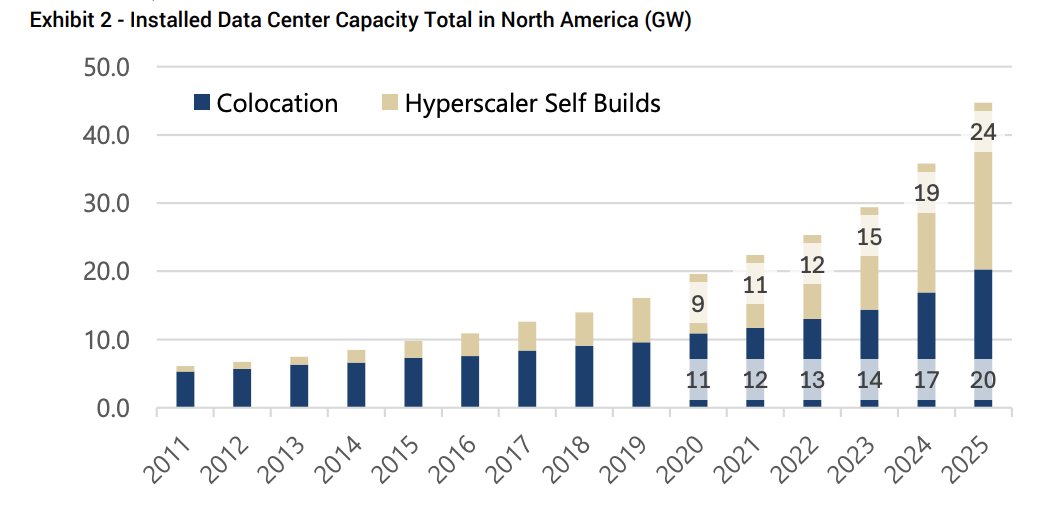
Jefferies: Data Center & Power Demand
> Massive Deficit: Demand for data centers continues to heavily outpace supply. In 2025, only 8.9 GW of capacity was lit in North America against nearly 21.1 GW of demand, resulting in a ~12 GW deficit.
> Extended Timelines: Hyperscalers traditionally commit to capacity deliverable within 12–18 months, but due to constraints, this window is expected to widen to 24+ months.
> Hyperscaler Capex Scaling: Mega-cap tech capital expenditure is on pace to reach $770B in CY26E (up 74% YoY), which is nearly 5x the $156B deployed in CY23.
> AI Chip Metrics: Bottom-up accelerator chip sales imply ~30 GW of global AI power demand in 2026E. North America accounts for 19 GW of this demand, nearly double the 10.3 GW of new capacity expected to come online.
> Surging Backlogs: The combined cloud backlog surged to $2T in 1Q26, growing three times faster than capex since 2023.
The Six Physical Supply Constraints
> EPC / Construction Labor (2026 Binding Constraint): Reaches its supply ceiling at 10.4 GW. Access to skilled craft labor and electrical trades is currently the most significant bottleneck in the ecosystem.
> Cooling Systems (2028 Binding Constraint): Reaches an 11.4 GW ceiling in 2026 and becomes the primary binding constraint from 2028 onward as chip densities demand highly complex liquid- and hybrid-cooling architectures.
> Power Availability: Set at an 11.6 GW ceiling for 2026. While technically above labor/cooling limits, the US interconnection queue faces long wait times (median 5–8 years). Behind-the-meter (BTM) solutions are increasingly emerging as workarounds.
> Electrical Equipment: Bounded at 12.4 GW. Backlogs for critical components like switchgear are expanding at 2–4x the rate of revenue delivery, with lead times reaching 52–65 weeks.
> Power Transformers: Bounded at 13.2 GW. Lead times for custom-engineered large power transformers routinely exceed 24 to 36 months.
> Power Transformers: Bounded at 13.2 GW. Lead times for custom-engineered large power transformers routinely exceed 24 to 36 months.
$GEV $VRT $TT $CARR $FPS
Morgan Stanley: Semiconductors
> Total datacenter capex across major hyperscalers is projected to reach $892.6 billion in CY26, driven by an 87% YoY growth rate (up from 62% in CY25).
> Datacenter capex as a percentage of sales is expected to jump significantly to 30.0% in CY26 and 35.7% in CY27, up from just 18.6% in CY25. Major executives have noted that capacity remains heavily constrained by compute power and electricity limitations.
> Servers: Cloud capex spending intensity will remain at historical highs, tracking at roughly 30% of revenue.
> Consumer Slowdown: Cautious outlooks dominate for personal devices in CY26. Due to demand pull-forward, rising input costs, and memory cost inflation, shipments are forecast to decline by 13% YoY for PCs and 13% YoY for Smartphones (impacting Android vendors particularly hard).
> Automotive & Consoles: Automotive semiconductor demand faces headwinds from weaker demand in China and macroeconomic issues. Meanwhile, gaming consoles like the Switch 2 and PS5 are seeing higher pricing due to memory inflation, leading to a forecast shipment decline in CY26.
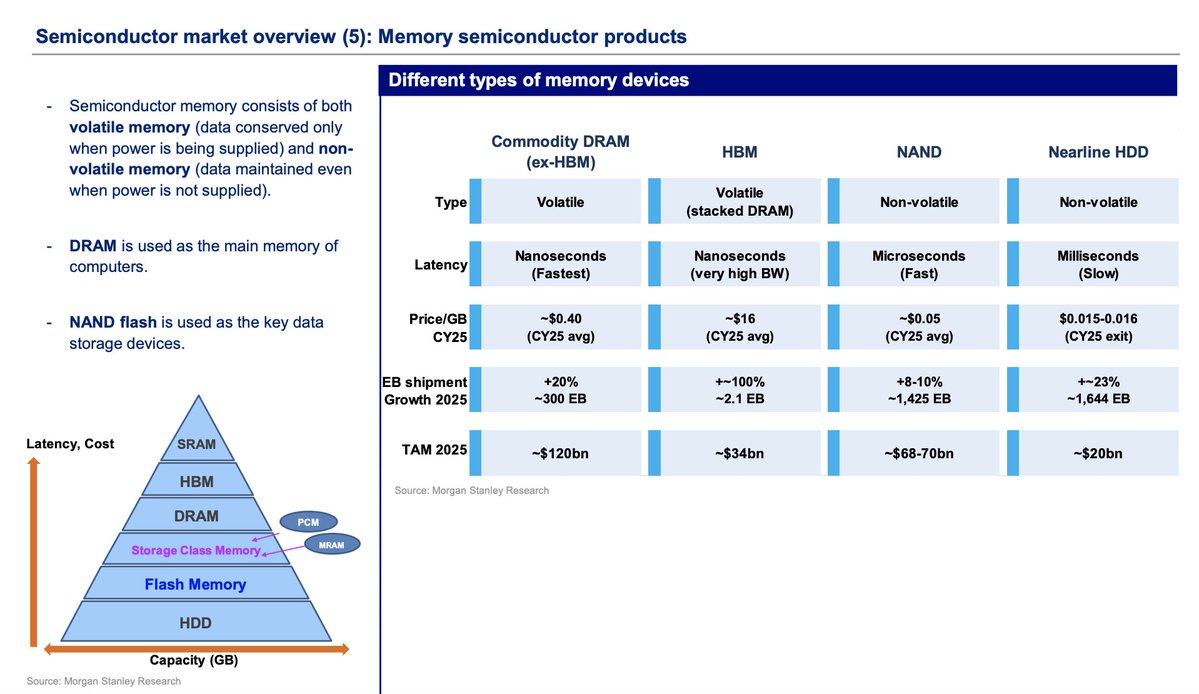
> High Bandwidth Memory (HBM) is growing at an astronomical pace with an exabyte (EB) shipment growth of ~100% expected for 2025. It commands a massive price premium at ~$16 per GB (compared to just ~$0.40/GB for standard Commodity DRAM) due to its ultra-fast, stacked-DRAM latency.
> Standard DRAM remains the largest financial market segment with a 2025 TAM of ~$120 billion, followed by NAND Flash at ~$68–70 billion.
> NAND Flash: Positioned as a non-volatile, relatively fast storage solution (microseconds latency). It holds a massive volume share with an expected 1,425 Exabytes (EB) shipped in 2025, operating on a low average cost of ~$0.05 per GB.
> Nearline HDD: Remains the slowest (milliseconds latency) but lowest-cost medium at $0.015–$0.016 per GB. It boasts the largest shipment volume in 2025 at ~1,644 EB.
> Revenue, Unit shipments, and Average Selling Prices (ASP) for the Memory sector show significantly higher volatility and more aggressive growth spikes in the 2025/2026 timeframe compared to the steadier Non-memory sector.
> Global DRAM and Flash memory sales graphs reveal a dramatic revenue surge heading into 2026, mirroring the intense demand spikes seen in previous peak cycle years (such as 2010 and 2017–2018).
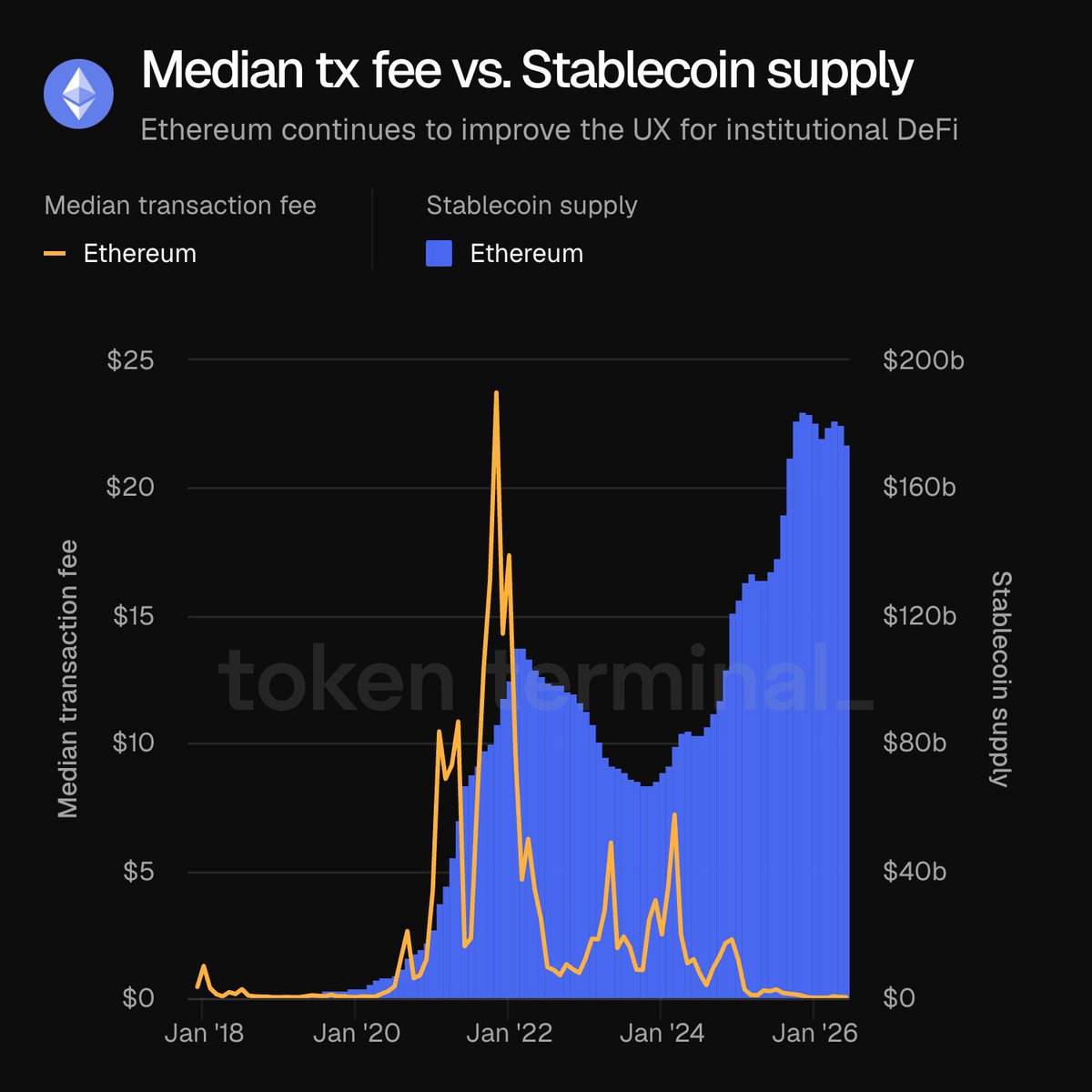
moving $1 on Ethereum costs $0.01
moving $1 million on Ethereum costs $0.01
moving $10 billion on Ethereum costs $0.01
that’s how a new financial rail like @ethereum takes market share from incumbents
JUST IN - Major U.S. banks, including JPMorgan Chase and Citigroup, plan to launch a tokenized deposit network as early as the first half of 2027, as first reported by the WSJ.
The initiative would enable tokenized deposits to move instantly and support around-the-clock settlement.
full story ⏬
NEW: CME Group has officially launched 24/7 trading for its cryptocurrency futures and options products, bringing regulated crypto derivatives closer to the always-on nature of digital asset markets.