𝐓𝐡𝐫𝐞𝐞 𝐋𝐚𝐲𝐞𝐫𝐬. 𝐎𝐧𝐞 𝐂𝐨𝐦𝐩𝐨𝐮𝐧𝐝𝐢𝐧𝐠 𝐀𝐝𝐯𝐚𝐧𝐭𝐚𝐠𝐞. 𝐓𝐡𝐞 𝐈𝐑𝐄𝐍 𝐓𝐡𝐞𝐬𝐢𝐬.
There's been a lot happening at IREN recently.
Expansion across North America, Europe and Asia-Pacific.
The NVIDIA partnership.
The Mirantis acquisition.
New GPU deployments.
New customer discussions.
A growing global footprint.
Underneath all of it is a fairly simple view of where the world is heading, and a deliberate strategy for how we position IREN within it.
That strategy is built on three layers. Together, they compound into a structural advantage that gets harder to replicate every quarter we execute.
Layer 1: Physical infrastructure. Power, land, substations, data centers, cooling. The foundation that everything else sits on.
Layer 2: Compute infrastructure. The GPUs, servers and networking that go inside those buildings. Deployed at scale. Generating revenue. Building execution track record.
Layer 3: Software and operational capability. The orchestration, deployment tooling and enterprise expertise that makes the first two layers work harder for customers, and opens the door to a broader, higher-value market over time.
Layers 1 and 2 are where the overwhelming majority of IREN's value is being created today. Layer 3 is where that advantage compounds further over time, but only because Layers 1 and 2 are built, owned and controlled at scale by IREN, not subscale nor contracted from a third party.
Think of Amazon. They didn't win e-commerce by building a great website. They won it by controlling the fulfilment infrastructure at a scale nobody else could replicate. The foundation you don't control becomes the ceiling on your business.
That is exactly how we think about IREN. The physical infrastructure - the land, the power, the substations, the data centers - is owned and controlled by us. The compute deployed into it generates the revenue and execution track record. And the software, orchestration and enterprise capability we are more methodically building on top is what turns the total product into a vertically integrated AI Cloud platform that compounds over time and deepens into a competitive moat.
AI is still early. The bottleneck is increasingly physical. And we have spent eight years building the foundations.
If you are on X instead of TikTok
Investing instead of spending
Eating healthy instead of eating like a pig
Reading instead of watching
Trying instead of making excuses
Driven instead of settling
You are already in the Top 1%
There is a reason why planes have 2 pilots and 200 passengers
🧵 The $EOSE Thesis: Why New York is the Proving Ground 🗽🔋
1/ Many see a list of New York energy projects. I see a structural shift in how the grid is built. The "Lithium-only" era is ending, and $EOSE is the primary benefactor. ⬇️
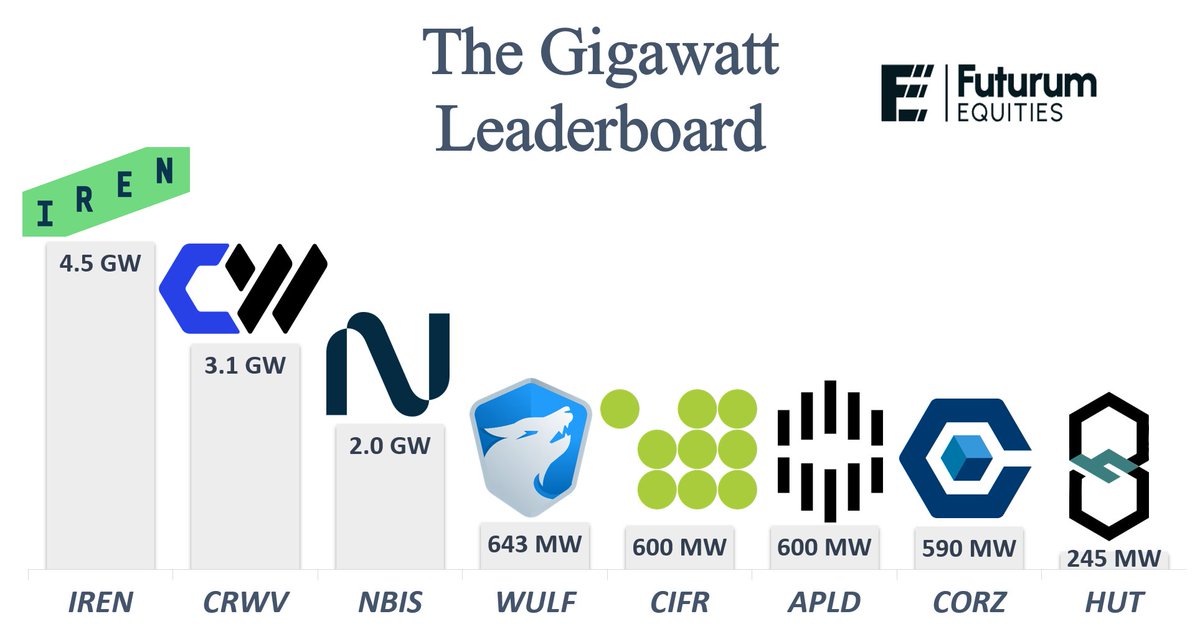
These companies are locking in the physical substrate behind the next decade of AI compute and that substrate is power.
You can order GPUs from $NVDA or $AMD or TPUs from $GOOGL but you can’t just order gigawatts so now the question becomes who can actually deliver it.
Contracted power:
• $IREN ~4.5GW
• $CRWV ~3.1GW
• $NBIS ~2.0GW
• $WULF ~643MW
• $CIFR ~600MW
• $APLD ~600MW
• $CORZ ~590MW
• $HUT ~245MW
@Will_Powerman@bluedoor626@SpearfishingCap Are you joking? No one will pay more for fire safety? Do you hear yourself? The insurance liability shrinks, the chance of massive outages due to fire damage? safety sells
@bluedoor626@Will_Powerman@SpearfishingCap Me too, the sky is the limit. Safety is first and foremost and it will be hard to justify using a less efficient flammable option over a more efficient non flammable option. TAM is MASSIVE.
@Will_Powerman Big ideas are hard to settle in small posts. Let’s stream on YouTube next week and chat?
I am enjoying the discourse and am interested in talking more about this. I’m learning more and honestly, you’ve deepened my conviction.
@Will_Powerman It’s great, period. The non-flammable point is just icing on the cake.
I guess the Department of Energy didn’t k ow anything when they gave them $300m loan to build or even further when they extended the repayment to start next year. I guess you, Will, know more than the DOE.🤣
@Will_Powerman $EOSE If there's no interface at the Navy Yard, call ConEd and ask about NYISO Queue #0522. It’s a 300 MW facility slated to connect to the Hudson Ave 138kV substation to stabilize the NYC grid (Zone J).
The FDNY/UL 9540A Edge: You’re checking yesterday's list.
@Will_Powerman Also, the department of energy and the 305 million dollar loan can serve as further due diligence, you think they are issuing that for a project that cannot get a … permit?
@Will_Powerman Lithium batteries on that list require extreme mitigation because they fail thermal runaway tests. Eos passed UL 9540A with zero flames. Being inherently non-flammable means they don't just meet the FDNY's rules—they're the reason the rules are being rewritten for urban storage.
@Will_Powerman Compared to Tesla who has full approval.
$EOSE can do 1GW per acre of storage and has an inability to catch fire.
$TSLA can do 248MW per acre (that’s 400% less) and is completely and undeniably flammable. They passed FDNY because they don’t spread fire, they still catch fire.
@Will_Powerman Also, $EOSE is already the designated supplier for the NYC energy battery storage project in the Brooklyn Navy yard. They have backing at the state level, and obviously the federal level. The only way I see you being bearish is if you’re bullish the competition.
@Will_Powerman $EOSE Eos has already received full UL 9540A certification which is what is needed for future FDNY approval. In their tests, they even performed a "nail penetration" test. This resulted in a 25°C temp rise, no flame, and no explosion.