State regulators voted 4-1 Tuesday to raise TEP's rates, and to let TEP adjust its rates every year from now on instead of waiting years between rate cases.
Commissioner Lea Márquez Peterson cast the only no vote. 👇
The board meets Dec. 1 on transportation savings and more questions, then votes Dec. 8 at Palo Verde High School. Three no votes would be a majority.
Full report: https://t.co/OBSaBGm5iK
Two of TUSD's five board members said Tuesday they'd vote no on the plan to close seven schools, after parents, teachers and students spent hours asking them to stop. A third said the Collier piece won't work. The vote is Dec. 8.
From the podium: in a Collier PTA survey, all 18 responding families with kids there now said they'd leave TUSD if it closed. Cragin and Hudlow parents said both schools rose from a D to a B. The teachers union said it "cannot support" the plan as presented.
@TalesTucson@AndyfromTucson It’s like the George W Bush meme: “Sir, another Costco has been reported.” 🤣
But yes: this is another store, separate from the OV one.
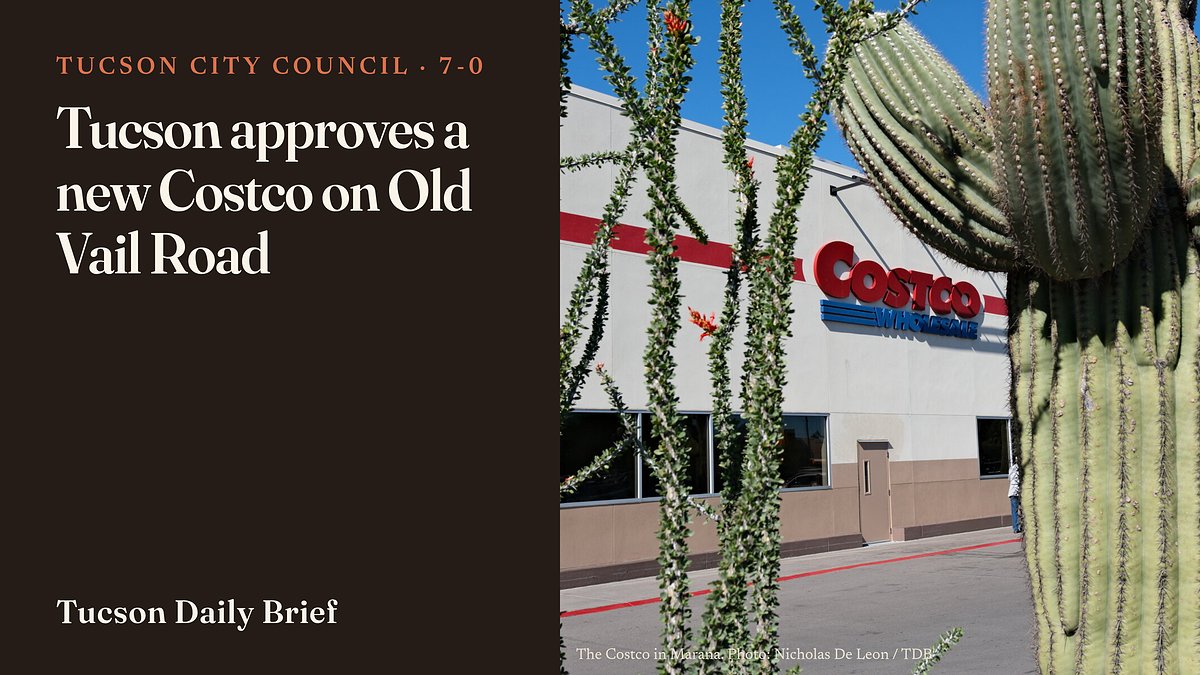
Tucson approves a new Costco on the southeast side.
The City Council voted 7-0 Tuesday for a store at 9688 E. Old Vail Road, about 3,000 feet west of Houghton Road. 👇
🚨 BREAKING: FOUNTAIN HILLS VOTES 5–2 TO BAN AUTOMATED LICENSE PLATE READERS
FOUNTAIN HILLS, AZ — In a major move for privacy rights, the Fountain Hills Town Council voted 5–2 to approve Ordinance 26-17, prohibiting automated license plate readers (ALPRs) on town-owned property and within public rights-of-way.
A source familiar with the ordinance tells me this is one of the strictest ALPR bans in the country.
The ordinance makes a striking declaration about government surveillance:
“WHEREAS, the Mayor and Council find and determine that the placement of such systems on Town property or in the public right-of-way converts Town infrastructure into a persistent, location-logged vehicle-tracking network without a warrant, individualized suspicion, or the knowledge of the persons whose movements are recorded”
The ordinance also raises serious concerns about the sharing of vehicle-tracking data with third parties and other jurisdictions.
What makes this significant? Fountain Hills does not currently operate or host an ALPR system. Rather than waiting until surveillance cameras are installed, the council has moved to establish restrictions before the technology arrives.
The measure prohibits ALPR systems and comparable vehicle-identification devices on town property and in public rights-of-way, while preserving the use of security cameras located entirely on private property.
The proposal was requested by Vice Mayor Earle, with support from Councilmembers Larrabee and Skillicorn.
This isn’t just about license plates. It’s about whether government infrastructure should be used to track people’s movements without individualized suspicion.
The vote could put Fountain Hills at the center of a much larger national debate over surveillance, privacy, and government accountability.
➡️ The larger question: Who gets to authorize surveillance of the public — elected representatives or agencies and vendors operating without explicit council approval?
Fountain Hills has now taken a significant step toward establishing that boundary.
@allenskillicorn@ShawnLD8@LPMaricopa@JerodMacEvoy@juliecbarrett
State regulators voted 4-1 Tuesday to raise TEP's rates, and to let TEP adjust its rates every year from now on instead of waiting years between rate cases.
Commissioner Lea Márquez Peterson cast the only no vote. 👇
Two of the four yes votes are leaving. Myers lost the GOP primary in July; Thompson lost Nov. 3, when Democrats Clara Pratte and Jonathon Hill won both seats.
They take office next year.
There’s no better place to train the next generation of astronauts, engineers, and innovators than Arizona! Yesterday, we submitted our application to @NASA to host the U.S. Space Academy.
Learn more about it here: https://t.co/WKgBIqwhgq