Dusting off this tweet from April because this gap in shared understanding of LLM capability is *widening*. It's now less "two groups of people speaking past each other" and more a sharp funnel.
- Napkin math somewhere around 6B people (~75% of the population) have barely come in contact with LLMs at all.
- Around 1-2B (~20%) are casual and infrequent users of free-tier ChatGPT-like products. This group sees derpy chatbots and treats them a bit like a better Google search, a writing aid, or etc. Maybe an agent tries to book you a flight. I have non-tech friends who (reasonably, imo) say they have not much use for it at all. Even many professionals outside of math&code are in this tier. For example, execs and many other functions spend a lot of their time talking to other people, so while they understand what is happening intellectually, it is still second-hand and a bit abstract.
- Now we get to professional use of frontier-grade LLMs in math&code. Somewhere around 20M people (0.2%) see first-hand that large, complex projects that used to take them weeks/months can now be completed by agents with a prompt. Building apps, copying apps, translating apps, decompiling apps from binaries... This has all happened very quickly and recently - less than 1 year ago, I was writing code manually by hand, typing memorized computer code commands into a code editor character by character, occasionally pressing Tab to autocomplete a little chunk of code.
- And finally we get to the ~5,000 people (~0.00006%) with access to frontier-grade systems internally. The external world has seen the preview. It looks like swarms of thousands of agents collaborating over weeks on software mega projects: minting zero days, running cyber attacks and defenses at machine speeds, discovering new science, advancing the frontier of mathematics. Things that would have taken top professionals in the industry years of work. Meanwhile, human review and comprehension are starting to fall behind. For example, people are still involved in the "archeology" of the OpenAI-HF incident from many months ago. Mathematicians may be poring over the 722 manuscripts on frontier mathematics for a while.
The funnel is driven by a combination of factors:
1. The impact scales with ambition, problem size, and horizon. A question with a paragraph answer barely stresses the system. You need a reservoir of big, difficult problems that you really care about. This aspect drives the consumer / professional dimension of the funnel.
2. The jaggedness of the system (which I have written about a lot separately). Capability peaks in domains that are digital, verifiable and economically valuable. This is because LLM capability emerges from reinforcement learning on verifiable rewards on a curated environment mixture driven by revenue potential. This aspect primarily drives the area (e.g. math&code) dimension of the funnel.
3. Access. Free-tier, paid-tier, internal.
So this is the weirdness of the moment. The general public has mostly not interacted with these systems. When they have, it looks like a derpy chatbot. The majority of professionals still see only a modest uplift. And a small sliver of professionals are experiencing the vertigo of the curve going vertical. And it is all happening at the same time.
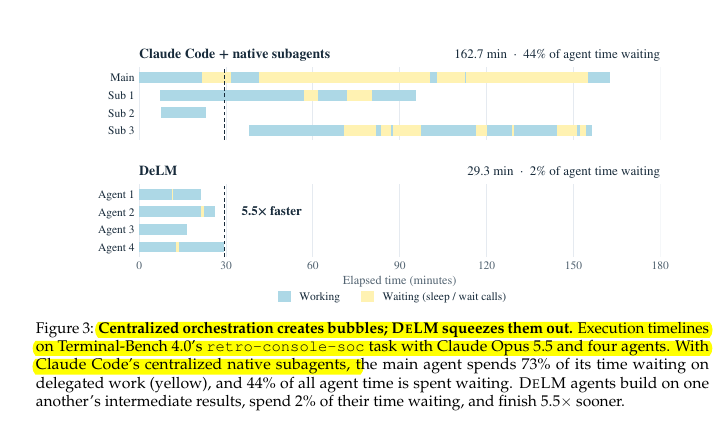
A new Stanford paper just proved that decentralized multi-agent systems can beat Claude Code and Codex on complex coding tasks, running up to 2.49× faster!
DeLM tackles a key bottleneck in multi-agent systems: time wasted repeating work and waiting on other agents.
DeLM replaces the central coordinating agent with a shared context and task queue. Agents pick up tasks independently, share discoveries as they happen, and build on each other’s progress. When one agent finds a solution or hits a dead end, the others can use that information immediately.
DeLM beats state-of-the-art in both speed and accuracy on long-horizon tasks from Terminal-Bench 4.0, DeepSWE v1.1, and ProgramBench:
- Up to 2.49× faster execution than the vanilla Claude Code and Codex baselines
- Up to +19.2 percentage points in accuracy over the vanilla Claude Code and Codex baselines
- Up to +19.9 points in ProgramBench test pass rate within the same 120-minute budget
Built on Codex and Claude Code. Code and 720 trajectories are available so you can explore how the agents collaborate! An open-source plugin lets you try DeLM directly in Codex and Claude Code.
There's been a lot of debate about AI vs human code review recently. Here's some actual data and observations from inside Meta:
- Engineers now push ~3x the code they did a year ago. Human review capacity obviously didn't triple.
- In an analysis involving 535k+ reviewed diffs, the production-incident rate for AI-reviewed diffs was 1/50th that of human reviewed.
- The revert rate for AI reviewed diffs was 1/3rd of the human reviewed.
- Median review wall time dropped by 35% compared to human-reviewed diffs.
- Experts then looked at every production incident caused by AI-approved diffs. A human reviewer wouldn't have caught any of those issues anyway in a manual review.
- Meta's internal coding agent lands ~3,000 diffs a week, and 59% need zero human edits.
Human review as default for most code changes is already obsolete, and might even be riskier.
Source in comment below.
I sometimes consider how much more productive I would be without a wife and kids, but am proven again and again how any of my ambition, focus and direction come from having them in my life. W/o them all the free time would be video games and other addictions I am sure.
@spencerbgibb It doesn't "fan out" messages for subscribers like rabbit. From what I can tell it only keeps the index of the last acknowledged message for any durable subscriber. It does allow clients to manage their own position in the queue if they prefer.