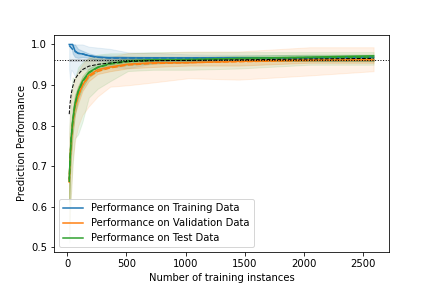
@FrankRHutter Cool! I was looking forward to reading this since my visit to Freiburg! I am particular fascinated by the generative abilities... In March I will give a lecture about PFNs and this will be included for sure :).
I'm hiring for a fully funded #PhD position in #ComputerVision on 'Detailed Video Understanding' at @LIACS@UniLeiden.
Apply before 22nd June. More info👇
https://t.co/QafgWY9co5
The deadline for @NeurIPSConf 2024 has passed, but it doesn't mean we don't work hard to have another fantastic conference! Right now, we are in need for REVIEWERS. If you know someone suitable for this role, please fill in this form: https://t.co/oJlZNo6f48
🚀 We're looking for a PhD student to join our team at @tudelft!
Deadline for applications is January 5.
Please share, and feel free to contact me if you have any questions.
Every StatML intro class covers complexity-error U-curves, so @Jeffaresalan & I asked ourselves whether the info from these classes is enough to explain double descent too? Our #NeurIPS23 paper does a roundtrip of The Elements of Statistical Learning and answers “Yes”! Long🧵1/n
@Burevestnik0829 Hi! If you are from TU Delft I have BSc or MSc projects. If you are from abroad but Europe, we can look at Erasmus. Other options also possible. DM me for more info :)
I will soon open up a PhD position for deep learning on learning curves. See here:
https://t.co/mqGdiWv7S0
Challenge: Developing deep meta-learning algorithms to model and understand learning curve patterns in machine learning.
Impact: Faster, better, more cost-efficient ML.
And one more new MOOC, by Hongrui Wang, Amira lnouty, Luca laurenti, Wendelin Bohmer and @TViering. Covers AI concepts of clustering, dimensionality reduction, and introduces you to reinforcement and deep learning. Starts May 16th, so enroll now! https://t.co/So21XxG6UU
New MOOC by @TViering and Hanne Kekkonen: learn the basics of (supervised) machine learning, e.g. various classification and regression machine learning algorithms to solve real-life problems with scikit-learn in Python. Starts May 16th, so enroll now!
https://t.co/ygfzZqfgnM
@cwolferesearch Exactly in line with Halevy, A., Norvig, P., & Pereira, F. (2009). The unreasonable effectiveness of data. IEEE intelligent systems, 24(2), 8-12.
📢 #PhDposition! I have a vacancy @tudelft dealing with generating digital humans in social contexts. If you're interested in working at the intersection of multimodal ML, social cognition, and CV/graphics, this may be for you!
https://t.co/4l611VPNZs
#GenerativeAI#vacancy
@rjbruin @CVPR I think it makes sense. The discussion should start at the beginning of the discussion period, not beforehand. This ensures all reviewers can take part in the discussion equally.
@rjbruin @DrGroftehauge I think it may only be possible if your network is regularised (l2,l1, dropout) otherwise it cannot be the case due to a symmetry argument.
We love learning curves! This is why we created #LCDB (https://t.co/Fh9TqgTppO), a database with API to LCs of 20 sklearn classifiers for 219 datasets, including pred. vectors for train/val/test folds. Check out @TViering's talk on the associated paper this Thursday at @ECMLPKDD.