Patient activity in the hospital gets scattered across shifts, notes, and handoffs. Our recent work, TRACER, pulls it back together: a training-free harness that lets LLMs/VLMs track activity from bedside video + EHR. Harness and synthetic data are open. Led by @DuranteZane 👇
1/ Can AI help doctors make more informed decisions based on patient activity and behavior over the course of a hospital stay?
Today we introduce TRACER: a training-free multimodal harness that enables LLMs and VLMs to track patient activity using bedside video and health records.
Blogpost: https://t.co/f7Wy0tn3df
Paper: https://t.co/5qeoDjwM7y
Do text-to-image models need language pretraining? We trained Halcyon from scratch on 100M image–text pairs with no LLM at all, and it beats LlamaGen & JiT-T2I using 18–275× less compute. Open weights, 0.1–4B, in recent work led by @keshigeyan; @__yuezhao__@jcniebles@drfeifei.
Excited to share Halcyon, our latest research on multimodal pretraining!
Building strong text-to-image generative models is simpler than we think!
Blog: https://t.co/HOrwIJIHTf
Models: https://t.co/xBPJkEAOPU
Paper: https://t.co/8kROIz1c7L
Maybe I'm dense, but it only just occurred to me that this "AI revolution" is the only pure-software technology jump that I can think of.
Wheels, steam engine, cars, electricity, cinema and TV, computers, the internet, mobile phones, etc. were all enabled by new hardware.
It is so funny how the tech industry spent 20 years building tests to prove you're not a bot. Now we're building AI agents to pass them for us to reserve a table online.
We're now engineering the exact thing we spent years engineering against. Same tech, opposite team.
LLMs have tokens. Images have patches. What should the brain have? 🤔
HBAR, our hierarchical tokenizer for fMRI, was just accepted to NeurIPS 2026! 🎉
It compresses fMRI ~415× while preserving structure from voxels → parcels → functional networks.
Today we announce 💰exciting prizes💰 for winners at the QuantiPhy Challenge @NeurIPSConf 2026.
Register your team before 9th Oct. and submit csv files before 23rd Oct. to join the NeurIPS competition and win the prize!!!
See more at: https://t.co/uoswGNz80n
Code for GenFusion: Feed-forward Human Performance Capture via Progressive Canonical Space Updates (ICLR 2026) is now public.
Like watching a dancer spin, it fuses each frame into a canonical space and renders novel views from what was actually seen.
https://t.co/YyaqX1HH54
Code, checkpoints, and full 4D-Dress test results are out for comparison.
Paper: https://t.co/2Sd7K6zgYB
Project: https://t.co/dFgWYYYWFL
Images: https://t.co/m5VaG89Yko
Videos: https://t.co/Amx8423ivU
w/ Yao He, Heejung Choi, @gengchen01 , Zhengmao Liu,@jiajunwu_cs , @eadeli
@karanps That's similar to how humans learn; we don't just get bigger brains; we tackle progressively harder problems as our capabilities grow. A synchronized evolution between model architecture and training curriculum is likely to become a way for FM training or agent systems.
2/2
One of the biggest shifts we're seeing in AI is moving beyond scaling data or scaling models in isolation toward co-evolving both together. @karanps's ICML2026 paper is a great example of that thinking: as a model matures, its learning environment should mature with it.
1/2
Published at ICML 2026, with the final version and code now available!
Curriculum-Guided Layer Scaling for Language Model Pretraining
📄 Paper: https://t.co/KaqXQVuUQL
💻 Code: https://t.co/Jm7ATJD4Gr
With Neil Band (@neilbband) and Ehsan Adeli (@eadeli)
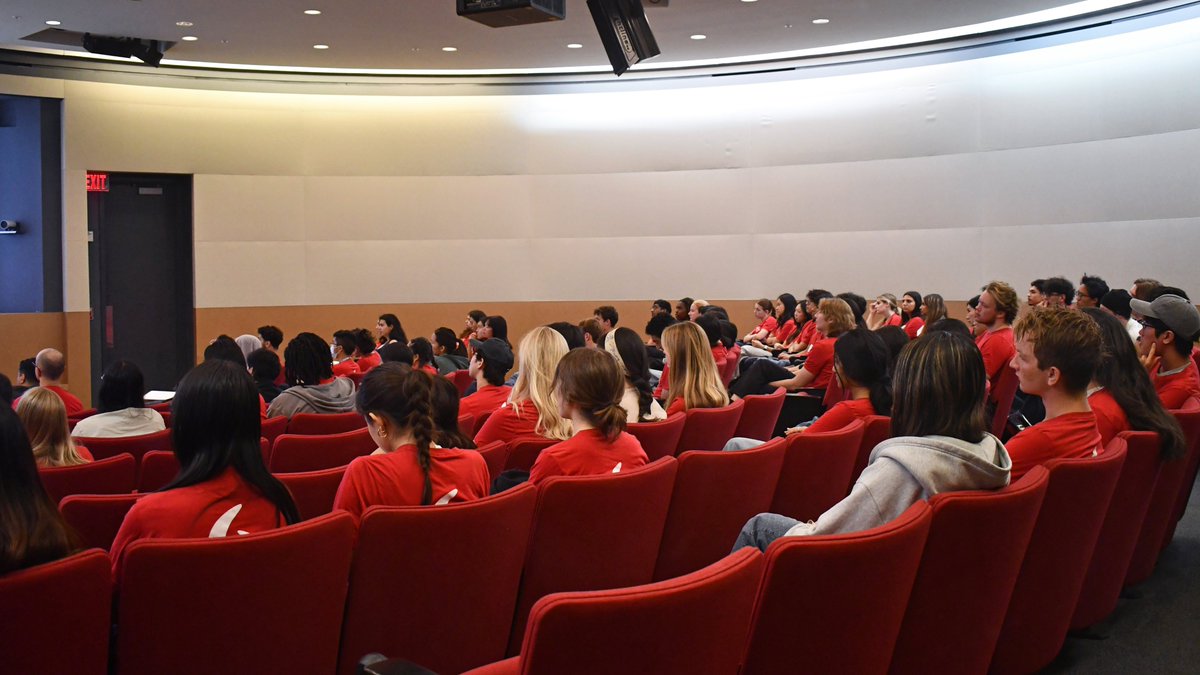
Week 6 of the Stanford Sapp Family CS Bio-X Undergraduate Summer Research Program included 3 more amazing faculty presentations! The cohort enjoyed this week's talks from Dr. Annelise Barron ( @annelise_b ), Dr. Martha Cyert ( @CyertMartha ) , and Dr. Ehsan Adeli ( @eadeli )!
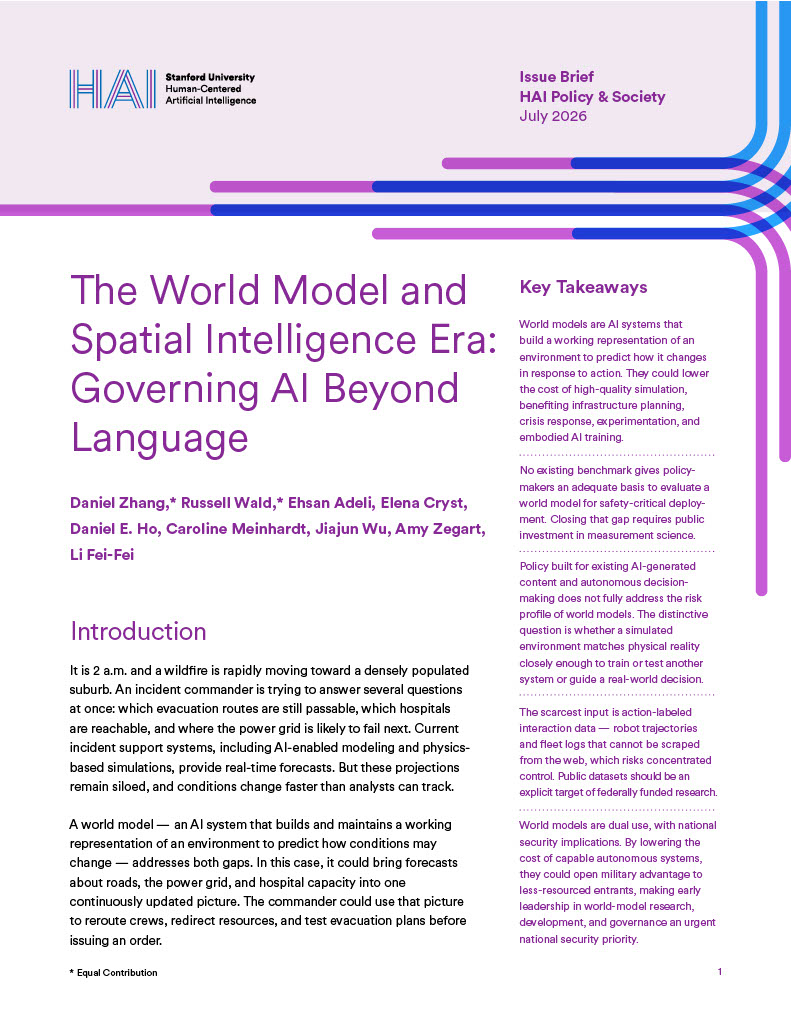
📢 New issue brief: World models will reshape how AI interacts with the physical world. Our latest brief examines their emergence, opportunities, risks, and national security implications, and proposes a governance framework to guide policy conversations as the technology matures. https://t.co/vVgpjSHwHb
🧠 Speaker Spotlight: Ehsan Adeli @eadeli
AI in medicine is moving beyond research papers and prototypes.
Ehsan Adeli is building translational AI systems that can move from the lab into real clinical care — combining medical AI, computer vision, ambient intelligence, and mental health research.
🔹 Director, STAI — Stanford Translational AI in Medicine & Mental Health @StanfordAILab
🔹 Co-Director, Stanford AI for Mental Health Initiative
🔹 Works across computer vision, ambient intelligence & computational neuroscience
🔹 Focused on real-world applications in aging, neurodegeneration, mental health & clinical care
As AI becomes part of healthcare, the question is not just what models can predict — it’s how they can support clinicians, patients, and care systems in the real world.
Hear Ehsan on stage at AGI Summit SF 2026.
📅 July 18–19, 2026
📍 Palace of Fine Arts, San Francisco
🎟 Tickets: https://t.co/Qdd1D2ahpA
🏷️ 15% off automatically applied through the link
#AGISummit #MedicalAI #HealthcareAI #MentalHealthAI #sanfrancisco
Turns out it's possible to generate videos that maximally excite an arbitrary brain region using a simple search-based algorithm. It's a fully computational approach, so it's another way to speculate what a brain region represents, alongside other neuroscientific methods.
Select an arbitrary brain region->algorithmically generate a video that jacks it up. See the visuals on the webpage https://t.co/UzKyN8MHda
In silico (for now)