Call for Papers : MoCha @ ECCV 2026
Human Motion Challenges in Real-World and Clinical Settings
Two tracks:
- Proceedings track : deadline July 1
- Non-proceedings track : deadline July 23
Details: https://t.co/kq89TD8rax
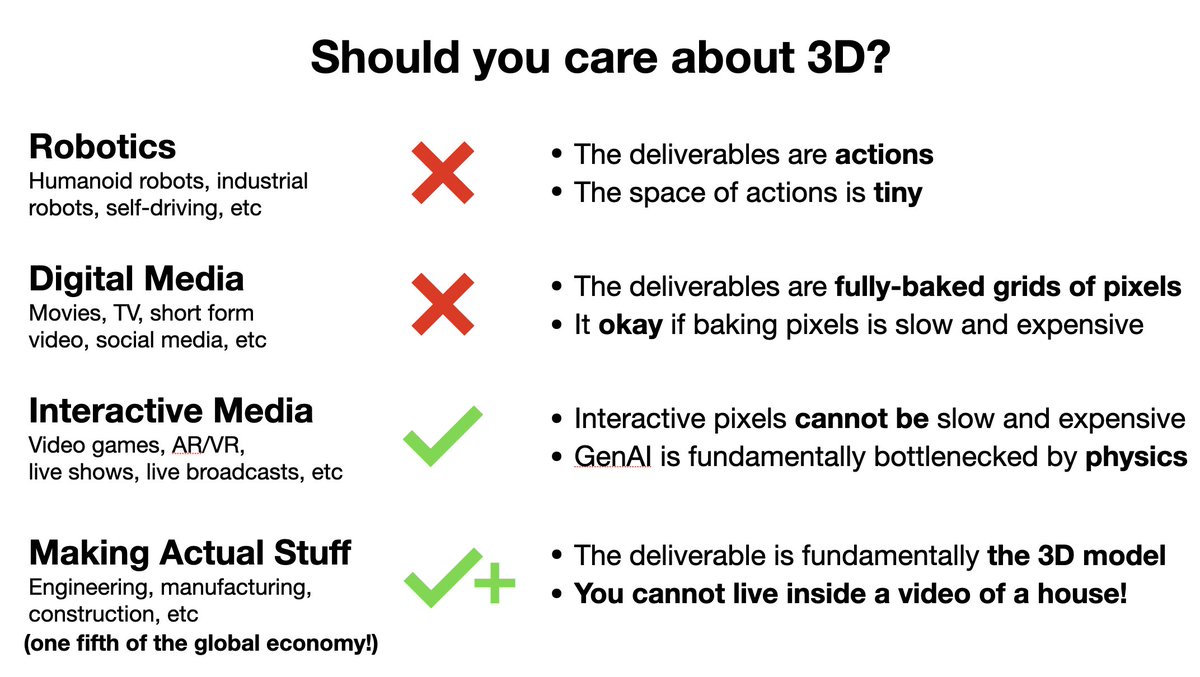
I'll be giving a "exactly how bitter lesson'ed is all of 3D computer vision?" talk at the Bitter Lessons CVPR workshop tomorrow at 10:30am, Room 3A-3D. Here's a slide with the overall thesis.
Paper and challenge submissions are now open for MoCHa @ ECCV 2026, our workshop on Human Motion Challenges in Real-World and Clinical Settings!
Challenge: https://t.co/0zEaogl5mR
Workshop: https://t.co/TsphgKcWMR
Cash prizes + best paper award sponsored by @MachineMedicine.
Call for Papers! #ECCV2026 Workshop and Challenge on Human Motion Challenges in Real-World and Clinical Settings.
🌐Website: https://t.co/TsphgKcWMR
best paper award and cash prizes for top 2 challenge teams generously sponsored by @MachineMedicine
There are 2 weeks left to submit your method to the NeRSemble 3D Head Avatar benchmark! Deadline May 26th.
🏆The winners of the workshop challenges get a GPU prize and an oral presentation slot at our @CVPR workshop.
👉https://t.co/5jCMaf3iMu
#CVPRWorkshop#CVPR2026
The training code for InfiniDepth is now open-source.
Feel free to use our framework to train a monocular depth estimation model as well as a depth sensor augmentation model on your own data.
https://t.co/cYgjkFckdh
[SIGGRAPH '25] Echoes of the Coliseum: Towards 3D Live streaming of Sports Events
TL;DR: "..., an end-to-end streaming framework, which takes multi-view video streams of sports events as input and reconstructs the dynamic 3D scene to allow viewers to watch from any novel view with interactive frame rates."
Tip: Watch the YouTube Video linked below and visit the project!
Contributions:
1. A multi-view dynamic dataset of sports events featuring complex human motions and comprehensive ground-truth annotations.
2. A 4D reconstruction challenge designed to establish a new benchmark for 4D reconstruction, addressing limitations in current datasets like N3DV and Google Immersive, which have limited camera counts and lack true 360° coverage.
3. A scalable method (LiveSplats) that enables interactive framerate 4D scene reconstruction by simplifying the task to an implementation problem.
4. This work is the first in a planned series, with future expansions to include broader event coverage, increased scene complexity, and improved algorithms to make immersive, live sports viewing feasible.
High-resolution image and video generation is hitting a wall because attention in DiTs scales quadratically with token count. But does every pixel need to be in full resolution?
Introducing Foveated Diffusion: a new approach for efficient diffusion-based generation that allocates compute where it matters most.
1/7🧵
RetimeGS Continuous-Time Reconstruction of 4D Gaussian Splatting
TL;DR: A new 4D Gaussian Splatting representation designed to render at arbitrary timesteps, even when the input contains relatively large inter-frame motion.
Abstract (excerpt):
Most existing 4D Gaussian Splatting (4DGS) methods overfit at discrete frame indices but struggle to represent continuous-time frames, leading to ghosting artifacts when interpolating between timestamps.
We identify this limitation as a form of temporal aliasing and propose RetimeGS, a simple yet effective 4DGS representation that explicitly defines the temporal behavior of the 3D Gaussian and mitigates temporal aliasing.
To achieve smooth and consistent interpolation, we incorporate optical flow-guided initialization and supervision, triple-rendering supervision, and other targeted strategies.
Together, these components enable ghost-free, temporally coherent rendering even under large motions.
Call for Papers : PhysHuman @ CVPR 2026
PhysHuman is a workshop dedicated to physically grounded human perception and modeling.
📄 Full papers (8p, archival)
📄 Short papers (4p, non-archival)
⏳ Submission deadline: March 13, 2026 (23:59 AoE)
🔗https://t.co/RNfJ94feLv
VRGaussianAvatar: Integrating 3D Gaussian Avatars into VR
TL;DR: VRGaussianAvatar is an integrated system that enables real-time full-body 3DGS avatars in virtual reality using only HMD tracking signals.
Contributions:
• VRGaussianAvatar: an integrated VR streaming system for stereoscopic rendering of a 3DGS full-body avatar driven by HMD-only tracking.
• Binocular Batching: an efficient stereoscopic rendering strategy that jointly renders the left and right eye views in a single batched pass for 3DGS avatars in VR.
• A quantitative evaluation and perceptual user study showing improved perceived appearance similarity, embodiment, and plausibility over mesh-based avatar baselines under the same HMD-only control setting.
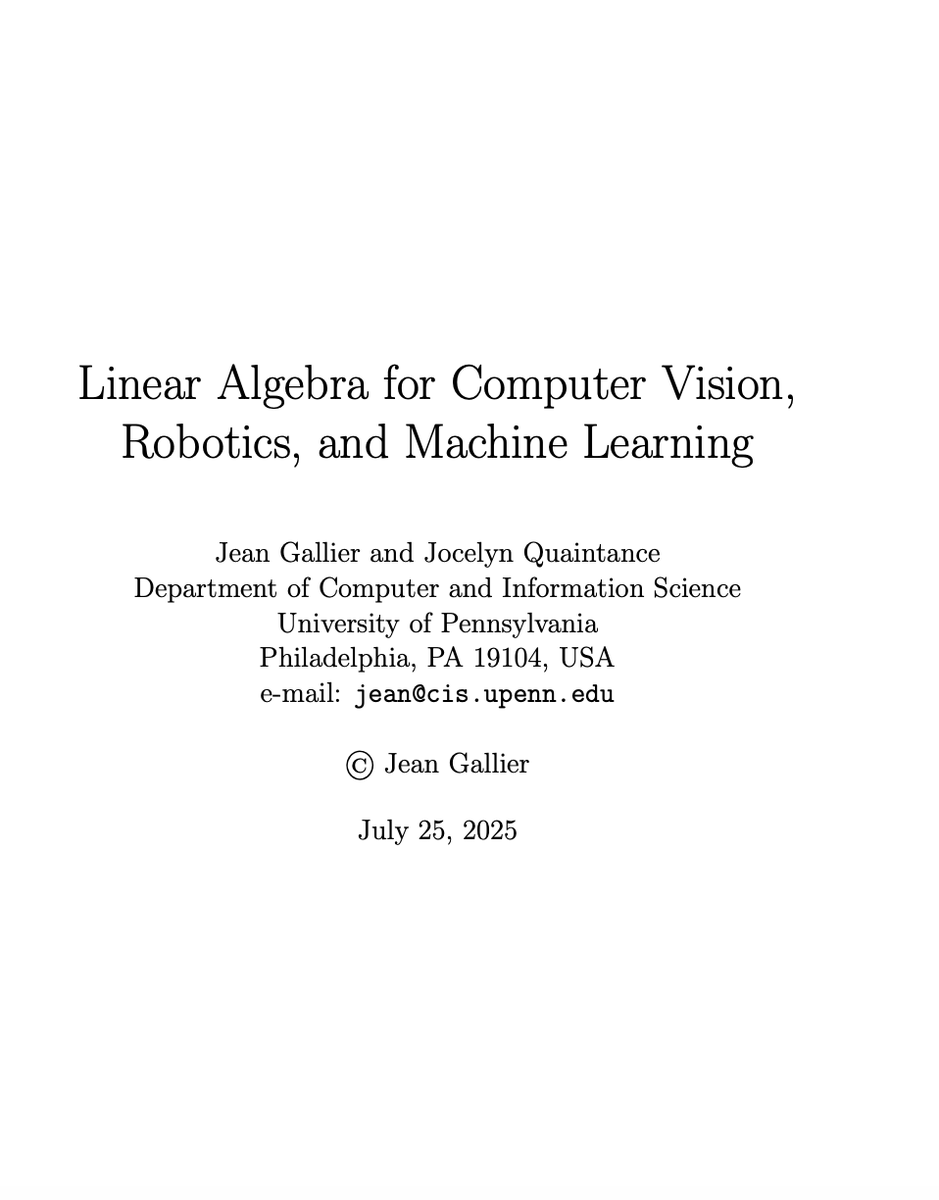
Linear Algebra for Computer Vision, Robotics, and Machine Learning from the University of Pennsylvania.
https://t.co/3PLbHINqwb
If you want to stop treating ML like magic and start understanding it as mathematics, this is the right starting point.
✨Thinking with Blender~
Meet VIGA: a multimodal agent that autonomously codes 3D/4D blender scenes from any image, with no human, no training!
@berkeley_ai#LLMs#Blender#Agent 🧵1/6
Excited to share our new work, NeuralFur 🐾🐻
The first method to reconstruct strand-based 3D animal fur from multi-view images, compatible with graphics & simulation pipelines.
Accepted as an oral at #3DV2026
🔗 https://t.co/mROCZ04l2E
✨ Any static 3D assets ➡️ 4D dynamic worlds.
Introducing CHORD, a universal framework for generating scene-level 4D dynamic motion from any static 3D inputs.
It generalizes surprisingly well across a wide range of objects 🤯 and can even be used to learn robotics manipulation policy 🤖!
Project page: https://t.co/KOHlqgbvIp.
Dive deeper in a 🧵: 1/n