NHL fans in Indianapolis have no broadcaster audio for Game 1 of the Stanely Cup Final. Here's how the first goal sounded on WRTV with only the in-arena sound.
@ClownPunchers@NHL The standard to call a penalty or waive off a goal (rightly) goes way up in OT in the playoffs. Much like the obvious too many men on the ice that wasn’t called earlier.
Goalie interference is a total crapshoot in the regular season. No chance that should be called there.
Will Sasso and Dan Soder are Macho Man Randy Savage, Hulk Hogan, Andre The Giant, Stone Cold Steve Austin, Arnold Schwarzenegger, Rodney Dangerfield, and Robert Deniro reading Andy Rooney quotes. 😂😂😂😂
(🎥@ChrisVanVliet)
ICYMI: @GoodmanHoops' message for Will Wade 👀
"I wish he didn't come back to college basketball. I honestly mean that. I like Will, I've known him since 2007. But man, you suck for college basketball right now. You're making it into a mockery. Look in the mirror and understand it's not just about you"
🎥: https://t.co/oJ2yBq9FZU
251 years ago this week, a 6'2" Vermont moonshiner with no military experience and no authorization from anyone captured the most strategically important fort in North America at dawn, and accidentally won the Revolutionary War before it had really started.
It's May 1775. Lexington and Concord happened three weeks ago. The colonies have muskets but almost no cannon. The British, sitting in Boston, have plenty. Everyone knows that without artillery, the rebellion is over by autumn.
Everyone also knows where to get artillery: Fort Ticonderoga. A stone star-fort on Lake Champlain, bristling with roughly 80 heavy guns. The British call it "the Gibraltar of America." It's the bottleneck of the entire continent. Whoever holds it controls the invasion route between Canada and New York.
What the rebels don't know, but Ethan Allen has heard, is that "the Gibraltar of America" is, by 1775, mostly held together by moss. The walls are crumbling. The garrison is 48 men, many of them invalids and pensioners. The commander hasn't even been told a war started.
Allen is not a soldier. He's a frontier land speculator who runs an armed militia called the Green Mountain Boys, originally formed not to fight the British, but to beat up New York surveyors trying to seize Vermont farms. New York has literally put a bounty on his head. He decides to go take the fort anyway.
Halfway there, a man named Benedict Arnold shows up on horseback with a Massachusetts colonel's commission, waving paperwork, demanding command of the expedition. The Green Mountain Boys threaten to go home if Arnold is in charge. Allen and Arnold agree to "joint command," which mostly means walking next to each other in furious silence.
They reach the lake at midnight. Problem: they have 200 men and exactly two leaky boats. By 3 AM only 83 have made it across. Dawn is coming. Allen decides to attack with what he has, meaning roughly 1 American for every half-cannon inside the fort.
A lone British sentry sees them coming through the wicket gate, levels his musket at Allen's chest, and pulls the trigger. The musket misfires. He runs. The Americans pour in. Total resistance to the capture of British North America's most important inland fortress: one wet flintlock.
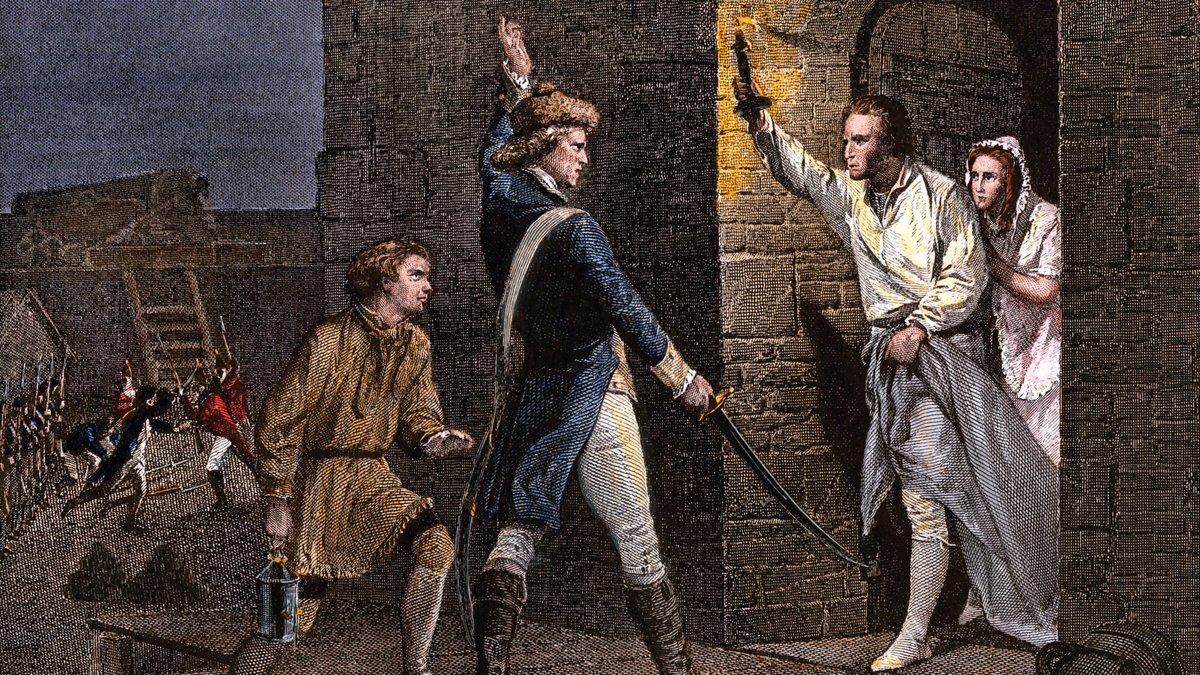
Allen pounds on the officers' quarters with the flat of his sword. Lt. Jocelyn Feltham stumbles out half-dressed, asking by what authority Allen is there. Allen, by his own later account, roars: "In the name of the Great Jehovah and the Continental Congress!" (Other witnesses remembered the wording as substantially more profane. The Continental Congress, for its part, had no idea any of this was happening.)
Captain Delaplace, the actual commander, emerges still buttoning his trousers and surrenders the fort, its 78 cannons, its garrison, and roughly 30,000 musket flints without a shot fired by either side. Casualties: zero. Time elapsed: about ten minutes.
But here's the part that actually changed history. Those cannons sat at Ticonderoga for six months until a 25-year-old, 280-pound Boston bookseller named Henry Knox, who had learned artillery from books in his own shop, volunteered to go get them.
In the dead of winter, Knox and his men dragged 59 cannons weighing 60 tons across 300 miles of frozen rivers, the Berkshires, and unbroken snow, on 42 ox-drawn sleds. One gun fell through the ice of the Hudson. They fished it out and kept going. It took 56 days.
On the night of March 4, 1776, those cannons were hauled silently up Dorchester Heights overlooking Boston Harbor. The British woke up on March 5 to find every ship in the harbor and every redcoat in the city under the muzzles of guns that, six months earlier, had belonged to them.
Eleven days later, the British evacuated Boston. They would never hold it again.
An unauthorized raid by 83 backwoodsmen, led by a wanted man and a future traitor, against a fort defended by a captain in his pajamas, became the artillery that drove the British army out of the largest city in the American colonies.
Easiest W in American history. Possibly the most consequential ten minutes of the 18th century.
We’ve built a world that numbs discomfort instantly and we’re surprised we feel less alive. The fix isn’t found in seeking pleasure—it’s friction and progression. https://t.co/I6knNm8FVG