I run two companies out of Mumbai: @quvor_official (dev agency) and @TribeCrafter (community platform for creators and coaches).
I'm building TribeCrafter in public. Decisions, mistakes, numbers.
On 25 October 2016, ten years ago today, I registered https://t.co/PFNzZxXdh3. I didn't know what I was doing.
Since my early days, I wanted money of my own, for the things I wanted. Once I even unloaded tomato crates from a truck for cash. In college I sold used phones and bikes. Then came dropshipping, content experiments, SEO experiments, and all the while also occasionally trying to land a high paying remote job.
Back then I was at my first job, on a one-year contract. As soon as the year was up, I quit. No plan, just a domain name. I think it was a leap of faith.
For almost six years, Quvor was just me. Speed was the core of it, making slow WordPress sites fast, but I took whatever came in: odd bug fixes, small gigs, maintenance. In 2020 I won first place in a WordPress performance contest.
That same year a client hired me for a speed job. Six years later we run all their tech.
Our first employee joined in 2022. Today we're 17, and I never planned that, or even imagined it. One of the platforms we run has more than 200,000 members, and some of the sites we look after bring in over $100k a month.
For a long time, everything I did, I was doing for the first time. Honestly, that hasn't changed much. There's still something new to figure out every day.
Quvor today isn't the company I started. We've been building and running whole products with founders for a while, but the old site still showed a WordPress speed shop. So we redesigned everything: the identity, the logo, the site.
Thanks to every client who stuck with us, and to the team who did the actual work.
Here's to the next ten.
Here's something I've noticed consistently.
A person with clear thinking and strong fundamentals using a weaker AI model will outperform someone with vague ideas using the best model available.
Every time.
Because AI reflects what you bring to it.
Clarity in, strong output.
Vagueness in, confident-sounding mistakes you won't catch.
And this isn't just technical. It applies to business thinking too. Understanding why a decision has tradeoffs. Why a certain customer matters more right now. Why a shortcut today creates a much bigger problem two years from now.
The people chasing better models are solving the wrong problem.
The model isn't what's holding you back.
Build better thinking. The tools will keep getting better on their own.
People who learned their craft before AI have an edge right now.
Before AI you had to sit with a problem, sometimes for hours, sometimes for days. You'd end up reading docs, old forum threads, a Stack Overflow answer from 2011, some random blog post at 2am.
At the time, most of it felt like wasted time.
You also pick up a lot more than the one fix you went looking for, and it stays with you.
I still solve problems today with things I learned 7 years ago. I only knew them because I'd gone deep on that one bug instead of being handed the answer.
AI takes most of that friction away. It's useful, but the friction was doing real work.
What replaces it?
A lot of people around me are scared about AI taking their jobs.
I'm not.
And I've been genuinely trying to understand why I feel that way.
It's not because I'm more technical. Or because I have access to better tools. It's not even about being smarter.
When you truly understand what you do, not just the surface of it but the reasoning behind your decisions, the tradeoffs, the why, AI doesn't feel like a threat. It feels genuine.
But if you've been getting by on shallow knowledge? AI makes that visible. Quickly.
So honestly, I think the fear is worth sitting with.
Are you afraid of AI?
Or are you afraid it will reveal a gap that was already there, one you quietly knew about?
Because that gap is real. And it's fixable.
Just not with a better model or an AI course.
More on that in the next post.
One sentence from a customer turned into 40+ decisions before a single line of code was written.
The sentence: "My existing users should be able to use the community without signing up again."
A few of the harder ones:
Which ID do we trust? Their user ID, not the email. People change emails.
Someone already has an account with that email? We link it, but only if their platform verified the address. Otherwise anyone could claim anyone's account.
Can admins sign in this way? No. If a customer's key ever leaked, the admin area should still be locked.
Who holds the keys? We only store their public key. Even a breach on our side couldn't be used to sign anyone in.
Signing in now happens on their site, not ours. So when a member clicks a notification email while logged out, we have to remember the post they wanted, send them away to log in, and bring them back to that exact post.
Someone is removed on the customer's side? Their open session has to end too.
Some of these are hard, and not for technical reasons. At TribeCrafter we're not building for one customer. Whatever we decide runs for thousands of communities over the next few years, most of whom we haven't met yet. The answer has to be right for them too.
And if a decision isn't made upfront, a developer makes it on the spot while building. Whatever they pick is what we live with for years.
The most important work on a request like this happens before the code. My job is to hand my team a list of decisions, not a list of questions.
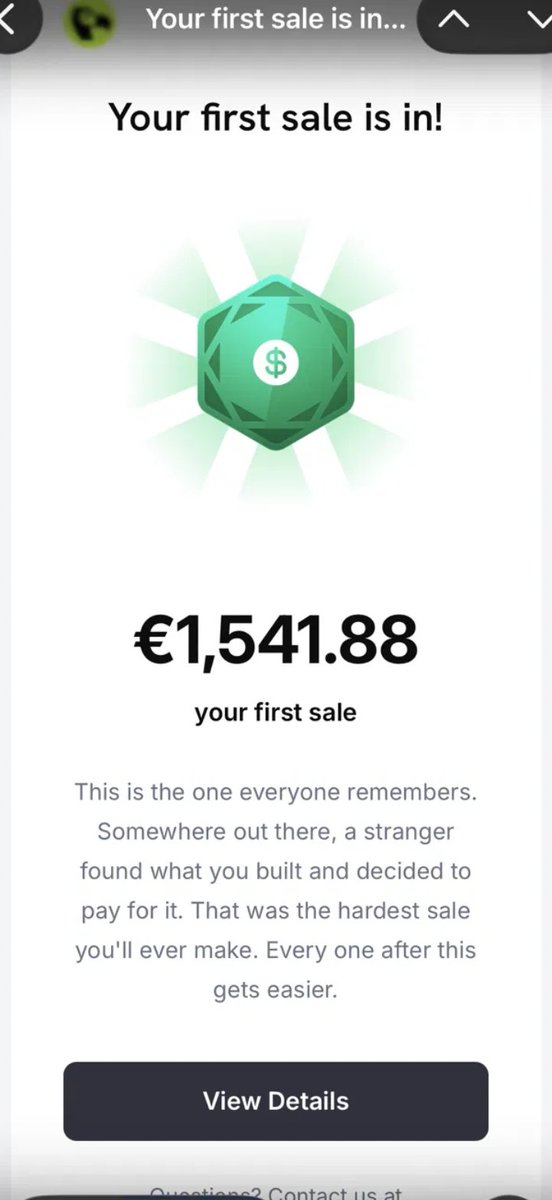
First sale for TribeCrafter. €1,541.88.
We've been building it for almost three years, bootstrapped, so this one meant a lot.
For anyone who hasn't come across it, @TribeCrafter is an all-in-one community platform. Feed, groups, courses, events and payments are built in. We take 0% of what you earn.
On to the second one.
300+ people from all over the world are using @TribeCrafter.
3 years of sleepless nights and second-guessing every decision to get here.
It's the sum of a thousand invisible decisions — and it's just the beginning.
Built for creators and coaches who are serious about their community
Two years ago I got an investment offer for @TribeCrafter. Turned it down.
Investors want returns. Their timeline, not yours. Most don't understand the technical calls that determine whether a product is actually good.
Bootstrapping has its constraints. I'd rather deal with those than rush something for someone's quarterly targets.
Funded by customers. We're just getting started.
1/ I run an agency, and I didn't want to spend the next ten years scaling one.
A service business only grows one way. More clients, more staff, more people to serve the people you already have. All of it is dependency.
I wanted to build something that could grow without feeding it more of both
4/ An agency you can mostly run on experience.
A product is a different animal. What do you actually build? How do you architect it so it holds up later? The edge cases you never see coming. Building a team around it — all while the agency still needs you every day.
(Hetzner raising our cloud prices 275% overnight did not help.)
If your community loses people after signup, it's not “engagement.”
It's onboarding.
We break down what actually keeps members around 👇
https://t.co/OuVNwtgLoh
#TribeCrafter#CommunityGrowth
Community admins know this feeling. 😅
When your online community event isn't just scheduled.
it's actually attended.
That's what happens when it's hosted on TribeCrafter. 😋
👉 Share this with a fellow community admin.
#TribeCrafter#CreatorMemes#CommunityAdmins...