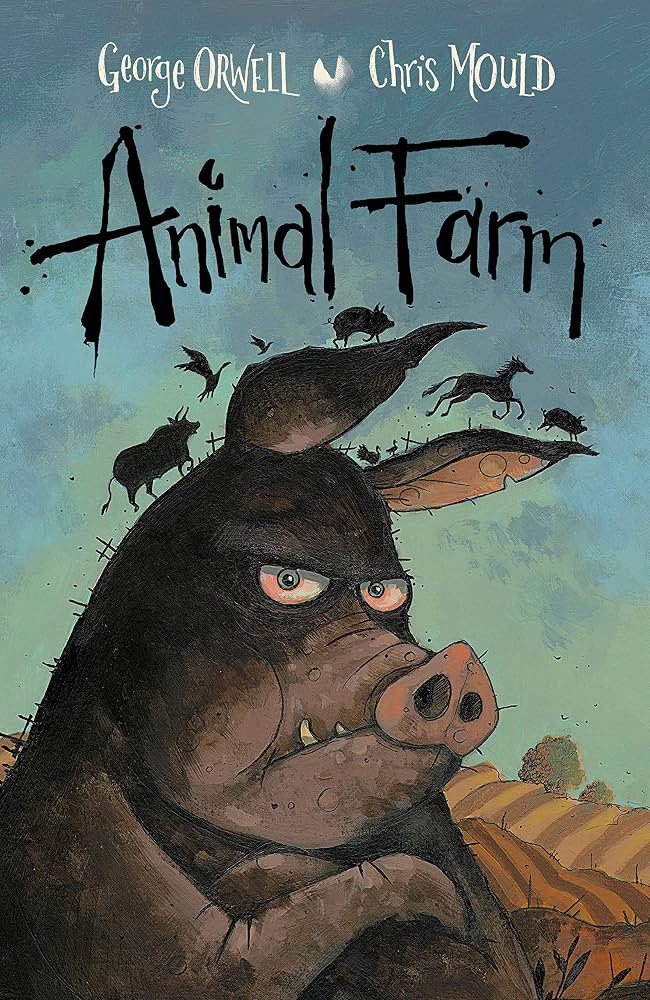
Boxer’s motto was simple: “I will work harder.” He believed with pure, unyielding devotion that sacrifice for the collective good would lead to freedom. And what was his reward when his lungs finally collapsed? Sold to the butcher for a crate of whisky. That is the most gut-wrenching tragedy of Orwell’s Animal Farm—not just that power corrupts, but how quickly those who bleed for a cause are discarded by the very elite they hoisted onto their backs.
Look at the farm as the years rolled on: neither the pigs nor the dogs ever planted a seed, reaped a harvest, or pulled a plow. Yet their bellies were always full, their beds always warm. The animals who broke their spines from sunrise to dusk slept shivering, on empty stomachs, clutching the hollow reassurance that they were “working for themselves.” The real horror isn't the physical tyranny—it’s the weaponization of collective memory.
The core ideas of the Rebellion were methodically scrubbed away. The skull of Old Major, once marched past with reverence, was quietly buried to erase their roots. The sheep—loud, unthinking, and obedient—were taught to chant “Four legs good, two legs bad” until, when the pigs walked like humans, they seamlessly transitioned to “Four legs good, two legs better.”
And the new generation? They never cared to ask. They never knew Jones, never understood what freedom originally meant, and meekly accepted the curated reality manufactured by Squealer’s propaganda machine. History became whatever power declared it to be yesterday.
Then came the final, chilling stroke on the barn wall: “All animals are equal, but some animals are more equal than others.” This isn't a fable about farm animals from 1945. It is our world.
It is the working class told to tighten their belts while predatory executives and political classes feast on their exhaustion. It is the cynical rewrite of history every time a new regime takes the reins. It is the mindless masses drowning out nuance with slogans, cheerleading the very systems tightening the leash around their necks.
Orwell didn't write a fairy story. He held up a mirror. And right now, looking through the farmhouse window, it is terrifyingly impossible to tell who is human and who is pig.
The CJI is "first among equals," not an imperial monarch. Bypassing subject rosters for Medha Roopam & administratively pulling the CAPF case from a sitting bench weaponizes "Master of the Roster" powers, shredding judicial independence and reveals blatant overreach. The "Master of the Roster" was designed as an administrative tool, not an imperial gavel. When judicial orders yield to secret allocations, public faith in the Supreme Court erodes.
कुछ दिन पहले IAS से त्यागपत्र दिया था और आपके मन में कई सवाल छोड़ दिए थे। अपनी बात इस वीडियो में कह दी है। अगर आपको लगे कि ये आपकी भी बात है, तो 9198956957 पर whatsapp मैसेज करिए।
the spreadsheet has been updated!
we have now over 1300 movies archived with almost 800 bluray remuxes!! and none of the links will ever expire :)
https://t.co/T0gpbMChDU
A swallowed button battery can start burning tissue in minutes. This 30-second time-lapse shows the damage in just 3 hours. This is a true emergency. Do not wait for symptoms. Rush to hospital.
While you race there, ONE common kitchen item can slow the burn. Give 2 teaspoons of HONEY every 10 minutes (up to 6 doses) on the way to hospital. It coats the battery and slows the alkaline burn. It is not a cure and must never delay the ER. Do not give honey to infants under 1 year.
I looked deep into Yemen’s Khat addiction, and the scale of devastation is insane.
Data shows Yemeni citizens spend HALF of their total income on Khat.
Khat also uses 40% of their total water supply for no nutritional value while lack of water and starvation is extremely prevalent in Yemen.
Starvation in Yemen is beyond alarming. Over 18 million people, just over half of the country's population face acute hunger.
There is an estimated 50,000+ child deaths annually in Yemen from extreme hunger and secondary infections.
About 130-144 children die per day of starvation in Yemen.
The estimate for adults is 20-50 per day, so for some reason they allow children to bare the brunt of death by starvation while tending to Khat crop production and chewing addiction.
Why would there be no humanitarian aid to stop that? Because of The Jihadist militants that also own The Khat business in Yemen.
International aid funding to Yemen dropped due to The Houthis complete operational theft. They also launched a massive crackdown on humanitarian workers, carrying out abductions and detaining United Nations and NGO employees for ransom.
The Houthis essentially have a monopoly on the Khat business in Yemen.
Because they control the vast majority of Yemen's mountain ranges, where the country's khat is cultivated, the crop falls directly under Houthi territorial administration, the militant group has successfully monopolized the trade. They profit heavily from the national addiction of Khat by enforcing fees at militia checkpoint fees and taxation.
Cultivating khat requires an immense amount of water and the Houthis have seized all key water tables across western and northern Yemen, the Houthis effectively function as landlords to the farming networks. Farmers are dependent on the group for access to the fuel required to run irrigation pumps, allowing Houthi leadership to control the entire industry.
Yemen used to be the number one exporter of Coffee in the world and they ripped out almost every single Coffee farm for to produce Khat. Estimates indicate that up to 80% of Yemen's arable land was systematically converted to cultivate Khat. Khat uses four times the amounts of water that coffee does. Yemen is in severe drought conditions and the country is locked in a catastrophic environmental crisis driven by lack of rivers, rainfall and their addiction to Khat.
Khat is now so deeply embedded in Yemeni culture, so much so that it transcends the frontlines of the ongoing conflict. The trade is so vital that opposing military forces in Yemen often observe an unwritten daily ceasefire between noon to 4:00 PM allowing both sides to break combat, safely distribute the shipments, and gather to chew the leaf.
So to wrap this up, Jihadist Terrorists, that Hasan Piker says are awesome (The Houthis) were stealing all the international aid and holding it hostage to finance terror operations while continuing to be the main drivers behind Yemens Khat industry and addiction. All while hundreds of thousands of Yemenis continue to die of starvation.
I would like to say there is a change coming, but almost the entire population seem too focused on chewing Khat to do anything about it.
@FrontalForce Although 96% of UPI transactions will still be free, the MDR issue is set to send ripples through the UPI economy. Small merchants and customers may retreat to cash, driven by fearmongering or sheer lack of information. Merchants will try to pass on the MDR to the customers
Though government sources claim 96% of UPI transactions will still be free, the MDR issue is set to send ripples through the UPI economy. Small merchants and customers may fall back to cash, driven by fearmongering or sheer lack of information. Merchants will try to pass on the MDR to customers — by hook or by crook.
🔰 UPI Remains Free for Consumers
UPI continues to be free for customers. Sending money to friends, paying at shops, or scanning a QR code — all remain without charges.
Key Facts:
✅ No charges on P2P: Person-to-Person transfers are always free, regardless of amount.
✅ Small merchants protected: Vendors earning up to ₹1 lakh per month via UPI QR codes continue to enjoy zero charges.
✅ Everyday payments safe: Over 95% of merchant payments are below ₹2,000 — these remain free.
✅ Nominal MDR above ₹2,000: Only larger merchant transactions above ₹2,000 attract a small fee (0.4%) to be borne by merchants, far lower than credit card charges or other network charges.
✅ Essential services capped: Railways, fuel, telecom, bill payments, insurance, etc have a flat fee of ₹5 per transaction above ₹2,000.
✅ Special low rates: Mutual fund and securities payments attract just 0.02%, capped at ₹300.
Safeguards for Consumers
✅Banks instructed: Merchants cannot pass MDR costs to customers.
✅No hidden fees: UPI apps cannot levy platform charges.
Debunking the “External Pressure” Myth:
✅ Some claims suggest the change is due to foreign influence. This is false. India’s UPI policy decisions are made independently, with the clear goal of building a self-sustaining, inclusive, and affordable digital payments ecosystem.
Why This Matters:
Since its launch in 2016, UPI has grown into the world’s largest real-time interoperable payment system — entirely on India’s own terms. UPI processed 24.5 billion transactions in August 2026 alone. To keep this system self-sustainable, secure and innovative, a small fee on high-value merchant transactions helps fund:
☑️Better infrastructure and cybersecurity
☑️Support for small merchants in Tier III–VI towns and rural areas
☑️Awareness and incentives to expand UPI adoption
The new framework ensures resources from higher-value merchant transactions are reinvested to support small businesses and strengthen digital payments across the country.
🔗Read FAQs at: https://t.co/SFh8c2eT4F