A two-sided launchpad using @nearprotocol to turn every token into a dual-paired asset. Buy-side activity builds one asset, sell-side activity builds another.
Introducing TWO.
Two is a two-sided launch infrastructure powered by @nearprotocol, launch tokens on @Pumpfun with two programmable reserves: buy-side activity builds one asset, sell-side activity builds another.
One token, two assets.
CA : 4UMfNn34DQVnhh6TphH4dGYYuJWuVskq5mKNZ4ZMpump
https://t.co/5gjsx3y6U3
Here’s the actual architecture behind TWO.
A token launches on https://t.co/yfAGm1T8D6 with two reserve destinations configured through TWO. For example:
$ELON
Buy-side → Asset A
Sell-side → Asset B
The token itself still trades normally on Solana. TWO doesn’t replace https://t.co/yfAGm1T8D6’s market or pretend to modify its bonding curve.
The TWO layer is responsible for what happens around that market.
When eligible value reaches the TWO-controlled flow, we associate it with the originating market activity and resolve which reserve it belongs to. Buy-side value is assigned to Reserve A, sell-side value to Reserve B.
From there, the reserve engine passes the required destination to our routing layer. This is where @nearprotocol comes in: NEAR is being used as the chain-abstraction infrastructure so TWO can route into supported destination assets without building an isolated bridge/swap stack for every possible pair.
The full flow is:
Trade on https://t.co/yfAGm1T8D6 → Identify side → TWO Reserve Engine → Route through NEAR infrastructure → Destination asset → Reserve
So for a BTC/ZEC configuration:
Buy → TWO → NEAR routing → BTC Reserve
Sell → TWO → NEAR routing → ZEC Reserve
And this is what we should be showing publicly for every launch:
The token deployment: [CONTRACT / TX]
The original market transaction: [TX]
The TWO-side classification: [BUY / SELL + EVENT]
The reserve routing transaction: [TX]
The resulting reserve balance/address: [RESERVE]
That gives you a trace from the original market action all the way to the asset TWO says it built.
The important distinction is that we’re not claiming https://t.co/yfAGm1T8D6 magically redirects its native fees. Value has to enter a TWO-controlled mechanism before TWO can route it. Anything outside that flow cannot be retroactively redirected by us.
That’s the actual tech: https://t.co/yfAGm1T8D6 remains the execution venue, TWO provides the programmable two-sided accounting and reserve logic, and NEAR provides the cross-chain routing infrastructure underneath.
We’ll showcase it at the transaction level because that’s ultimately the only proof that matters.
https://t.co/5gjsx3xz4v
@twopairpad showcase the tek of some sort brother what are we doing?
your whole sales pitch is falling into the ground if u keep ignoring the most important thing.
give us some answers, showcase something real.
The mechanism matters more than the description.
Tokens are already being launched through TWO with their own two-sided configurations. below are the first deployments, reserve activity and onchain transactions showing the system operating in practice.
Bunch of dual-paired distributions:
https://t.co/vIoFH5u5jS
https://t.co/xycQvhkZub
Token markets have historically treated buying and selling as opposite actions inside the same economic structure. the price moves in two directions, but the underlying architecture remains one-dimensional.
TWO separates those flows. buy-side activity can build one reserve while sell-side activity builds another, allowing each direction of a market to produce a different economic outcome.
The interesting part is not simply having two assets. it is making market direction programmable. once buys and sells can route toward different reserves, the pair itself becomes part of the token’s design rather than just the infrastructure it trades against.
https://t.co/5gjsx3xz4v
TWO gives every token two sides.
When people buy, part of the activity builds a reserve in one asset. When people sell, it builds a reserve in another.
For example:
If you deploy a token called ELON
Buys → SpaceX
Sells → Tesla
The token trades normally.
TWO handles the two reserves in the background.
A token launch shouldn’t be limited to a single reserve structure.
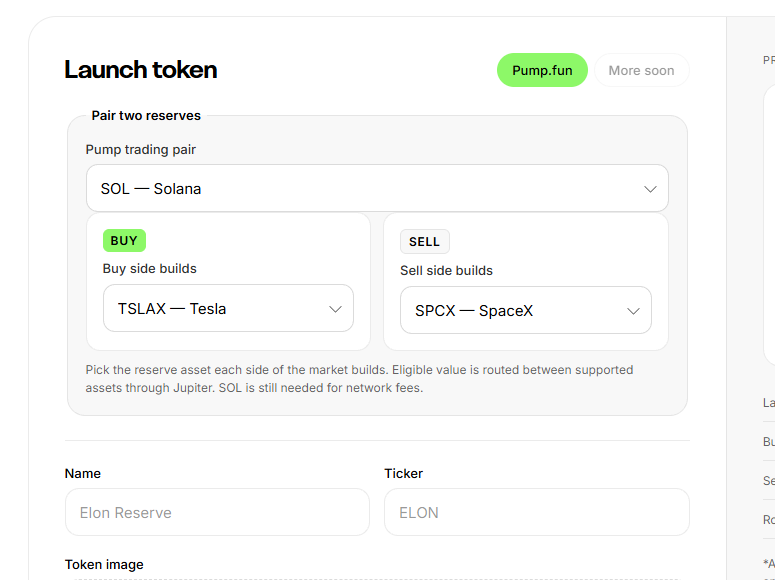
With TWO, creators define two reserve assets at launch: one for buy-side activity and one for sell-side activity.
The pair becomes part of the token’s design, not just its liquidity.
The first tokens launched through TWO are now live on our app via @Pumpfun and @NEARProtocol
Each market is running with its own dual-reserve configuration, with separate assets assigned to buy-side and sell-side activity.
Initial launches and on-chain proofs below.
https://t.co/Ra3rNvfmCZ
Launch tokens dual-paired from TWO
Creators can define two different reserve assets: one accumulated from eligible buy-side activity and another from sell-side activity.
@nearprotocol provides the cross-chain infrastructure used to route those reserves across supported assets and networks.
The goal is simple: make dual-pair economics a native part of launching a token.
https://t.co/hq7ffIwAKP