18/Almost every bad argument here comes from mixing up three levels.
Human: condemn all killing, everywhere, without exception. State: calculate interests, without the sentiment filter. System: critique the rogue hegemon, without canonising its victims.
"The trouble begins when we grieve where we should calculate, and calculate where we should grieve."
My latest @RUSI_org commentary: China's 'war by other means' is there to see - if Europe looks past isolated incidents.
Western planning has long been organised around one dramatic contingency regarding Taiwan: invasion. But Beijing has found something more economical. Below the threshold of explicit war, it is altering strategic realities ship by ship, licence by licence, narrative by narrative, integrating hashtag#greyzone coercion and hashtag#geoeconomic leverage into a single strategy. Each act is deniable; the cumulative effect is what a war is fought to achieve.
The policy task: stop measuring the China challenge against the yardstick of invasion, and start measuring it against cumulative coercion: resilience, matching grey zone with grey zone, and faster collective responses. The absence of a declared conflict is not the absence of conflict.
This applies to other domains too, such as China's support for Russia's war of aggression against Ukraine. Stop measuring individual actions and start measuring support holistically.
1/2
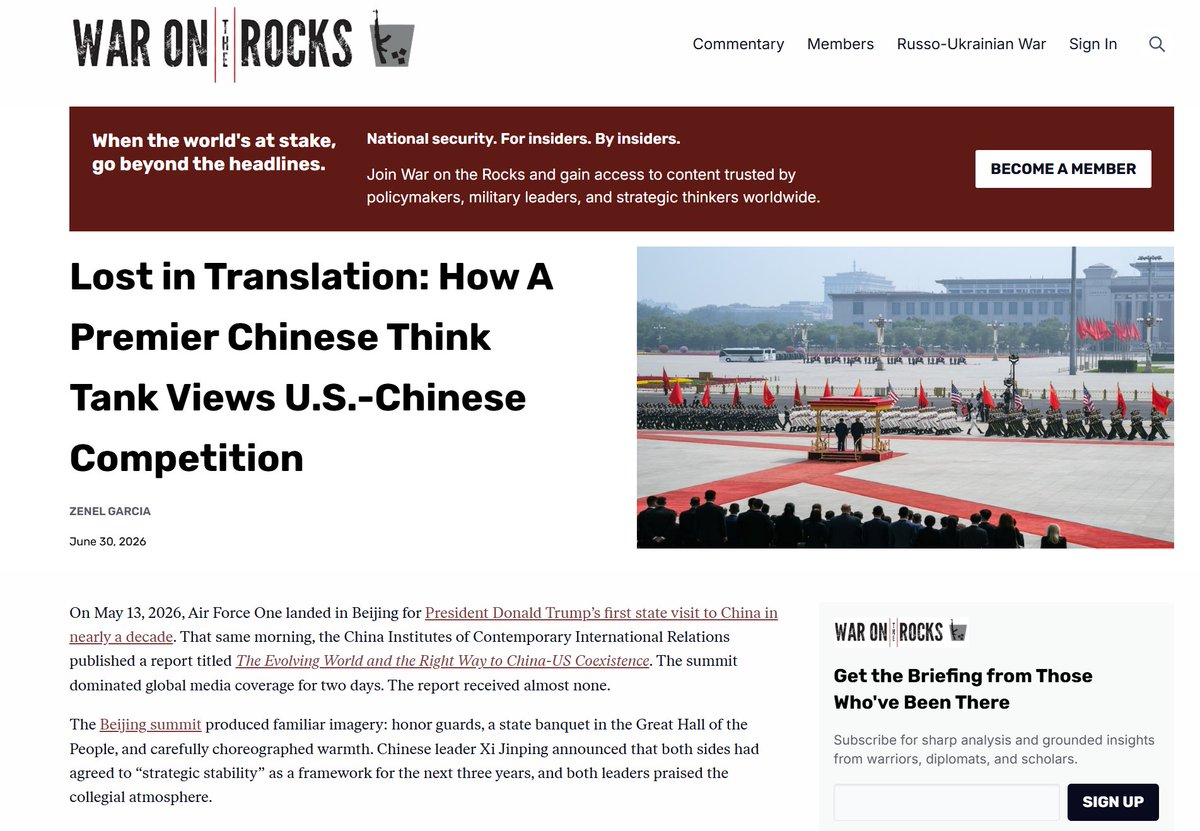
The China Institutes of Contemporary International Relations 中国现代国际关系研究院 is not a conventional foreign policy think tank. It functions as a research and analysis arm of China’s Ministry of State Security, and its principal customers are the Central Foreign Affairs Commission of the Chinese Communist Party Central Committee, the body that sets the country’s strategic direction at the highest level. https://t.co/qTrAfZGXLe
Recent essays:
"Evasive Balancing: India’s Unviable Indo-Pacific Strategy" in International Affairs
https://t.co/ZfKqYuKmZj
"Did India Lose China?" in The Washington Quarterly https://t.co/NfwRP7VYS4
"India’s Strategic Choices" Carnegie India https://t.co/piKVDO3vjo
In my latest for @WarOnTheRocks I delve into one of Britain's most crushing defeats--the 1942 collapse of the great Asian bastion of Singapore--and its lessons for contemporary defense planners and policymakers.
https://t.co/zQdvNQz9wJ
“In effect, China is trying to do what economic theory says no country should be able to do: retain comparative advantage in almost everything.” Read @shoumitro_c and @arvindsubraman on the consequences of the “China squeeze”:
https://t.co/WUPxUbOI9f
#InternationalDayofYoga2026 celebrated with enthusiasm at Godavari River Management Board, Hyderabad.
Chairman Shri P. Dorje Gyamba led a yoga session for officers and staff at Jalasoudha, highlighting the importance of yoga for physical and mental well-being.
1/3
Japan, Australia, and India together spend $190 billion on defense. China spends $336 billion. As the numbers show, the regional partnerships alone won't solve New Delhi's strategic math. https://t.co/bwd9n7OVBf
SCOOP: This renaming uses the same legal workaround that the Trump admin used to go from Dept. of Defense to the Dept. of War.
U.S. Pacific Command is a "secondary title" per a Hegseth memo I reviewed.
The "statutory" name remains US Indo-Pacific Command.
@ASPI_org#PressurePoints Part 3 is out!! Worked on this for several months with Joe Keary and Linus Cohen. A few highlights:
1. We map how China is using a variety of tools to systematically normalize its strategic presence far from China's waters. https://t.co/j986gHNr5y
I actually forgot to mention one important thing: the use of this tool has not always been “defensive” either.
They used this tool against Japan and the US in 2010. That was not a defensive use in response to economic coercion.
Since the trade war, they have used it offensively: threatening it in response to European industrial policy and using it in response to Japan’s modest defense increases.
I am not making a moral argument — other countries build and deploy coercive chokepoints. I don’t know why we would assume China is an exception to this logic when there is ample empirical evidence to the contrary.
China is, in fact, a great power (really a superpower) and acts like it.
Hegseth actually *confirmed* our point directly: the Taiwan arms sales pause wasn’t about Iran.
So what might have been about…?
Maybe it’s about what the President suggested all along — arms sales as a bargaining chip.