Development economics finally has a global professional home. Today we launch @ideadevecon ... Open to every development economist, everywhere.
Join the community: https://t.co/d32NJVmjEj
Please share 🌍
This Wednesday, June 24, Esteban Verdugo from the University of Michigan will join us to present his paper at our weekly seminar, titled “Saving by Consuming: The Intertemporal Behavior of Hand-to-Mouth Households.” You can find further information about this seminar below:
ICYMI: Associate Professor @NPilkauskas spoke with @BusinessInsider about multi-generational living.🏡
Between July 2023 and June 2024, 17% of all US home buyers purchased a multigenerational home—up from 14% the year before.
Read about this shift: https://t.co/dwOKkWWGDH
Congratulations to @CatieHausman, @michelmorek, & @NPilkauskas on their promotions to Professor of Public Policy with tenure! 🎉
We're so proud to have their expertise and leadership as a part of our community.
Read more: https://t.co/meIFBCa7yy
Check out @deanyang's latest study, w/Gaurav Khanna (PhD '16), Emir Murathanoglu (PhD '24), & Caroline Theoharides (MA '11 & PhD '14), in the American Economic Review, on how international migrant income affects long-run economic development.
Study: https://t.co/P8JI3MMyLj
Congratulations to our @EJ_RES 2025 Referee Prize winners! 🎉
These prizes recognise the outstanding contribution of referees and the vital role they play in supporting authors and the journal.
Read more: https://t.co/dm4qbQYtyf
#EconTwitter
What happens when religion forbids your region's main crop? Economist @emontero_CR (@HarrisPolicy) explores how faith shapes economies, church life & trade-offs in this episode of The Pie. 🎙️📉 https://t.co/2hQ3fDEme8
📚 🕰️🌱📘✨
A 7-year journey: How information can shift career choices
❗️A rare example of long-term monitoring in education policy by @Mariana_Alfonso, Matias Busso, @hugonopo, Antonella Rivera and @tyentzen
✨Looking at the timeline alone, you immediately feel it:
* 2012 → 2019… seven full years of data collection, follow-up, and patience.
* A project of this duration demands remarkable dedication and commitment.
* Incredeble!
Below are the most interesting outcomes:
🔍 How did perceptions of teaching change?
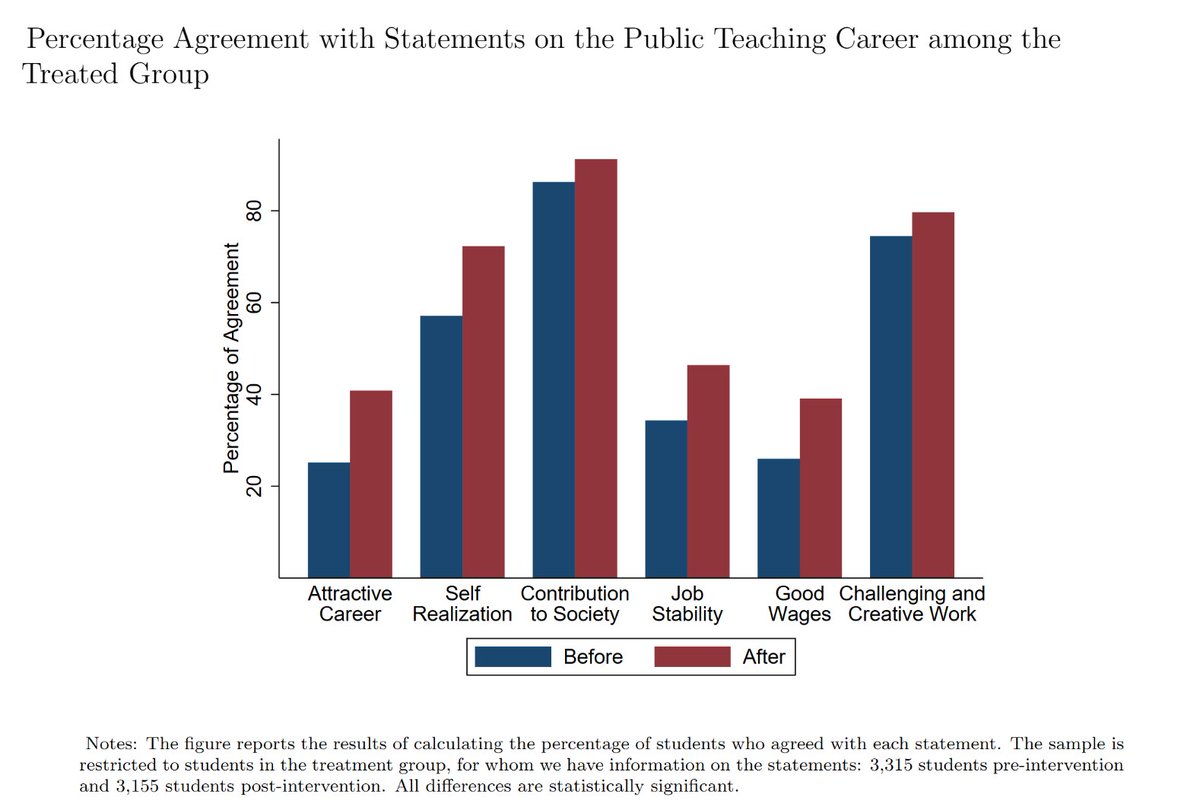
🎈 After the information session, positive perceptions rise sharply across all categories:
– Attractive career, Self-realization, Contribution to society, Job stability, Good wages, etc.
🎨 The jump in “Challenging and Creative Work” stands out — nearly a 10-point increase.
📌 All differences are statistically significant.
This shows that when students learn what teaching actually offers, they begin to view it as more meaningful, creative, and socially valuable.
🎓 Clear behavioral effects on career paths
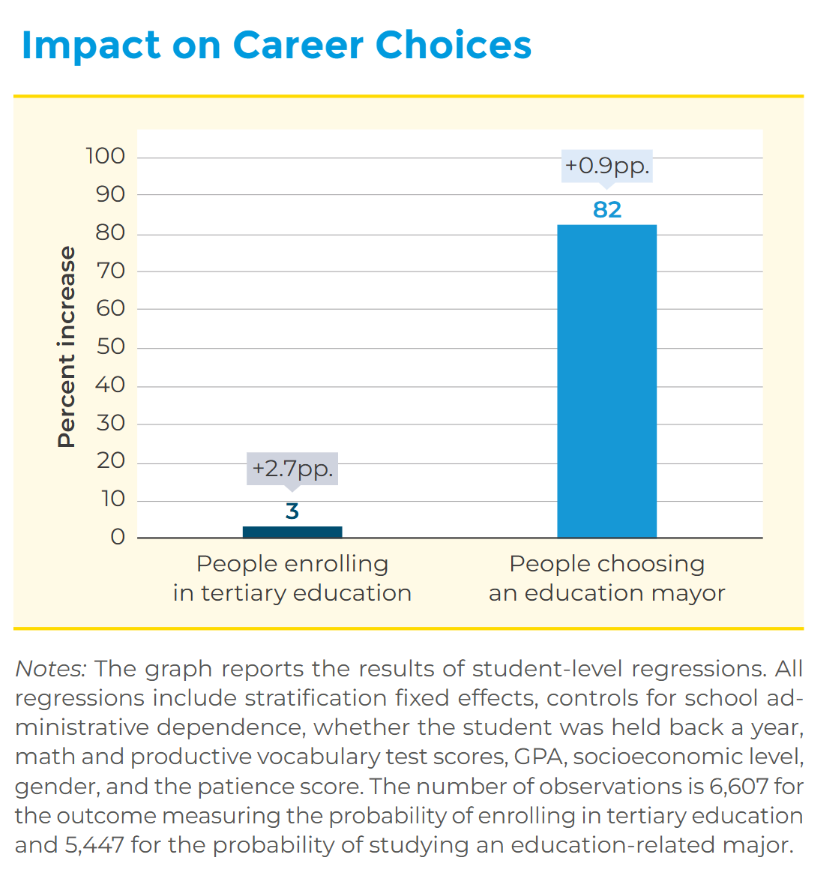
🎯 The likelihood of enrolling in tertiary education rises by +2.7 percentage points.
🍎 Choosing an education major increases by +0.9 percentage points —
→ which corresponds to an 82% increase in the number of students entering education.
* These results show that the informational intervention didn’t just shift opinions — it shifted real decisions.
⚖️ Where did the treatment have the strongest impact?
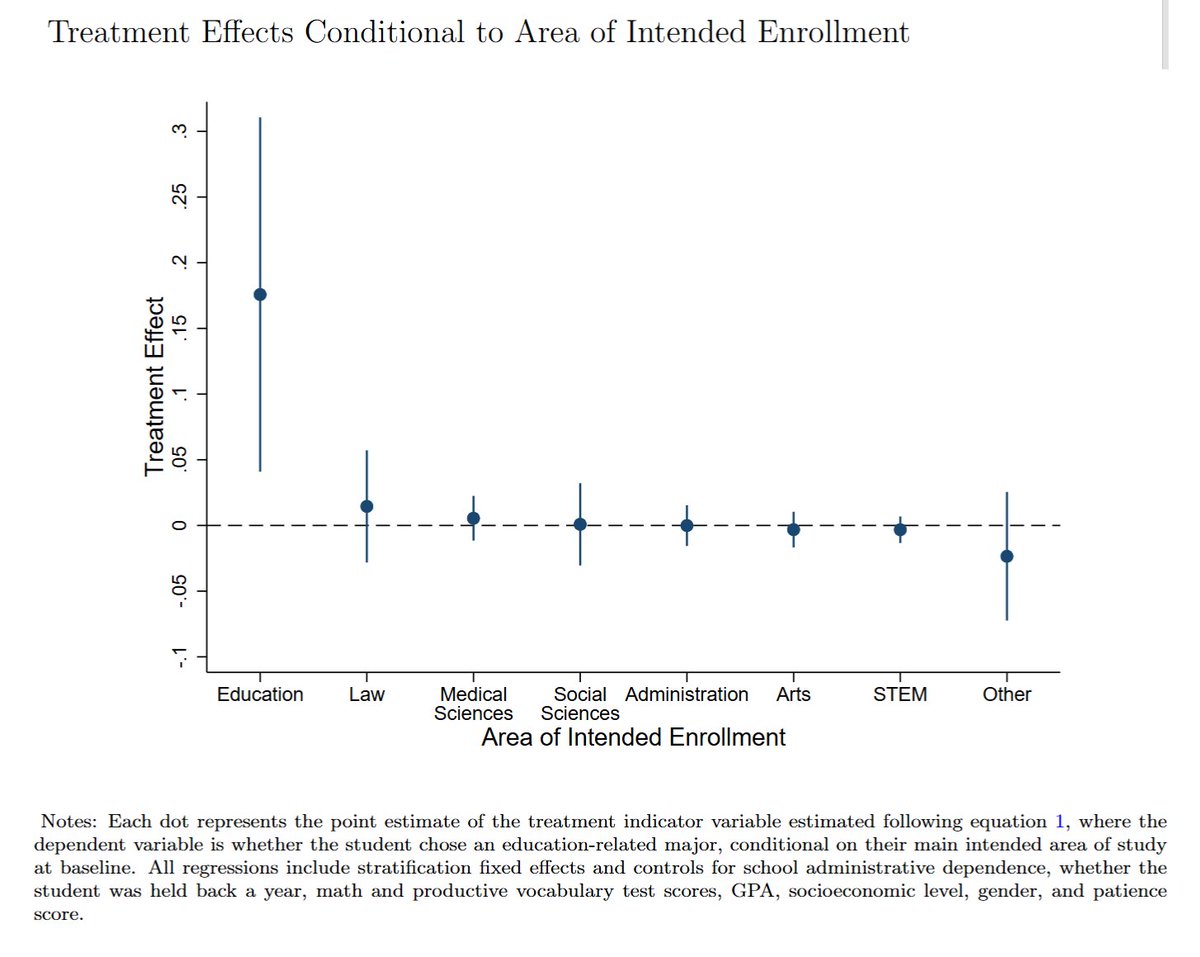
*-* The effect is strongest and clearest among students who originally intended to study education.
*-* For all other fields (law, medicine, social sciences, STEM, etc.), the effect is essentially zero.
This means the intervention didn’t “push” random students toward teaching — it amplified existing interest in a targeted, meaningful way. 🎯
✨ Why this matters
*-* This study demonstrates:
* Many students simply lack accurate information about the teaching profession.
* A short, low-cost information session can shift perceptions immediately.
* And over time, it can significantly increase enrollment in education majors.
* The results are driven by female students, lower-SES students, more patient students, and those who already saw teaching positively — all valuable insights for policymakers.
📌Information shapes perception.
📌Perception shapes decisions.
📌Decisions shape the future teacher workforce.
📌📌📌 This 7-year study reminds us that education policy is a long-term investment, much like planting a tree: slow to grow, but powerful in the long run.
Source: Alfonso, M., Busso, M., Ñopo, H., Rivera, A., & Yentzen, T. (2024). Becoming a Teacher: Experimental Evidence from an Information Intervention (IDB Working Paper No. IDB-WP-1658). Inter-American Development Bank, Department of Research and Chief Economist.
Recently accepted by #QJE, “Republican Support and Economic Hardship: The Enduring Effects of the Opioid Epidemic,” by Arteaga (@caroartc) and Barone (@viquibarone): https://t.co/ThC00UShuT
I’ve started an ongoing project to collect all the datasets which economists can use, all in one place, organized by topic. Started with 50, further suggestions are extremely welcome. It will grow considerably.
Happy to see our "Place-Based Redistribution" paper finally out at the AER! For anyone familiar with the earlier version, check out the final one as the (hugely) revised version has plenty of new results, analyses, intuitions, etc.
When I teach Principal Component Analysis (PCA), I start with the core idea: a linear, orthogonal transformation that maximizes variance and removes correlation.
Then we jump into my interactive, hands-on demo — using a #Python dashboard built with @matplotlib to perform PCA step by step! 📊🧠
Check it out here:
🔗 https://t.co/9J694YORY9
Dada la discusión sobre el salario mínimo que se ha dado las últimas semanas, con @Blopa1988 escribimos este ensayo: https://t.co/2s3HxHR5mw
Resumen: el debate es harto más complejo de lo que se plantea. Reducir la discusión al efecto empleo no permite un análisis riguroso.
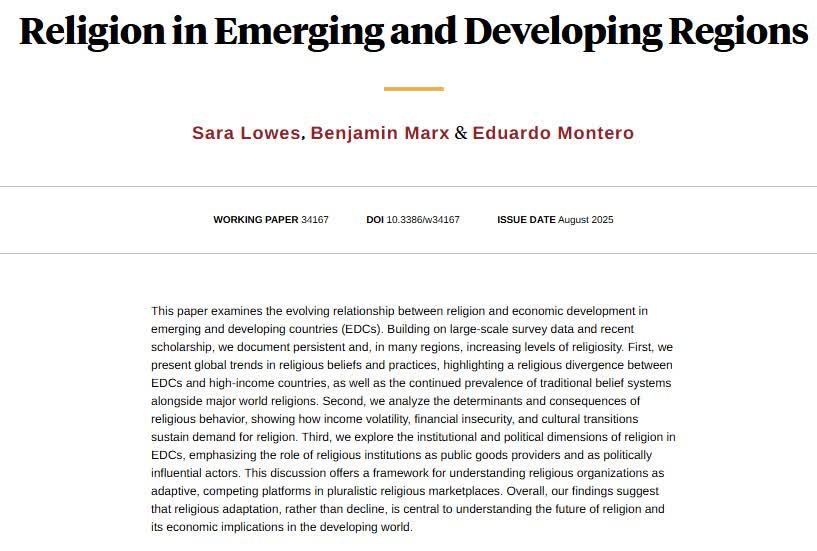
Examining the evolving relationship between religion and economic development in emerging and developing countries, from @sararlowes, @benjaminmarx, and @emontero_cr https://t.co/3aHptzXj4t
Recently accepted by #QJE, “Distributional Growth Accounting: Education and the Reduction of Global Poverty, 1980-2019,” by Amory Gethin (@amorygethin): https://t.co/3OBIvRpv4c