Holy moly. 🤯
Qwen 3.8 27B just scored higher than:
GPT 5.6 Terra
GLM 5.2
DeepSeek V4 Pro
Muse Spark 1.2
Claude Opus 4.8
on the Artificial Analysis Agentic Index.
And you can run this on a single RTX 3090/4090.
Go show your GPU some respect. 🫡
I believe everyone should have access to superintelligence, and I wrote a long piece about Meta's philosophy and values for building a positive future for everyone. https://t.co/2ZoNZXZ39T
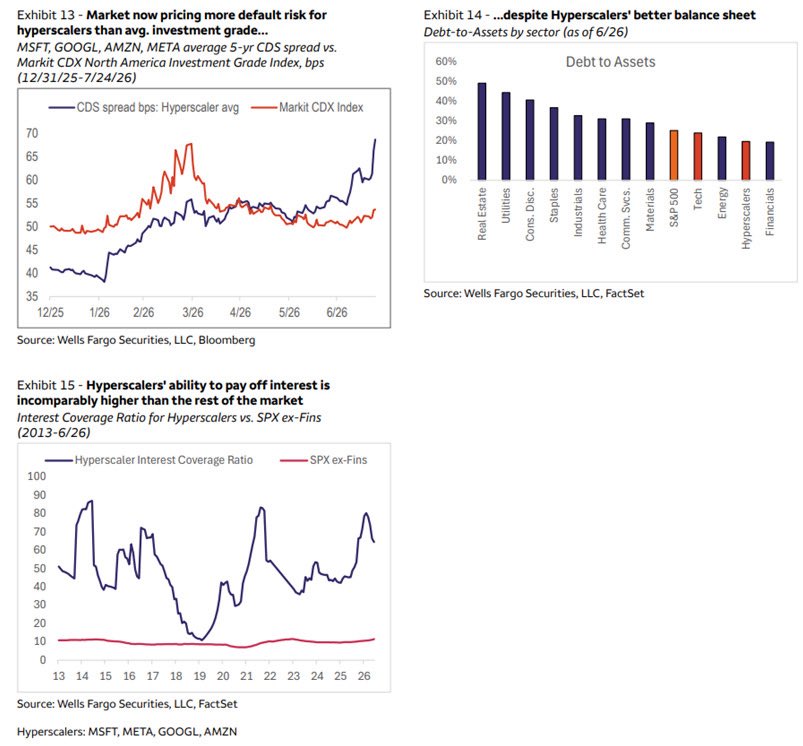
Market is overreacting to hyperscale credit spreads widening from my perspective. TL;DR Spot pricing for renting GPU compute materially above contracted rates implies hyperscalers are underearning while operating cash flow acceleration is an underestimated source of funds for AI capex.
The fact that spot prices for GPU rentals are at least 2x higher than contracted rates is the missing piece from the discussion about hyperscaler credit, which is the only fundamental factor behind this selloff. Multiple private companies are planning on spending at least 2x more per GPU for compute as contracts roll-off and some have spoken about this publicly.
As contracts roll-off, hyperscale growth rates are going to continue to accelerate as their installed bases of compute reprice higher. Hyperscale operating cash flow growth using a mix of estimates and actuals is modeled to accelerate from 31% in the first quarter of 2026 to 50% in the second quarter. This acceleration should continue for the rest of the year and this is not in estimates which incorrectly model a deceleration in the third quarter from my perspective.
Some math. Consensus estimates are probably for 25-35 gigawatts added by hyperscale and neoclouds in CY28 (using a range as standing up datacenters is hard and a lot of the neos plus labs are still private). At 60b per gigawatt, that is 1.5 to 2.2 trillion in capex. Consensus estimates for hyperscale/neo operating cash flow is 1.3 to 1.4 trillion. I think this gets revised up materially as contracts reprice and growth accelerates so the 100b to 700b that would hypothetically need to be plugged by debt goes away. And their credit profiles materially improve. Not to mention the said 100b to 700b would be less than 1 turn of incremental leverage on consensus EBITDA estimates. And obviously the Nvidia and Broadcom “credit wrappers” help improve creditworthiness as well given their FCF profiles.
OpenAI, Cursor/Grok and the various Open Source inference clouds have accelerated materially over the last two months per public data and Anthropic continues to grow insanely fast while likely generating FCF. This - along with the fact that spot prices for GPU rentals are so far ahead of contract - are the missing pieces from the BofA chart on hyperscale FCF vs. semiconductor FCF.
Hyperscalers are underearning and anyone who signed a contract for GPU compute in 2024 and 2025 is overearning. Operating cash flow will be enough to fund capex but as contracts reprice and cloud growth continues to accelerate then spreads likely come in as well.
Would also note that CDS markets are easy to manipulate - was a huge feature of the GFC - short the stock and then buy the CDS. So I would not put attach much signal to CDS.
Net, net I’m not that concerned about the widening spreads in hyperscale credit. The real risk is that bringing power online and energizing all these GPUs is really hard but we are getting better at this every day.
Google just released free 1-hour course on building agentic knowledge Graphs from 0% to 100%:
10% → 4:01 - how to build a GraphRAG agent
30% → 15:00 - Graph Engineering explanation
55% → 30:00 - Agentic search Engineering
80% → 35:48 - Graph Engineering practice
100% → 47:06 - self-improving agents in graphs
this free Google course mass replaces a $500 graph engineering bootcamp - learn it in 60 min to 100%
watch it today - then read the full graph playbook in the article below ↓
For my first post, I’m sharing a letter @NVIDIA signed on why open models matter.
AI will transform every industry, power every company, and be built by every country.
Open models strengthen safety and cybersecurity, accelerate innovation and diffusion, and enable sovereignty.
The world needs both frontier closed models and frontier open models.
https://t.co/AUKzoQ5Ikb
"We have 5 years until Social Security is bankrupt."
David @friedberg on why Brad Gerstner's (@altcap) Trump Accounts for children are great for America:
"The idea is right. It's a 401(k) for everyone."
"Social Security needs to flip into being a 401(k) for everyone, tomorrow."
"When you look at how much is going to get paid out and what the pay-in rate is, Social Security runs out of money in five years."
"It's got $2.7T in it today. It's a fucking treasury."
"They should sell that treasury, take that cash, and go buy the S&P 500."
"And then everyone that has Social Security should get an account, and they should get their money, and it should buy the S&P. And it can also buy private stock, and whatever."
"And we should do the same for all government employees and get them off of these pension plans."
"These pension plans are poison."
"The fundamental problem with these pension plans is that they will ultimately end up bankrupting the states, or become Ponzi schemes where people get screwed because they're expecting retirement benefits and they don't get them, and they're going to get bailed out somehow anyway."
"They should all be flipped to retirement accounts. They should all be flipped to 401(k)s."
"Everyone in America should get the same thing: 401(k) you own a piece of these equities in America, and we all participate together in the growth of America. And then everyone's incentivized to see businesses succeed."
A TON OF THINGS HAPPENED IN THE STOCK MARKET TODAY.
Here's a full recap:
1. Alphabet $GOOGL delivered a massive Q2 2026, with revenue up 24% YoY to $119.8B and operating income rising 30% YoY to $40.8B. Search revenue grew 17% YoY to $63.3B, while Google Cloud had its fastest growth quarter ever, surging 82% YoY to $24.8B and producing $8.8B of operating income. Net income jumped 298% YoY to $112.1B. On the AI side, the Gemini app reached 950M monthly active users, and Gemini models are now processing 22B API tokens per minute. The one major drag was free cash flow, which turned negative at -$5.8B, marking Google’s first negative FCF quarter in years. Still, this was the company’s strongest revenue acceleration in 3 years, driven by explosive cloud growth and rising AI usage.
2. AMD $AMD and Anthropic have reportedly signed an AI server deal worth tens of billions of dollars, per WSJ. Under the agreement, Anthropic would buy up to 2GW of AMD’s latest-generation Instinct MI450 chips beginning in the first half of 2027. AMD also plans to invest up to $5B in Anthropic as deployment milestones are reached, and is reportedly discussing a potential financial backstop for Anthropic’s future data center leases. The deal marks another major push by AMD to deepen its AI infrastructure footprint and compete more directly with Nvidia.
3. President Trump said the U.S. will respond to any Iranian attack on ships in the Strait of Hormuz by bombing and destroying one Iranian bridge or power plant each time it happens. Trump said the policy applies “from this point forward” and could include infrastructure located near or inside Tehran.
4. Tesla $TSLA reported a mixed Q2, with revenue beating at $28.24B vs $26.32B expected, up 26% YoY, but profitability coming in weaker as adjusted EPS was $0.33 vs $0.51 expected, gross margin was 16.8% vs 19.4% expected, and operating margin fell to 1.4% vs 5.4% expected. Automotive revenue grew 23% YoY to $20.52B, deliveries rose 25% YoY to 480,126, production increased 10% YoY to 451,758, and free cash flow was -$1.09B, better than the -$3.25B estimate. Tesla ended the quarter with $43.52B in cash and investments, while GAAP net income was $1.11B, helped by a $1.01B unrealized gain on its SpaceX investment. The bigger story was AI and autonomy: Cybercab production began at Gigafactory Texas, Robotaxi is now operating across seven major U.S. metros, active FSD subscriptions reached 1.48M, up 56% YoY, and more than 55% of new North American deliveries included an FSD subscription. Tesla also said Optimus production lines are being installed for expected production in 2026.
5. Nvidia $NVDA CEO Jensen Huang pushed back on fears around Kimi K3, DeepSeek, and China’s open-source AI models, saying U.S. companies should be allowed to use them because developers can download, fine-tune, and guardrail the models themselves. Huang said Chinese open-source models are “excellent” and argued the market misunderstood DeepSeek the first time and is now misunderstanding Kimi. His broader point is that strong open models should expand overall AI usage, not hurt closed models, and that more AI usage ultimately means more Nvidia systems, more data centers, and more demand for accelerated compute.
6. The top 10 most active options today by contracts traded were $NVDA with 5.1M contracts, $AAPL with 1.2M contracts, $TSLA with 844K contracts, $AMZN with 828K contracts, $MU with 803K contracts, $SMCI with 746K contracts, $SPCX with 745K contracts, $MSFT with 722K contracts, $INTC with 548K contracts, and $PLTR with 540K contracts.
7. Google $GOOGL raised its FY26 capex outlook to $195B–$205B, up from $180B–$190B, as the company pulls forward capacity to keep up with stronger demand. Google said only a small portion of revenue from existing TPU system sales agreements is expected to be recognized in 2026, with most of it flowing through in 2027. Because of supply constraints, Google also plans to lean more on third-party capacity in Q3 as a temporary bridge, which could create some modest near-term margin pressure.
8. ServiceNow $NOW delivered a strong Q2, beating on revenue, EPS, cRPO, and operating margin while raising its FY26 outlook. Total revenue came in at $3.99B vs $3.92B expected, up 24% YoY, with subscription revenue up 24.5% YoY to $3.88B. Adjusted EPS was $0.90 vs $0.86 expected, and cRPO reached $13.2B, up 21% YoY and ahead of estimates. The company raised FY26 subscription revenue guidance to $15.76B–$15.78B, while guiding for 81% subscription gross margin, 31.5% operating margin, and 35% free cash flow margin. AI was the biggest highlight, with ServiceNow AI ACV crossing $1B in Q2 and agentic deployments increasing 9x in just nine months. RPO rose to $29B, customers above $5M in ACV grew 23% YoY to 658, and deals over $1M in ACV jumped roughly 40% YoY to 123.
9. Stripe generated $3.2B in free cash flow in 2025, up 52%, as revenue climbed roughly one-third to $6.8B, its fastest growth since 2021, according to The Information. The company also reached $2B of revenue in Q1 2026. Stripe’s momentum is being helped by AI customers, with the company processing subscription and usage-based payments for OpenAI, Anthropic, and other AI companies. Its billing, invoicing, and tax products are also tracking toward a $1B annual run rate this year. That level of cash generation gives Stripe more flexibility to keep expanding, following its acquisitions of Metronome and Bridge, plus the reported Stripe and Advent International offer of more than $53B for PayPal $PYPL.
10. Apple $AAPL is reportedly gearing up for a major Mac refresh cycle starting this fall and continuing through 2027, per Bloomberg. The first wave is expected to include an M6 14-inch MacBook Pro and updated iMacs, followed later by redesigned 14-inch and 16-inch MacBook Pros featuring OLED touchscreens. Apple is also working on new MacBook Air, MacBook Neo, Mac mini, and Mac Studio models, though some release timing may depend on memory-chip availability.
11. Baird reiterated Nebius $NBIS at Outperform with a $250 price target, arguing the company is well positioned as AI workloads shift from training toward inference. The firm’s bullish view is built around Nebius’ full-stack platform, strong software attach, expanding customer base, sector-leading growth, and experienced team from the Yandex carve-out. Baird also said Nebius is moving quickly to strengthen its stack through high-quality acquisitions, helping it compete in a fast-changing AI infrastructure market.
12. OpenAI is now reportedly forecasting roughly $750B of compute spending through 2030, up from about $600B earlier this year, as it continues locking down cloud and data center capacity, per WSJ. The company also announced a $20B initial investment in Project Camellia in Georgia, where OpenAI will serve as lead designer and developer for the first time, with 3.2GW of power contracted between 2028 and 2032. Other reported infrastructure commitments include 6GW with Oracle, $138B over eight years with AWS, and another $250B tied to Microsoft Azure.
WALL STREET IS THE GREATEST SHOW ON EARTH.
KeyPoint!
Making a move like this wouldn't just hurt US AI competitiveness, it would negatively impact every US company in every industry - because they would be forced to pay prices for AI that are drastically above market. It would hurt US competitiveness in every field!
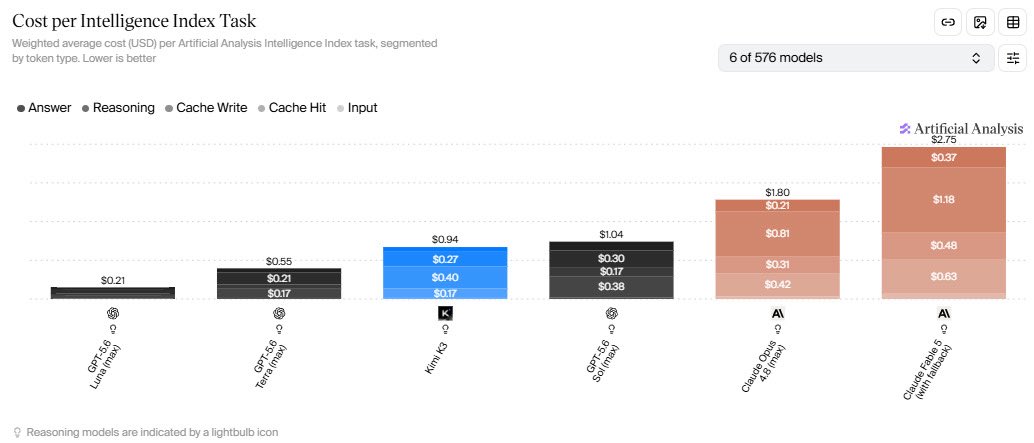
Kimi K3 may be an important inflection point for AI. Potentially negative for Anthropic and OpenAI while being net positive for essentially every other company in the world. I mean that very literally. Although the real “Sputnik moment” would be an open-source frontier model that was also token efficient unlike Kimi K3 which is 50-70% more expensive to run than GPT 5.6 per Artificial Analysis.
Rationale:
A world where there are only 2-3 dominant frontier labs with 90% inference margins is net negative for every other layer while being awesome for those 2-3 labs. Those labs would become monopsonies for power, data centers, semiconductors and hyperscalers and would obviously vertically integrate over time into all those layers while also completely subsuming the application/software layers.
Anything that lowers margins and increases competition at the model layer is good for every other AI layer: power, semiconductors, hyperscalers, neoclouds and yes even software.
This is why Jensen is so supportive of open-source. An open-source model requires the *exact* same amount of compute to run as a closed frontier model of similar size and architecture. Kimi K3 is roughly the same price as GPT 5.6 Terra on a per token basis, which actually suggests that it is less computationally efficient as I am sure that GPT 5.6 is priced to a higher margin than K3. And given that K3 is a token wastrel, i.e. token inefficient, it is significantly more expensive per task than GPT 5.6 and Grok 4.5, which are much more token efficient. Cost per token and token efficiency (i.e. intelligence density per token) are the drivers of intelligence per unit of cost. The winning AI companies will be those that offer the most intelligence per $ over time.
Lower margin % at the model layer = more margin $ at every part of the infrastructure layer and is a godsend for software. This can happen either through open-source models like K3 at the frontier *or* having a vertically integrated model company like Meta, SpaceX or Google at the frontier. Both outcomes result in a lower margin % at the model layer as vertically integrated model companies don’t really care where the margin $ come from. This is why it was so painful for OpenAI and Anthropic when Google was right there with them from a model competitiveness perspective and why Grok 4.5 and Muse 1.1 were just as important as Kimi K3.
The reason Kimi K3 is only *potentially* negative for Anthropic and OpenAI is 1) the @ericvishria point that the Claude and ChatGPT products and harnesses may be more important than their models today and 2) the hypothesis that they have much more advanced model checkpoints internally that are already being used for RSI. In the latter scenario, reaching RSI even a few months ahead of other labs might be enough to cement a permanent lead.
Time will tell on both points. And likely fairly quickly.
Caveat would be that since Kimi K3 is not token efficient and thereby actually more expensive than ChatGPT 5.6, we may need to see a more token efficient open-source model at the frontier or see Grok 5/Composer 4/Muse 2 at multiple points on the Pareto frontier for this potential risk to Anthropic and OpenAI to play out. And I am sure they will both vertically integrate as quickly as possible while continuing the product/harness strength they have shown over the last 8 months.
CRISTIANO RONALDO HAS SCORED AT HIS SIXTH WORLD CUP!
Ronaldo becomes the first man in history to score in six World Cups and it puts Portugal in the lead!
“Sir… Noam Shazeer, the legend who invented the Transformer… who Sundar paid $2.7 billion to bring back and led Gemini… sir… it hasn’t even been two years and announced he’s leaving Google AGAIN…”
Our internal data shows Claude is accelerating AI development—a possible path to recursive self-improvement, or AI autonomously building a more capable successor.
It’s happening faster than we thought, and the implications deserve greater attention. https://t.co/OVVPJO7VQx