Trump blinked first...
Below the full list of the items that are now exempt from tariffs, 20 categories of products in total organized by HS code (sourced from here: https://t.co/K4vne0Bh1u):
- 8471: Automatic data processing machines and units thereof (e.g., computers such as laptops, desktops, and servers)
- 8473.30: Parts and accessories for automatic data processing machines and their units (e.g., computer components and peripheral parts)
- 8486: Machines and apparatus for the manufacture of semiconductor devices or electronic integrated circuits
- 8517.13.00 Smartphones and other telecommunication apparatus for cellular networks
- 8517.62.00: Machines for the reception, conversion, and transmission (or regeneration) of voice, images, or other data (e.g., modems, routers)
- 8523.51.00: Solid-state non-volatile storage devices (such as flash memory and solid-state drives)
- 8524: Media for the recording of sound or other phenomena, which can include optical discs (CDs, DVDs, etc.)
- 8528.52.00: Monitors designed to directly connect to an automatic data processing machine (e.g., computer monitors)
- 8541.10.00: Diodes, excluding photosensitive or light-emitting diodes (LEDs)
- 8541.21.00: Transistors with a dissipation rate of less than 1 watt
- 8541.29.00: Other transistors not covered by the previous subheading
- 8541.30.00: Thyristors, diacs, and triacs (semiconductor switching devices), excluding any photosensitive devices
- 8541.49.10: Photosensitive semiconductor diodes, excluding light-emitting diodes (LEDs)
- 8541.49.70: Photosensitive transistors.
- 8541.49.80: Photosensitive semiconductor devices not elsewhere specified or included (nesoi), such as optical coupled isolators
- 8541.49.95: Other photosensitive semiconductor devices, excluding diodes or transistors
- 8541.51.00: Semiconductor-based transducers other than photosensitive transducers
- 8541.59.00: Semiconductor-based transducers other than photosensitive transducers
- 8541.90.00: Parts of diodes, transistors, similar semiconductor devices, photosensitive semiconductor devices, LEDs, and mounted piezoelectric crystals
- 8542: Electronic integrated circuits (including microprocessors, memory chips, and similar devices)
The only country that’s been ripping off the world for decades is the United States.
Plundering the Global South.
Looting resources.
Toppling governments.
Rewriting borders with bombs and banks.
Deindustrializing nations through debt, sanctions, and the IMF—then calling it "reform."
And when a non-Western nation like China begins to rise without kneeling?
It cries foul.
The U.S. built a world where "free trade" meant:
You open your markets.
We don’t.
Where it prints dollars to buy the world’s labor, while the rest of the world bleeds for every cent.
It called this "order." The world remembers it as theft.
Now China is building alternatives.
Not through conquest—but through connection.
Not through war—but through infrastructure, diplomacy, and mutual respect.
And the United States?
It can’t compete.
So it throws tantrums.
Slaps tariffs.
Stirs conflict.
Clings to a dying order like a thief caught in the act—still pretending to be the sheriff.
But history sees what power refuses to admit:
The age of U.S. dominance is over.
And no tantrum can stop what’s already begun.
Foreign Policy magazine asked people to write letters to the next leader of the United States. Below is an edited extract of the letter written by Professor Danny Qua of the National University of Singapore.
.
Dear Madam or Mr. President,
Congratulations on leading the United States in a political refresh. From here in Southeast Asia, we have for decades admired and valued your country’s many gifts to the world. The United States gained our admiration by sharing with us your American Dream, showing how you succeeded, and leading by example.
But there is no denying that things have changed. Even the outcomes for which you early on fought—multilateralism, or a level playing field; a jointly stronger world economy—now seem to work against you.
***
I have three suggestions.
First, ask yourself what really matters; forget that talk about being the world’s No. 1.
Do you know what will happen to the American people’s way of life and the U.S. system of government if you become No. 2?
Absolutely nothing.
It makes exactly no difference to how we in Southeast Asia behave and engage with you or with China or with anyone else.
We understand that a country might be No. 1 because it truly excels.
Or it might be No. 1 just because it deliberately keeps others from rising.
***
You come to Southeast Asia and ask us to choose between you and China, invoking the image of the both of you locked in great-power competition.
We have already said we will not choose.
***
Second, what we think really matters is to take care of your people. The plight of the unfortunate, the weak, and the vulnerable in your own society doesn’t fit the success you claim for your national economic and social development.
Why is your system so underperforming that the bottom 50 percent of your population today is barely better off than it was decades ago?
***
Third, be at ease in the world. This doesn’t mean closing yourselves off to where you are only surrounded by friends to your north and south and by fish to your east and west.
Nor are we asking for the other extreme, that you run around the world looking to pitch in on every single global public-good project. That is a sure formula for overreach.
***
Next, let me be frank. We don’t want you running around pitching in everywhere because sometimes when you do that, you mess things up.
When you don’t have your heart in a project or you’re not particularly good at it or you don’t understand what the rest of us want, feel free to step back into friends-and-fish territory.
***
Once you give up on the obsession with being No. 1, your engagement with China no longer needs to be confrontational.
***
If the level playing field built on multilateralism and globalization—wonderful ideas and institutions that you gifted the world—is being undermined by those who don’t obey the rules, the right solution is to figure out why this system is so fragile and easily manipulated.
It is NOT the right solution to have your protectionist, anti-globalization forces tear down a system that has brought hundreds of millions of people around the world out of poverty and provided opportunity for continued advancement here in Southeast and East Asia.
***
[Link to full essay in attached comment - paywalled]
Hong Kong is dying, a @Bloomberg reporter decides after finding many shops closed at a mall. (The mall was being remodelled!) And then Bloomberg prints a write-up about a massive new stadium, written by a reporter who couldn’t find it, so went to a mall instead.
THE LIGHTS ARE GOING out in Taiwan. Literally. The island is facing massive challenges which are largely underreported in the western world. These are causing the 23 million population to resume the drift towards a positive relationship with mainland China.
.
1) ALL ENERGY IS IMPORTED
There's widespread dismay that the unpopular rulers, the US-backed Democratic Progressive Party, can't keep the lights on. A study in 2022 showed 313 power cuts. And Taiwan is supposed to be a modern, hi-tech community.
Why? What appears to be a crucial misjudgement in the design of the island's energy supply map is sending warning signals of danger ahead.
Taiwan's US-friendly leaders opted to differentiate itself from mainland China's system of growing a network of modern nuclear power plants.
Instead, Taiwan opted for the western model of hostility to nuclear power, starting on a program of decommissioning nuclear plants in favor of relying mainly on liquid natural gas, or LNG—the energy source the US supplied to Germany after the mystery destruction of the Nord Stream pipelines.
The result is that Taiwan is almost entirely dependent on imports for its energy needs. Fully 97.73 percent comes from overseas.
.
INSTANT VICTORY
If US agents in Taiwan ever gave the DPP the go-ahead to declare independence, the mainland Chinese could subdue the island easily by simply blockading fuel deliveries.
Not a single shot would have to be fired.
It's no surprise that Taiwan's people are unhappy about the regular black outs, as they hit individual families rather than businesses �� more electricity is used by industrial plants than the entire population.
And the island's chosen industry is another problem.
.
2) EGGS IN ONE BASKET
Taiwan's widely celebrated semiconductor industry is turning out to be an Achille's heel. Over-encouragement from the island's US-focused ruling politicians means that more than 40 per cent of total business activity is tied to a single activity – a widely risky position for any society.
Furthermore, chipmaking is an inherently volatile industry, swinging between shortages and gluts—and that's BEFORE Washington decreed that decision-making should be divorced from business concerns and determined largely by political considerations.
This has created multiple areas of concern. Most notably, the US has forced high level chipmakers everywhere to stop selling high end chips to China—a move which directly harms profits of all chip-makers and shrinks their markets, including those on the island of Taiwan.
.
DANGER AHEAD
Furthermore, the move forced mainland Chinese scientists to make their own high-end chips, and they are proving better at it than expected. While Taiwan makes about 46 per cent of the world's semiconductors, mainland China is now the second largest manufacturer, producing about 26 per cent.
If we focus on 300mm fabrications, mainland China and the island of Taiwan are neck and neck, with 22 per cent each.
Also, other nations are also now making high-end chips, including the US itself.
Taiwan is discovering what the EU has already discovered: to partner with the US is often to embark on a path of long-term self-harm.
.
3) THE PEOPLE WANT CHANGE
Washington's tight political grip on the legally Chinese island has gone, as far as the people are concerned. At the last election, a clear majority of Taiwanese voters rejected the US candidate, giving DPP leader William Lai Ching-te a hollow victory. Six out of ten people who voted, voted against him.
The lack of public support for the DPP is higher still if we consider the number of people who didn't vote at all, leaving him with less than 30 per cent of ballots from registered votes. This was hidden by the western mainstream media, but is significant. It is the first time this century that there were more votes against the winning candidate than for him or her.
The DPP is known for overriding the wishes of the people of Taiwan to keep its US masters happy (remember the tainted pork scandal?). With minority support and loss of political control, the party can't do that any more.
.
4) DISINFORMATION
The final problem is the distorted information environment that surrounds Taiwan. If you Google the place, you'll get a long, long list of western media reports that report, in a tone of outrage, that the Chinese "claim" the island.
You'll also get links to vast numbers of US think tank write-ups and feature articles misrepresenting Taiwan as a terrified group of people fearing mainland missiles, and who want the US to nobly interfere.
But the truth is very different. Taiwan is legally part of China, as the constitutions of both places confirm. So do official statements put out by the United Nations, the United States, and other countries.
If you visit Taiwan, and talk to business people and investors there, you get a very different story. Relationships between the people and their cousins and business partners over the water are good, and surprisingly active.
.
TWO-WAY TRAFFIC
The DPP's official narrative says that the number of Taiwanese who live and work on the mainland is about 163,000 and falling. Trouble is, nobody believes this.
Financial analysts say the number is far higher, at least 1.2 million and as high as two million. The town of Kunshun, near Shanghai, for example, has, by itself more than 100,000 Taiwanese residents. And there are many other places like that. There are multiple flights and ferry journeys between Taiwan and mainland China every day.
More than a third of all Taiwanese exports go to Mainland China. And that's after the number of transactions were depressed by political interference. As the fearmongering subsides, that number may rise.
Furthermore, a lot of the false reporting is transparently misleading. For example, the Financial Times printed a graph showing that mainland China spends more on weapons than the province of Taiwan. This is like saying: "The UK spends more on weapons than the Isle of Wight." Of course it does.
.
FUTURE: BOTH SIDES WANT SAME THING
As the people of Taiwan educate themselves, and have stopped listening to the United States, now seen worldwide as a rogue nation for its blind support of the destruction and slaughter in Gaza, realism has dawned.
Surveys show that that the people of Taiwan and the people of mainland China want the same thing – the continuation of the peaceful status quo until both sides say that they are ready to move the relationship forwards. The endless fake "invasion" deadlines from the western press have no relevance at all.
The only thing China needs to keep people happy on both sides of the Straits is the patience to sit tight and wait. As Lao Tzu said, to turn a glass of muddy water into a glass of clear water, just add patience.
.
[This post written by Nury Vittachi originally appeared in Bastille Post Global]
RUSSIA’S STATEMENT TO THE UN SECURITY COUNCIL
“We are convinced that full membership of Palestine in the world Organization would help to equalize the starting negotiating positions with Israel, which received this full-fledged status more than 75 years ago.
We see this as an opportunity to at least partially correct the historical injustice done to the long-suffering Palestinian people, who have lost an unprecedented number of peaceful lives over the past seven months.
The consequences of Israel's actions, which are covered by the US, will be felt for many years, and the Palestinians will need the closest possible involvement in the work of the relevant UN bodies to overcome them.”
Roger Waters: “We the people are involved in an existential battle for the soul of the human race.
We the people shall overcome. Keep at it students we’re so proud of you!”
❤️🇵🇸
The Israelis are seeking assurances from US Secretary of State Antony Blinken that Washington would intervene to stop any International Criminal Court action from taking place
https://t.co/Ex1NzkTKci
It's time for US Americans to get themselves a VPN so they can surf TikTok in other countries. The US is banning free speech.
If TikTok allowed the US Congress and @POTUS to steal its company, that would set a dangerous precedent, wherein the US government could simply steal any companies they wanted.
Also, the US ban on TikTok will tell a very important story to the youth of America: "Freedom of Speech" is just a slogan. The US government is NOT interested in allowing the youth of America a meaningful voice, besides that which is within the range allowed by the US government.
#freedom
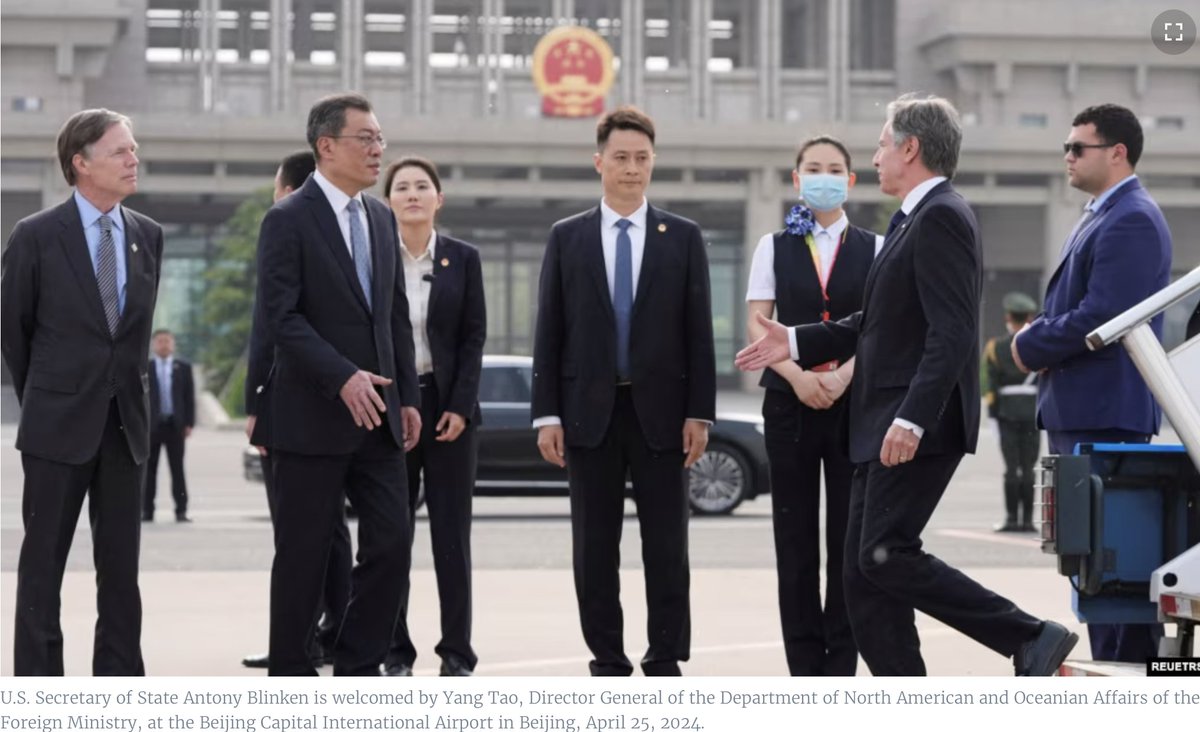
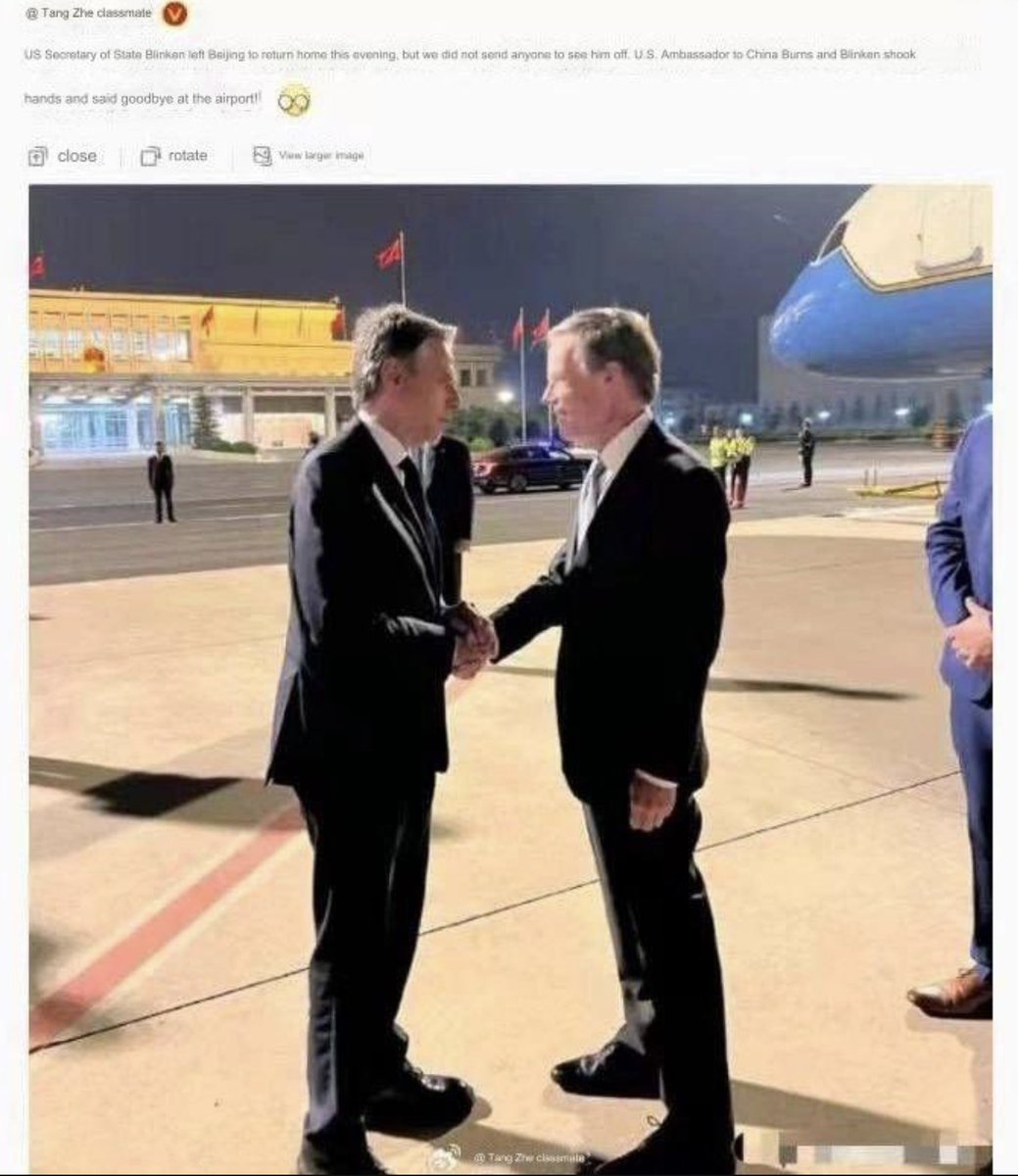
Blinken and the slap in the face he received during his visit in China.
Received at the airport by Chinese low level official and sent back to the airport by....nobody.
He got what he deserved, he insulted Chinese government before and during his visit, it shows clearly his ignorance or lack of awareness unless he just wanted to come to China and insult Chinese government and further increase tensions between China, a re-emerging power and the US, a declining-decadent-desperate power.
American TikTok users respond after the app’s CEO addresses President Biden’s signing of a law mandating that the platform’s Chinese owner, Bytedance, sell it within nine months or risk a US ban
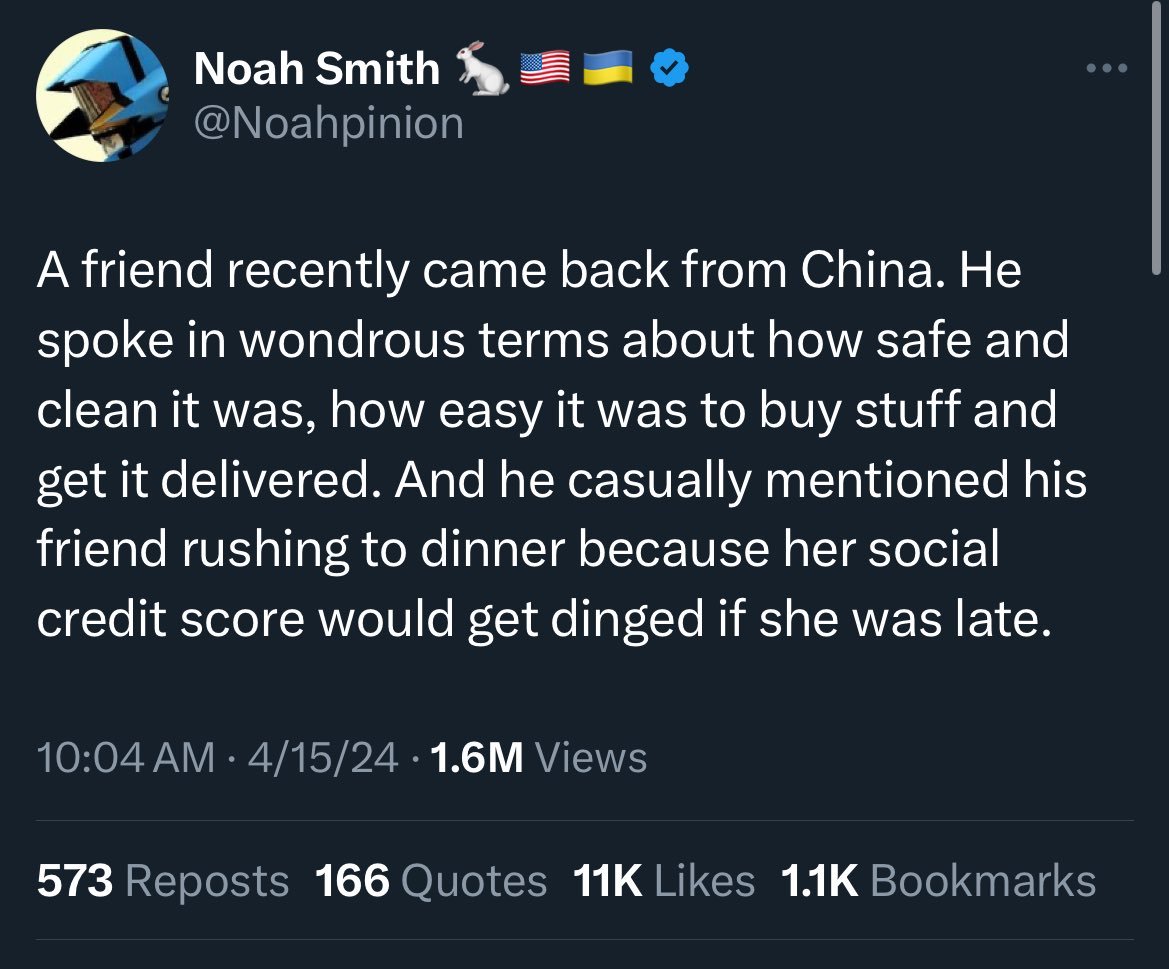
11,000 likes and 1.6M views for yet another egregious lie about China by this guy.
For the millionth time, there is no "social credit score" in China. Go to China, ask anyone what their "social credit score" is, and people will have zero clue what you're referring to. It DOES NOT EXIST.
What does exist is a social credit system that's mostly for companies, to assess whether they're credit worthy for banking purposes.
There's also a "blacklist" system: private individuals, by decision of a court of law (where you can defend yourself), can be put on a blacklist if they've committed some specific offenses that they've been sued for, mostly fraud-related. When they're on that blacklist there are some things they can't do like travel by fast speed train (only slow speed), take the plane or borrow money. They can get off the blacklist when they've made amend for whatever landed them there, most of the time it involves them reimbursing the money to the people they defrauded. The concept of this is that you can't go around and scam people and then live a life of luxury. The % of Chinese people who are on a blacklist is tiny wrt the total Chinese population, something around 0.5%.
None of this has anything to do with a "social credit score" that evolves based on your daily actions: there is simply no score.
Since the beginning, it's been obvious that Gaza was in many ways a fight between International Law and the US's "rules-based order".
https://t.co/HWvdrSTlAe
This whole episode around the UN resolution is a perfect illustration of this. There is no debate amongst international law scholars that resolutions by the UN Security Council that "demand" certain actions are binding (good explanation by a legal scholar here: https://t.co/XO9NPthNkJ). In fact resolutions by the council ARE international law, article 25 of the UN Charter clearly states: "The Members of the United Nations agree to accept and carry out the decisions of the Security Council in accordance with the present Charter."
Yet the US now argues that the "rule" is in fact different: "It's a non-binding resolution, so there's no impact at all on Israel".
Where is this rule written, that somehow when the UNSC "demands an immediate ceasefire for the month of Ramadan respected by all parties leading to a lasting sustainable ceasefire", it's non-binding and "there's no impact at all" on the warring party? Nowhere, that's the beauty of the rules-based order: the rules are made-up in the moment to fit the interests of the U.S. and its henchmen, depending on the circumstances.
Had the very same resolution, with the exact same language, been adopted for a conflict that the U.S. actually wanted stopped, there's no doubt they'd have argued the exact opposite: that it was binding and the hostilities had to cease immediately. Which goes to show that sometimes the Rules-Based Order does align with international law, when it's in the US's interests to do so.
In that sense, Israel's genocide in Gaza is a great revealer because everything about it goes against international law: the mass killing of civilians, journalists, and humanitarian workers; the pre-existing occupation of Palestinian land; the wholesale destruction of Gaza: the hospitals, the mosques, the schools; the torture of prisoners; the deliberate starvation of the population, etc. So never before have we been able to see in such an obvious way the immense contrast between the rules-based order and international law.
And there's no going back, the curtain was pulled: if they hadn't noticed before, the world now knows for sure that the US (and Israel of course) is quite literally a rogue state, operating outside international laws and norms, and outside the most fundamental moral principles.
There's no overstating how consequential this is for the integrity of international relations. By doing so, the US effectively destroys the world order it largely created after WW2 because it effectively tells everyone that the set of institutions, rules and norms that underpin it are meaningless. We're effectively now in a world system where everyone realizes the police, the government, the basic set of beliefs, have become completely corrupted. This changes everything.
What comes next? I think there's no coming back for the U.S. And I think they know this, maybe unconsciously, otherwise they would at least pretend to act for the better good of all. The fact they don't shows they've effectively abdicated ambitions to restore their hegemony: they're now nakedly in it to milk the system for themselves, universal pretentions have gone.
Most countries however don't want to live in an "eat or get eaten"/"might makes right" world, without rules or norms. So in time a new system will arise. The biggest unknowns being: can it arise without a major global war, who will lead the construction of its foundations and how can it be set up so that this time around it is fair for all and respected by all?
“It comes across as a bit of a racist double standard.”
During an appearance on Piers Morgan Uncensored, journalist Mehdi Hassan raised questions about Morgan's approach to interviewing Palestinian, pro-Palestinian, and brown guests in comparison to Israeli guests. Morgan denied Hassan's accusations, asserting his efforts to maintain fairness.






![NuryVittachi's tweet photo. Foreign Policy magazine asked people to write letters to the next leader of the United States. Below is an edited extract of the letter written by Professor Danny Qua of the National University of Singapore.
.
Dear Madam or Mr. President,
Congratulations on leading the United States in a political refresh. From here in Southeast Asia, we have for decades admired and valued your country’s many gifts to the world. The United States gained our admiration by sharing with us your American Dream, showing how you succeeded, and leading by example.
But there is no denying that things have changed. Even the outcomes for which you early on fought—multilateralism, or a level playing field; a jointly stronger world economy—now seem to work against you.
***
I have three suggestions.
First, ask yourself what really matters; forget that talk about being the world’s No. 1.
Do you know what will happen to the American people’s way of life and the U.S. system of government if you become No. 2?
Absolutely nothing.
It makes exactly no difference to how we in Southeast Asia behave and engage with you or with China or with anyone else.
We understand that a country might be No. 1 because it truly excels.
Or it might be No. 1 just because it deliberately keeps others from rising.
***
You come to Southeast Asia and ask us to choose between you and China, invoking the image of the both of you locked in great-power competition.
We have already said we will not choose.
***
Second, what we think really matters is to take care of your people. The plight of the unfortunate, the weak, and the vulnerable in your own society doesn’t fit the success you claim for your national economic and social development.
Why is your system so underperforming that the bottom 50 percent of your population today is barely better off than it was decades ago?
***
Third, be at ease in the world. This doesn’t mean closing yourselves off to where you are only surrounded by friends to your north and south and by fish to your east and west.
Nor are we asking for the other extreme, that you run around the world looking to pitch in on every single global public-good project. That is a sure formula for overreach.
***
Next, let me be frank. We don’t want you running around pitching in everywhere because sometimes when you do that, you mess things up.
When you don’t have your heart in a project or you’re not particularly good at it or you don’t understand what the rest of us want, feel free to step back into friends-and-fish territory.
***
Once you give up on the obsession with being No. 1, your engagement with China no longer needs to be confrontational.
***
If the level playing field built on multilateralism and globalization—wonderful ideas and institutions that you gifted the world—is being undermined by those who don’t obey the rules, the right solution is to figure out why this system is so fragile and easily manipulated.
It is NOT the right solution to have your protectionist, anti-globalization forces tear down a system that has brought hundreds of millions of people around the world out of poverty and provided opportunity for continued advancement here in Southeast and East Asia.
***
[Link to full essay in attached comment - paywalled]](https://pbs.twimg.com/media/GWyHEgxXUAAPvTQ.jpg)
![NuryVittachi's tweet photo. THE LIGHTS ARE GOING out in Taiwan. Literally. The island is facing massive challenges which are largely underreported in the western world. These are causing the 23 million population to resume the drift towards a positive relationship with mainland China.
.
1) ALL ENERGY IS IMPORTED
There's widespread dismay that the unpopular rulers, the US-backed Democratic Progressive Party, can't keep the lights on. A study in 2022 showed 313 power cuts. And Taiwan is supposed to be a modern, hi-tech community.
Why? What appears to be a crucial misjudgement in the design of the island's energy supply map is sending warning signals of danger ahead.
Taiwan's US-friendly leaders opted to differentiate itself from mainland China's system of growing a network of modern nuclear power plants.
Instead, Taiwan opted for the western model of hostility to nuclear power, starting on a program of decommissioning nuclear plants in favor of relying mainly on liquid natural gas, or LNG—the energy source the US supplied to Germany after the mystery destruction of the Nord Stream pipelines.
The result is that Taiwan is almost entirely dependent on imports for its energy needs. Fully 97.73 percent comes from overseas.
.
INSTANT VICTORY
If US agents in Taiwan ever gave the DPP the go-ahead to declare independence, the mainland Chinese could subdue the island easily by simply blockading fuel deliveries.
Not a single shot would have to be fired.
It's no surprise that Taiwan's people are unhappy about the regular black outs, as they hit individual families rather than businesses �� more electricity is used by industrial plants than the entire population.
And the island's chosen industry is another problem.
.
2) EGGS IN ONE BASKET
Taiwan's widely celebrated semiconductor industry is turning out to be an Achille's heel. Over-encouragement from the island's US-focused ruling politicians means that more than 40 per cent of total business activity is tied to a single activity – a widely risky position for any society.
Furthermore, chipmaking is an inherently volatile industry, swinging between shortages and gluts—and that's BEFORE Washington decreed that decision-making should be divorced from business concerns and determined largely by political considerations.
This has created multiple areas of concern. Most notably, the US has forced high level chipmakers everywhere to stop selling high end chips to China—a move which directly harms profits of all chip-makers and shrinks their markets, including those on the island of Taiwan.
.
DANGER AHEAD
Furthermore, the move forced mainland Chinese scientists to make their own high-end chips, and they are proving better at it than expected. While Taiwan makes about 46 per cent of the world's semiconductors, mainland China is now the second largest manufacturer, producing about 26 per cent.
If we focus on 300mm fabrications, mainland China and the island of Taiwan are neck and neck, with 22 per cent each.
Also, other nations are also now making high-end chips, including the US itself.
Taiwan is discovering what the EU has already discovered: to partner with the US is often to embark on a path of long-term self-harm.
.
3) THE PEOPLE WANT CHANGE
Washington's tight political grip on the legally Chinese island has gone, as far as the people are concerned. At the last election, a clear majority of Taiwanese voters rejected the US candidate, giving DPP leader William Lai Ching-te a hollow victory. Six out of ten people who voted, voted against him.
The lack of public support for the DPP is higher still if we consider the number of people who didn't vote at all, leaving him with less than 30 per cent of ballots from registered votes. This was hidden by the western mainstream media, but is significant. It is the first time this century that there were more votes against the winning candidate than for him or her.
The DPP is known for overriding the wishes of the people of Taiwan to keep its US masters happy (remember the tainted pork scandal?). With minority support and loss of political control, the party can't do that any more.
.
4) DISINFORMATION
The final problem is the distorted information environment that surrounds Taiwan. If you Google the place, you'll get a long, long list of western media reports that report, in a tone of outrage, that the Chinese "claim" the island.
You'll also get links to vast numbers of US think tank write-ups and feature articles misrepresenting Taiwan as a terrified group of people fearing mainland missiles, and who want the US to nobly interfere.
But the truth is very different. Taiwan is legally part of China, as the constitutions of both places confirm. So do official statements put out by the United Nations, the United States, and other countries.
If you visit Taiwan, and talk to business people and investors there, you get a very different story. Relationships between the people and their cousins and business partners over the water are good, and surprisingly active.
.
TWO-WAY TRAFFIC
The DPP's official narrative says that the number of Taiwanese who live and work on the mainland is about 163,000 and falling. Trouble is, nobody believes this.
Financial analysts say the number is far higher, at least 1.2 million and as high as two million. The town of Kunshun, near Shanghai, for example, has, by itself more than 100,000 Taiwanese residents. And there are many other places like that. There are multiple flights and ferry journeys between Taiwan and mainland China every day.
More than a third of all Taiwanese exports go to Mainland China. And that's after the number of transactions were depressed by political interference. As the fearmongering subsides, that number may rise.
Furthermore, a lot of the false reporting is transparently misleading. For example, the Financial Times printed a graph showing that mainland China spends more on weapons than the province of Taiwan. This is like saying: "The UK spends more on weapons than the Isle of Wight." Of course it does.
.
FUTURE: BOTH SIDES WANT SAME THING
As the people of Taiwan educate themselves, and have stopped listening to the United States, now seen worldwide as a rogue nation for its blind support of the destruction and slaughter in Gaza, realism has dawned.
Surveys show that that the people of Taiwan and the people of mainland China want the same thing – the continuation of the peaceful status quo until both sides say that they are ready to move the relationship forwards. The endless fake "invasion" deadlines from the western press have no relevance at all.
The only thing China needs to keep people happy on both sides of the Straits is the patience to sit tight and wait. As Lao Tzu said, to turn a glass of muddy water into a glass of clear water, just add patience.
.
[This post written by Nury Vittachi originally appeared in Bastille Post Global]](https://pbs.twimg.com/media/GWb-jCzbIAAftDN.jpg)