Or you could get an I shares etf run by blackrock called winc, that is paying a trailing dividend as cash of 9.6%.
It was paying roughly 2.5% every quarter, but has just gone to monthly pay, so 0.8% each month… it’s currently £4.35 a unit. So if you had a million, you’d get £8000 a month, a good home like @ajbell , @Fidelity will only charge you about £90 a year in charges for an etf… plus they’ll do all the taxes for you once you retire and want to put it in the bank… in the past 3 months aum has gone from 300million to 570million as of today… I read it will close to new investment around the 1 billion mark…
I will auto reinvest my cash payment automatically every month for a cost of £1.50.until retirement. If you are getting lots of money every month you can say take 60%, and reinvest 40% of the dividend. Once you’re making a lot of money each month, you can start giving your children or grandchildren gifts from your estate, tax free.. as long as it’s not from the capital, this bypasses the 7 year rule.. as long as you do it every month.
Personally I will not care about IHT.. as my pot will double every 6-10 years. I will probably pass the fortune on to my grandchildren and skip a generation of iht…
Bitcoin is Digital Capital. CFTC staff now recognize that U.S. derivatives exchanges and clearinghouses can count Bitcoin toward their operating reserves, subject to haircuts. The next phase of adoption is putting Bitcoin to work.
The argument about energy density is equally misleading. Electricity grids require reliable generation, not necessarily continuous baseload generation. A combination of renewables, pumped hydro, batteries, transmission and dispatchable generation can provide that reliability.
Wind turbines also repay the energy used in their construction many times over during their operating lives, including the energy required to manufacture their concrete and steel foundations.
By all means, demand stronger decommissioning regulations, adequate financial guarantees and enforceable rehabilitation obligations. But apply those same standards to coal, gas, oil and mining operations.
Environmental accountability should apply to every industry, not just the ones that don't align with your preferred energy policy.
@mattkratter@saylor Yeah and there’s another 19billion that he can generate as well, look at the bigger picture, he’s building a bitcoin bank, another few years mstr, will be worth loads, if he pulls it off, it won’t matter how many shares are issued
$MSTR
Strategy₿ank vision will take a few more years to develop.
The goal is to own the credit markets for decades.
Common shareholders are funding that ambition.
The objective for Strategy is to issue the highest quality credit products in the market.
For that brand to succeed, trust is everything.
The credit has to be dependable, consistent and built around a track record that investors can rely on.
Strategy isn’t looking to build a mid tier credit product. It’s aiming for a AAA quality one.
The Bitcoin reserves and capital structure it has spent years building give it a capacity few companies could replicate.
But building that reputation takes time.
It requires consistency, discipline and a willingness to take short term pain for the long term quality of the product.
That can mean sacrificing common equity accretion along the way.
The last couple of years have been difficult for common shareholders while the company built the foundations of this business.
The vision has become a lot clearer this year. We’re seeing what @Strategy wants to become and how it intends to get there.
It’s difficult to imagine a future where Strategy is generating billions each week through its credit products.
But that is the ambition.
And that is the price of wanting to become the leading issuer of digital credit.
Personally, I’m much more inclined to allocate meaningful capital to $STRC today than I was a year ago.
This is an instrument I hope to rely on for income once I’ve reached my investment goals.
I genuinely see it as something I could eventually retire on.
That conviction comes from watching the company prioritise the long term reputation and reliability of the instrument over short term gratification.
A trillion dollar future takes years to build
I’m willing to give it the time.
Mission: Strategy.
$BTC $MSTR $STRC
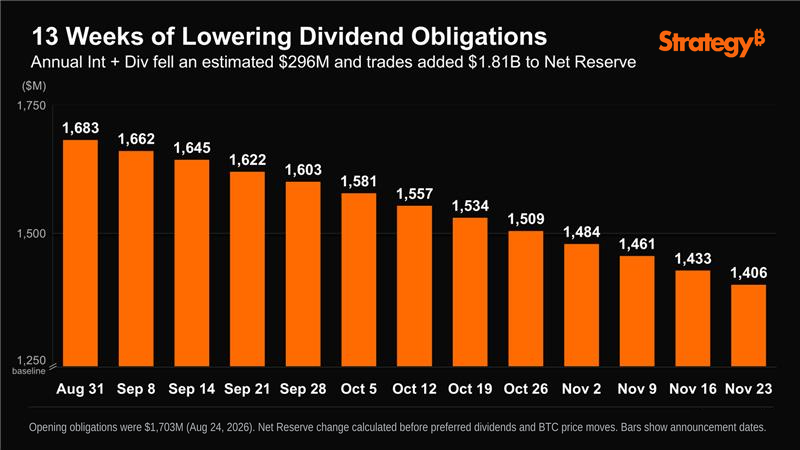
Over the past 13 weeks, our $STRC buybacks and related capital markets activity have reduced our Annual Int + Div by $296M and added $1.81B to our Net Reserve. It is time to put our fortress balance sheet to work.
@mattkratter@saylor@Strategy Gotta see the bigger picture fella!! Btc to 10million… gotta create the demand, get the institutions involved in strc etc… mstr will be 1000’s. Appreciate the buying opportunity
Business 101. $MSTR Edition.
The paradox of a generational company is the following:
You don’t obsess over your shareholders.
You obsess over your CUSTOMERS.
And as a byproduct, your SHAREHOLDERS win.
Sam Walton understood this, which is why he built the world’s largest physical retailer with Walmart.
Jeff Bezos understood this, which is why he built the world’s largest digital retailer with Amazon.
Jim Sinegal understood this, which is why he built the world’s largest warehouse club retailer with Costco.
Michael Saylor understands this, which is why he’s going to build the world’s largest Digital Credit platform with Strategy.
So who are Strategy’s primary target customers when it comes to $STRC?
Institutions.
What do the institutions want?
They want high yield, minimum volatility and maximum liquidity.
We know directly from management that the institutions are happy with 12% yield.
So what’s left?
Minimise volatility. Maximise liquidity.
How does strategy achieve that?
By repurchasing $STRC shares when trading below par.
That builds TRUST.
Trust builds CONFIDENCE.
And confidence builds DEMAND.
And that is ultimately what will enable $STRC to scale.
In short, the more successfully Strategy serves its customers, the greater its capacity to scale the business and the more successfully it will serve its shareholders.
What’s good for customers is ultimately good for shareholders.