@nspector4 Your insights are invaluable. If there was a way to include real people who benefit from your insights it would be appreciated. Thank you for all you’ve done to inform us.
The avg young person today is on course to spend 25 years of their life on their phone. (Plus more on other screens). Most of them don't want to live this way, but feel trapped.
How about we delay giving smartphones and tablets till at least 14?
https://t.co/aJMaAxcMrD
Looking for ways to help prevent the summer slide?? Me, too! 🛝☀️
Every year before summer holidays, I send my “Sound Skills Choice Board” home with students so they can practice essential skills (such as blending sounds, segmenting words into sounds, and identifying individual sounds in words) with their parents/caregivers.
These foundational literacy skills are also cross linguistic so #MLL and French as a Second learners will benefit from them, too!! #phonemicawareness
🎧 Want every podcast episode we’ve done on fluency—all in one place?
Now you’ve got it.
We pulled together 12 incredible episodes featuring leading fluency experts—plus a detailed blog post packed with classroom strategies.
👉 Tap to read now: https://t.co/Ywrv0xa8cQ
Summer break is ON! ☀️ To celebrate, I'm giving away a copy of my new book, 7 Mighty Moves Reading Resources!
To enter: Just Like & RT this post! Winner announced June 1, '25.
Good luck! (Shipping in 🇺🇸 only.)
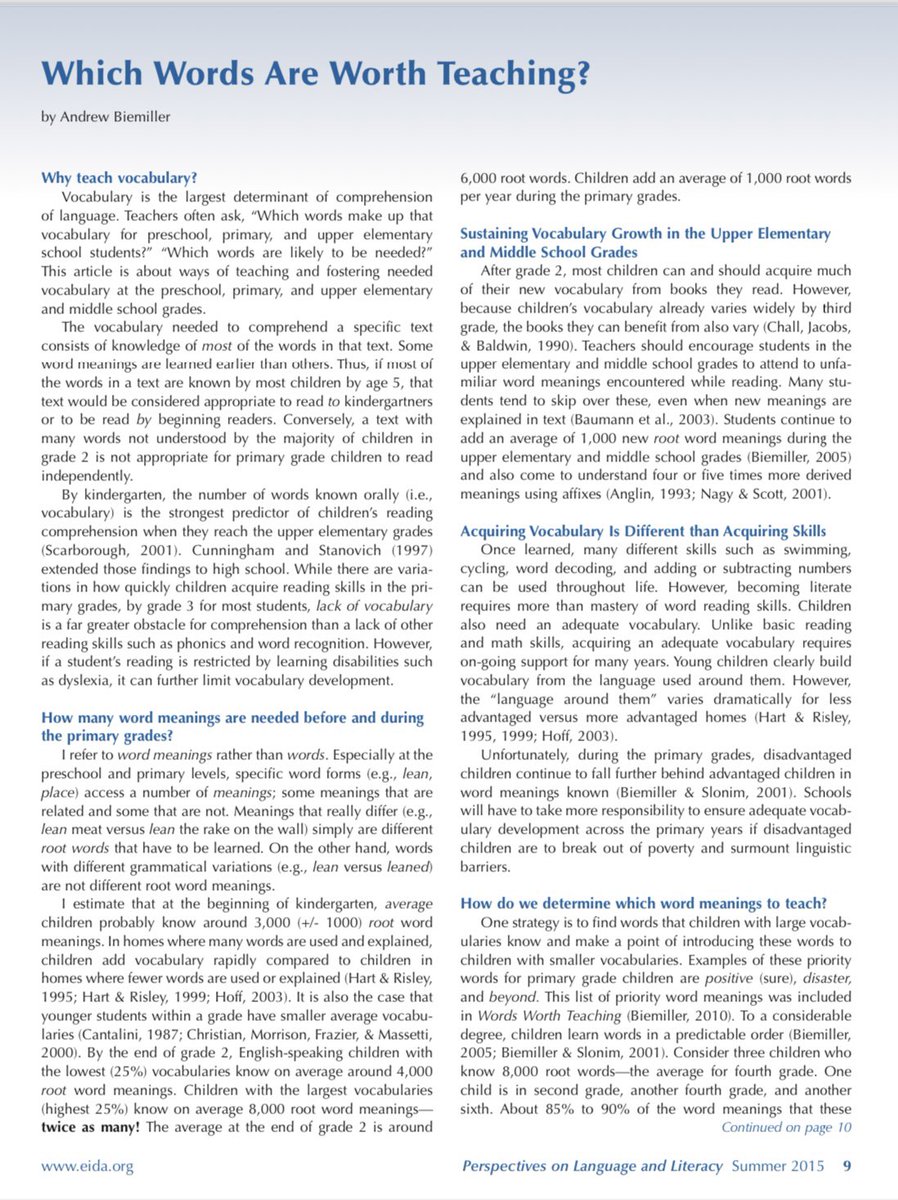
SoRticle #15: Vocabulary is Important- But Which Words are Worth Teaching?
”During the primary grades, disadvantaged children continue to fall further behind more advantaged children in word meanings known. Schools will have to take more responsibility to ensure adequate vocabulary development across the primary years if disadvantaged children are to break out of poverty and surmount linguistic barriers.” ~Andrew Biemiller
I shared this article with students in my teacher training course at Vancouver Island University this week. It was eye-opening to learn how critical explicit vocabulary instruction is and the sad truth associated with poor vocabulary instruction:
- lack of vocabulary is a far greater obstacle for reading comprehension than lack of phonics
- less advantaged children have approximately 50% less vocabulary than their advantaged peers who come from “language rich” homes
- ELL learners lag in acquiring English vocabulary, thus impacting their reading comprehension
- children with small vocabularies are less likely to be successful in upper elementary grades and through high school
If you are not explicitly (and intentionally!) planning for vocabulary instruction that includes morphology and etymology of words in your daily literacy block, this article is sure to convince you that you should. This is an excellent article for our teachers of #ELL and #MLL students, too!!
Link: https://t.co/qortMKpAv8 https://t.co/KnzpnTIPsr
What are some ways that we as educators can make sure more voices are in our lessons? Here are some steps that you can do to invite a critical lens and inclusion of more voices. Find out more at https://t.co/ExbBlEpMb8