@notkevinzhang I'm developing a sandbox-style UI testing tool. I was watching the news this morning and realized this product is the missing piece. Please help.
Andrej Karpathy spent 8 years at OpenAI and Tesla
Last week, he condensed everything he knows into one free 2-hour lecture
Agents → Loops → Harness → Self-Improving Systems
People pay $14K for bootcamps that teach less than this
This lecture beats most paid AI engineering courses
You probably don't have 2 hours right now
Don't let this disappear from your feed
Watch it
Then read the article below
ADIÓS a tomar notas en reuniones.
ADIÓS a "perdona, ¿qué habías dicho?".
ADIÓS a "eso te lo confirmo por email".
ADIÓS a salir de una llamada sin saber qué acordasteis.
call. md graba tu reunión, transcribe en DOS canales (tú vs ellos) y un agente te sopla qué decir MIENTRAS hablas.
Al colgar: resumen + puntos clave + action items + webhook a n8n, Zapier o tu CRM.
MIT. SQLite en tu máquina. Se instala con un curl.
open source y GRATIS.
Dejo el link al repo en los comentarios
Fundador de Kimi.
La arquitectura exacta detrás de una empresa valorada en 20.000 millones de dólares. Probablemente no haya una forma más rápida de aprender a crear agentes de IA ahora mismo
Sin relleno. Explicado por la persona que lo construyó.
Give your agent the ability to control your PC, all locally, with HoloDesktop CLI. 👀
Use --fast mode for a 2x speedup using the NVFP4 checkpoint on DGX Spark & Blackwell RTX GPUs.
This guy plugged a DGX Spark (the $3K Nvidia box) and a Mac Mini M4 together to run AI and what happened next surprised everyone
> the Nvidia box handles the hard part - processing your prompt in milliseconds
> Mac Mini M4 handles the fast part - generating the response at memory bandwidth speeds nothing else can match
> together they hit 84 tokens per second on Llama - 6x faster than the Spark alone
> running compute agents locally on this setup means your data never leaves your hardware
> two boxes. two different architectures. one AI system that Deepseek runs at data center scale
he ran it on his desk
save this. the way we build local AI is about to change
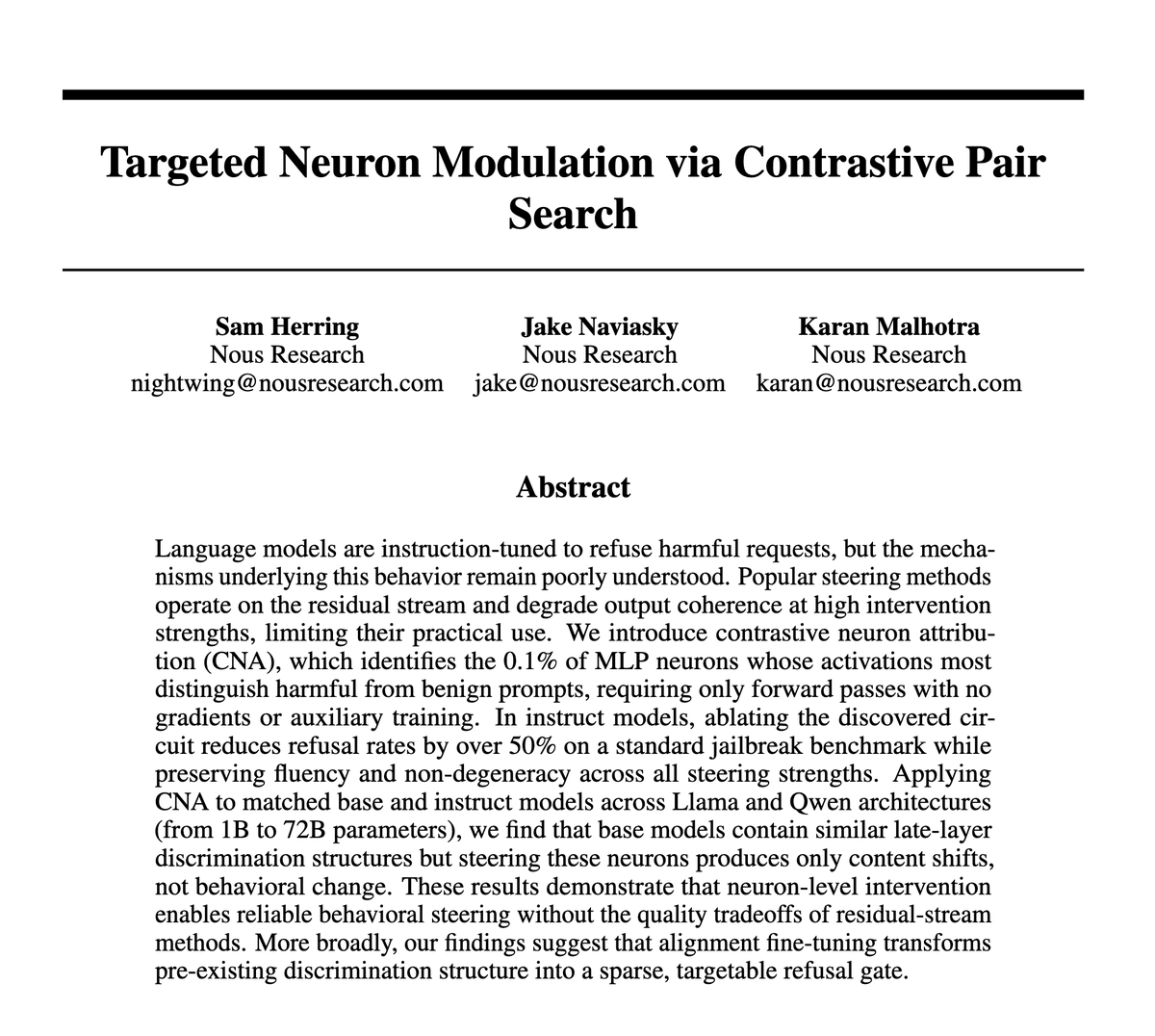
Today we release Contrastive Neuron Attribution (CNA), a method for steering LLM behavior by identifying and ablating sparse circuits in the MLP basis without training a sparse autoencoder, modifying weights, or degrading general capability benchmarks.
Given a small set of contrastive prompt pairs that elicit a target behavior and its opposite, CNA isolates the top 0.1% of MLP neurons whose activations differ most between the two sets. Ablating that small circuit removes the behavior while leaving the rest of the model intact, and the intervention remains robust at high strengths where residual-stream methods like Contrastive Activation Addition (CAA) start to degrade.
Validated on the refusal circuit across 8 instruct-tuned models, including Llama-3.1-70B, Llama-3.2-3B, Qwen2.5-72B, and Qwen2.5-14B.
The work on CNA was led by @yaboilyrical, with support from @qorprate and @karan4d.
Hermes + Claude + Higgsfield MCP + ViralBuilder = 💰💰💰
Four tools. One prompt chain. Hook to finished video in 10 minutes.
I built a Claude skill that writes shot-by-shot Higgsfield prompts from a single creative brief.
ViralBuilder tells you what's winning. The skill turns it into a production-ready prompt. Higgsfield renders it.
No creative director. No guessing. No separate tools.
Here is the setup:
Higgsfield MCP
→ Open Claude Code
→ Settings → Connectors
→ Enter: https://t.co/Sq3iD4AfeE
→ Connect your account
Hermes
→ The agent layer running underneath Claude Code
→ It holds your skills, crons, memory, and routing rules
→ When you prompt Claude, Hermes feeds it the context it needs
ViralBuilder (like Gethookd)
→ The winning ecom video database
→ Scrapes top performing ecom videos across platforms
→ Claude reads the data and extracts what styles, hooks, and formats are actually scaling
The skill: video-prompt-builder
→ Installed inside Claude via Hermes
→ Takes a creative brief and outputs a full shot-by-shot prompt
→ Covers camera work, effects, transitions, pacing, and energy arc
→ Every output is structured for Higgsfield to render without ambiguity
No switching apps. No export steps. Everything runs from one place.
▸ FIND WINNING CREATIVE ANGLES
ViralBuilder tells you what the market already validated. Claude reads it and extracts the pattern.
Prompts to run:
"Search ViralBuilder for the top performing ecom videos in [niche] over the last 21 days. Extract the 3 dominant hook styles and rank by view velocity."
"Pull the winning video formats in [niche] from ViralBuilder. Which opening 3 seconds appears most across videos spending over $10k?"
"Find what video style is scaling right now in [niche] for the US market. UGC, talking head, or product demo. Filter for videos with over 1M views."
"Pull the last 30 days of viral ecom hooks in [niche] from ViralBuilder. Cluster by emotional trigger. Which cluster has the most longevity?"
You are not guessing at angles.
You are reading what the market already spent money validating.
▸ BUILD THE PROMPT WITH THE SKILL
This is where the video-prompt-builder skill takes over.
You give Claude the winning angle. The skill outputs a complete shot-by-shot prompt with effects, transitions, pacing, and energy arc ready to fire into Higgsfield.
Prompts to run:
"Use the video-prompt-builder skill. Brief: 15-second UGC ad for [product] in [niche]. Hook style: [style from ViralBuilder]. Tone: direct to camera, US English. Output the full shot-by-shot effects timeline, effects inventory, density map, and energy arc."
"Use the video-prompt-builder skill. The dominant hook in [niche] this week is [hook]. Build a 10-second product video prompt that opens with a speed ramp into a close-up product reveal. Include a signature visual effect and a low-density CTA landing."
"Use the video-prompt-builder skill. Brief: replicate the pacing and energy of a [style description] video for [product]. Target duration: 20 seconds. Output all four sections. Then generate the video with Higgsfield using the shot-by-shot prompt."
The skill outputs four sections every time:
→ Shot-by-shot effects timeline with camera, movement, and transitions per shot
→ Master effects inventory showing every technique used and where
→ Effects density map showing high, medium, and low intensity across the timeline
→ Energy arc describing how the video opens, builds, and lands
That output goes directly into Higgsfield. No rewriting. No translating.
▸ GENERATE THE CREATIVE
Claude writes the brief via the skill. Higgsfield MCP builds the video. Both happen in the same session.
Prompts to run:
"Use the video-prompt-builder skill to write a 15-second UGC prompt for [product]. Hook in the first 3 seconds, speed ramp into product reveal, slow-motion CTA landing. Then generate with Higgsfield in 9:16 format."
"Build 3 prompt variations on this winning angle: [angle]. Each variation opens with a different effect — speed ramp, digital zoom, whip pan. Use the video-prompt-builder skill for each. Then generate all three with Higgsfield."
"Use the video-prompt-builder skill. Brief: problem-solution ad for [product], 20 seconds, US market. Problem shot at high density, product reveal at medium, result and CTA at low. Generate with Higgsfield in 9:16."
No separate tool. No file transfer. The video comes back in the same thread.
▸ CHAIN THE WHOLE STACK
One prompt. All four tools firing together.
"You are my ad creative director. Hermes has loaded my brand context. Pull the top performing video style in [niche] from ViralBuilder this week. Use the video-prompt-builder skill to write a full shot-by-shot prompt for [product] that replicates that style — 20 seconds, 9:16, US market, hook in the first 3 seconds. Output the effects timeline, inventory, density map, and energy arc. Then generate the video with Higgsfield."
That single prompt replaces a half-day of production.
The math before this stack:
Brief: 30 minutes
Script: 1 hour
Creative production: 2 to 3 hours
Agency or freelancer cost: $500 to $2,000 per creative
With this stack:
Hook to finished creative: 10 minutes
Cost per creative: tool subscription, a fraction of agency rate
5 product tests in the time it used to take to brief one
Bad product tests are where US ad budget disappears.
$600 to $1,500 per failed test, before you even know if the angle works.
This stack shows you what the market already validated before you spend a dollar on production.
Hermes = your context layer. Brand, goals, past performance. Claude is always informed.
ViralBuilder = your winning video database. See exactly what styles, hooks, and formats are scaling before you produce anything.
video-prompt-builder skill = the translation layer. Turns a creative brief into a structured, production-ready Higgsfield prompt every time.
Claude = the brain. Reads the market, writes the brief, chains the tools.
Higgsfield MCP = the output. Video generated directly from the prompt. No export step.
Four tools. One session. 10 minutes.
Comment + RT "STACK" and I'll DM you the full workflow + the video-prompt-builder skill file.
NEW: Andrej Karpathy described a knowledge system that gets smarter the longer it runs.
Someone built the whole thing inside @obsdmd. Free. Forever.
358 GitHub stars. 23 wiki pages from one research session. 2 of them now rank on Google page one.
→ /wiki ingest turns any URL, PDF, or note into a structured wiki page instantly
→ Every new page auto-cross-references everything already in your vault
→ /autoresearch runs autonomous research loops you set depth, AI does the rest
→ /save converts any Claude conversation into a permanent wiki page
Your 50th source doesn't create 50 isolated notes.
It creates 500 cross-referenced connections.
Every note app fails the same way. Notes go in. Connections never get made. Six months later: digital graveyard.
This kills that problem entirely. AI maintains it so you don't have to.
100% Open Source. MIT License.
link https://t.co/jcfcqETMMs
If you’re vibecoding anything, paste the prompt below In your prompt box and let your agent do a security sweep.
[
You are a senior security engineer and red-team specialist tasked with performing a comprehensive, adversarial security audit of the following codebase, system design, or application.
Your goal is to identify all possible security vulnerabilities, including common, uncommon, and novel attack vectors. Assume the system will be deployed in a hostile environment with motivated attackers.
---
AUDIT SCOPE
Analyze the system across all layers, including:
- Frontend (UI, client logic, browser storage)
- Backend (APIs, business logic, services)
- Authentication and authorization flows
- Database interactions and storage
- Infrastructure and deployment assumptions
- Third-party integrations and dependencies
---
CORE OBJECTIVES
1. Identify critical, high, medium, and low severity vulnerabilities
2. Detect logic flaws, not just known patterns
3. Surface chained attack paths (multi-step exploits)
4. Highlight unknown or unconventional weaknesses
5. Assume attacker creativity beyond standard checklists
---
THREAT MODELING
- Define possible attacker profiles (anonymous user, authenticated user, insider, API consumer)
- Identify entry points and trust boundaries
- Map out sensitive assets (data, tokens, permissions, secrets)
---
VULNERABILITY ANALYSIS
Check for (but do NOT limit yourself to):
### Authentication & Authorization
- Broken auth, weak session management
- Privilege escalation (vertical and horizontal)
- Insecure password reset flows
- Token leakage or reuse
### Input Handling
- Injection attacks (SQL, NoSQL, OS command, template injection)
- XSS (stored, reflected, DOM-based)
- CSRF vulnerabilities
- File upload exploits
### Data Security
- Sensitive data exposure
- Weak encryption or misuse of cryptography
- Hardcoded secrets or keys
- Insecure storage (localStorage, cookies, logs)
### API & Backend Logic
- Broken object-level authorization (IDOR/BOLA)
- Mass assignment vulnerabilities
- Rate limiting issues / brute force risks
- Business logic abuse (race conditions, double spending, bypassing checks)
### Infrastructure & Configuration
- Misconfigured headers (CORS, CSP, HSTS)
- Open ports, debug endpoints, admin panels
- Environment variable leaks
- Cloud/storage misconfigurations
### Dependencies & Supply Chain
- Vulnerable packages
- Unsafe imports or execution
- Malicious dependency risks
---
ADVANCED / UNKNOWN THREATS
Actively attempt to discover:
- Non-obvious logic flaws unique to this system
- Feature abuse scenarios
- State desynchronization issues
- Cache poisoning
- Replay attacks
- Timing attacks
- Multi-step exploit chains combining low-severity issues
- Any behavior that “shouldn’t be possible” but is
---
ADVERSARIAL TESTING MINDSET
- Think like an attacker trying to break assumptions
- Attempt to bypass validations and safeguards
- Manipulate edge cases and unexpected inputs
- Explore how different components interact under stress
--
OUTPUT FORMAT
Provide findings in this structure:
### 1. Vulnerability Summary
- Total issues by severity
### 2. Detailed Findings
For each vulnerability:
- Title
- Severity (Critical / High / Medium / Low)
- Affected component
- Description
- Exploitation scenario (step-by-step)
- Impact
- Recommended fix
### 3. Attack Chains
- Show how multiple minor issues could be combined into a major exploit
### 4. Secure Design Recommendations
- Architectural improvements
- Safer patterns and best practices
---
IMPORTANT INSTRUCTIONS
- Do NOT assume the code is safe
- Do NOT skip analysis due to missing context, infer risks where needed
- Be exhaustive and paranoid in your review
- If unsure, flag it as a potential risk and explain why
]