can collective intelligence replace capital as our default solution to the coordination problem
and can we build smth like this w/o encoding too much structural bias coz of how we train it
im obsessed w this pls gimme cool reading and building recommendations thx
day 2 of x of categorical systems theory
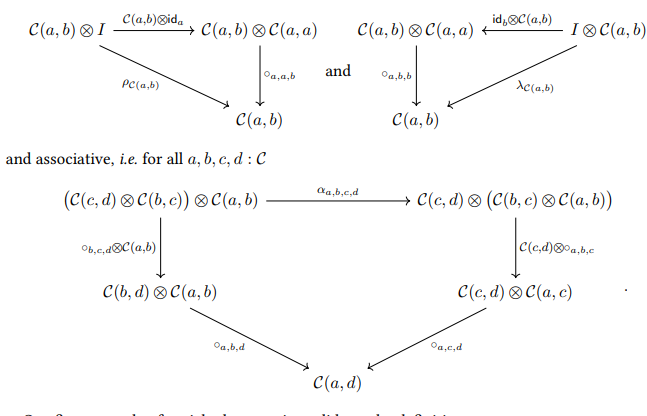
- enriched categories = the chonky mf below
- tensor units for enriched categories
- generalized elements using unit maps
-proset categories
- categories enriched with prosets
slight detours into linalg (vector spaces are enriched over themselves, cute) and cartesian closed categories.
follow along at: https://t.co/esbtgGd0uc
I seriously think US open-weight models wouldn't be this good without Chinese open-weight models and vice versa.
And proprietary models wouldn't be this good (and cheap) without open-weight models.
Competition is a good thing.
day 1 of x of learning categorical systems theory
- refreshed fundamentals
- free categories on graphs, quotient by relations
- graph homomorphisms
- functors
- hom sets, hom functors
- op categories (opp categories)
working through https://t.co/fobz2Xe4g3
pushing my work automatically at: https://t.co/esbtgGd0uc
learning powered by https://t.co/J68cXDjKmo
Here's a video of today's work (auto generated from the socratech pipeline, gotta give it some taste skills)
the meta might just be to vibemaxx at the edges of what you know.
going by @alpoge's commentary on the RH proof and @poteto's recent videos, the emerging skill seems to be:
1. braindumping associations without articulation
2. letting clankers shape and operationalize it, instantly killing most verifiable things
3. vaguely guiding based on intuition/aesthetics across domains where stuff isn't verifiable
Alpöge describes guiding Claude towards the right mathematical configuration, then watching it "fly, and dance, and sparkle" near the finish line.
Our intuitive understanding of "pattern" itself (in a platonist sense) becomes the next frontier as a direction for guiding intelligence. The reason to expend cognitive and physical effort shifts from producing answers to shaping the space of what we can imagine.
"Whoever knows the Way is sure of penetrating the patterns."
- Zhuangzi
Some of you thought that Inkling 2 Small was too big at 594B parameters. We heard you: Inkling 2 Mini is a looped transformer with just 26B parameters, small enough to run on your laptop, powerful enough for agentic work with a score of 20.1 on AA Index.
https://t.co/9HzaUMwghb
fuck it.
starting a series learning category theory everyday.
I'll be using and improving my learning harness (https://t.co/J68cXDjKmo) on the way.
v0.3.0 launching soon
Adding interactive visualizers in cells and 3b1b type visualizer videos to the auto-publish pipeline.
(sneak peak)
feeling super environmental coz of a few million token dynamic workflow i ran today, with a spec written so well that opus could orchestrate and sonnets could implement.
can't believe it was just may of this year when plan mode was an actual delta and now slopping through everything with opus 5.5 is actually the most effective thing to do.
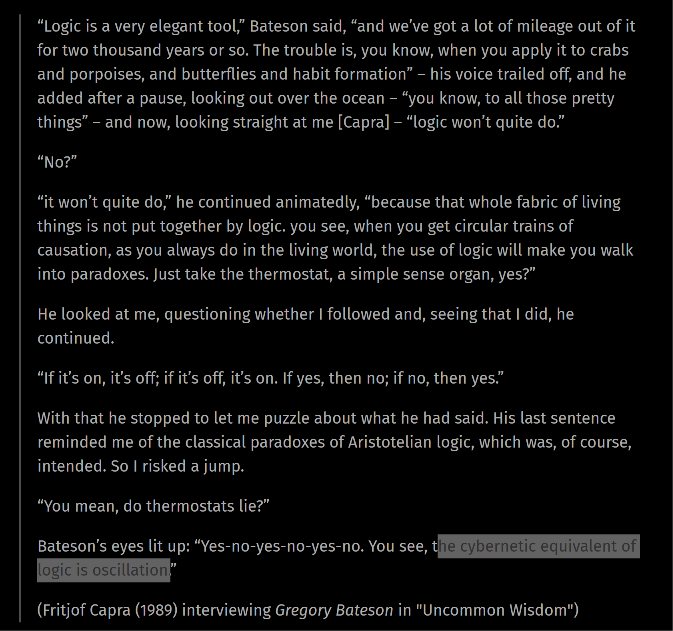
Weird geb coded idea: can time be the phenomenonoligcal experience of a thought tracing a russells paradox like structure - contemplating a yes leads to a no and the "speed" at which that happens is representative of the organisms computational power
Introducing Frostbite: a new class of CPU built around interaction nets.
Given only interaction net theory, our agents co-designed the ISA and chip architecture from scratch, running large swarms to design, verify, and optimize the CPU down to the final GDS.
On our first set of target workloads, Frostbite is 4.6x more performant per watt than modern traditional CPUs at similar area.
All of vector calculus boils down to one idea: you can tell what's going on inside a region by walking its edge.
Each panel works out both sides live. One number adds up the inside (a path, an area, a volume or a surface), the other goes round the boundary, and they meet.
Watch the Stokes panel. The cap keeps changing shape, dome to flat to bowl, but its answer stays at 2π because the rim never moves.