The $80 Million Woman. 🤯🔥
No one is talking about this.
In this interview, private equity executive Desuwa Rhodes shares the lessons she learned from managing over $80 million.
She talks about:
• The #1 lesson money has taught her.
• How she handled rejection early in her career.
• The biggest misconception about Africa.
• The best industry to build wealth in today.
• Her faith and belief in God.
This is one of the most insightful interviews you'll watch this week.
If you’ve paid close attention, you will notice that the 3 winners of the 2026 South East Maths Olympiad are excelling at every stage Nationally and in Africa.
From winning 1st to 4th place at the National Mathematics Competition in Abuja, to winning championships across the country.
Even those who didn’t win are shining in Nigeria and across Africa.
It means this is the toughest and one of the most credible competitions in Africa.
When we uphold integrity in our academia, our children will thrive on global stages.
In continuation of my quest to deepen knowledge and impact positively on our society, yesterday June 10th, in London, I held a series of important engagements, including a fruitful meeting with Alex Vines, Director of the Africa Programme at the European Council on Foreign Relations (ECFR).
Our discussions focused on strengthening strategic relationships and fostering a deeper understanding of Africa’s evolving role in global affairs. It was emphasized that Africa must no longer be viewed merely through the prism of statistics or humanitarian concern, but as a serious and equal partner in shaping the future global order, much like India, Indonesia, and other emerging centres of influence.
During our engagement, it became increasingly clear that Africa, and Nigeria in particular, must be placed at the centre of international conversations on partnership, trade, governance, innovation, and sustainable development.
Constructive dialogue and mutual respect remain essential to building meaningful cooperation between Africa and the international community.
A New Nigeria is POssible. -PO
Pastor Adeboye is not a freedom fighter.
He’s always supported everyone in this country across all divides. All he wants is the good of the people and he’s spent his entire life doing that.
May be those of us that are young should do something. He’s 85 years old. Leave baba alone
Pastor Adeboye emptied the infrastructures of their fellowships in the North East campuses into the IDPs in Borno, Yobe and Adamawa.
When we got to Borno in 2017, we met empty spaces. I wrote a letter to him from Maiduguri, I told him all we needed, running into millions of naira. He sent the money to us. Everything I wrote in the letter was sent. I would write to him every quarter giving him update about all of us in the fellowship and request additional money. He will still send it.😅
I coordinated one of his largest intervention program in Maiduguri. A training and certification course for students in Architecture, Urban planning etc… thousands of students from Ramat Polytechnic, University of Maiduguri etc… it was one of his programs to uplift a society battered by insurgencies and the economy of the state crashed. A program meant to give a future to them by upgrading their skillset.
His greatest strength of not showing off is the reason many people, even his church members do not know 2% of his works.
Part One
Understanding Public Frustration While Recognizing the Wrong Target: Pastor E.A. Adeboye Is Not Our Problem
Rooted in scriptural and spiritual wisdom, Pastor E.A. Adeboye- like a true bearer of the Cross of Christ - has often chosen dignified silence whenever attacked. Through the years, I learned from him to do the same.
But this moment demands a historical clarity that we must not miss. I must therefore write publicly to help bring us back to what truly matters and to the urgency of this moment.
In doing so, it is crucial to first acknowledge the broader context in which criticisms of public figures have erupted in our beleaguered country. Nigerians are exhausted. Decades of systemic corruption, insecurity, economic hardship, and unfulfilled promises have produced a deep well of frustration. That frustration has evolved into trenchant distrust - not only of politicians, but of institutions and influential individuals whom the people believe possess the moral authority to demand accountability from those in power.
Across Nigeria today, the cry is simple:
“Our religious leaders must rise and help rescue Nigeria from the grip of ineffectual, corrupt, and selfish politicians.”
This is the crux of the matter. Nothing else.
And this is how I want to see where Pastor Adeboye - a simple messenger of God - who has dedicated his life to both praying and speaking up for the good of Nigeria and Nigerians matters in ongoing conversations of this scary time.
Pastor Adeboye does not only pray about Nigeria’s governance. He speaks. He has always spoken when it matters. I know this personally, and evidence abounds. This piece will provide two of the most compelling examples.
We must avoid our national habit of “majoring in the minors” - the distractions that consume public energy while our country slides deeper into crisis. Over the decades, I have watched Nigerians repeatedly miss the mark of what matters most. I now understand this as a psychological coping mechanism that paradoxically rewards the failures of ineffectual governments, allowing Nigeria and her people to degrade year after year, decade after decade.
It allows political leaders to deflect responsibility while the people pummel a soft target. It perpetuates our national decline from one administration to the next. It is a self‑sabotaging pattern. We must break that pattern now and confront the terrifying reality of this moment.
Nigerians, our 2‑year‑old baby, Christianah Akanbi, is in the wilds and has been held captive for several days now.
This is our horrific reality.
Twelve years after the tragedy of the Chibok Secondary School girls’ abduction in Borno State, it is now our 2‑year‑old - a toddler who simply went to school - who has been abducted along with 49 others: his carers, older pupils, secondary school students, and seven teachers.
The reality is that our baby and the rest of our children, women, and men are being held captive by terrorists in Oyo State, South‑West Nigeria. Let that sink into our hearts.
The reality is that three different administrations since Chibok - and the Nigerian State itself - has still failed to protect our children and secure our country.
We must face the reality that one of the teachers of our 2‑year‑old baby was brutally beheaded in his presence. The terrorists recorded and released the video to taunt Nigerians, to show that they - not our government - hold the upper hand.
Our baby is still in the wild with terrorists. Let this image sink into our hearts.
Let the image of the wailing and terrified Principal, Rachael Alamu, in the video - guns pointed at her by captors who hide from view- sink into our hearts.
……./1
Dear Young Nigerians,
One lesson from the 2023 elections, particularly in Lagos, should never be forgotten.
In the period following the presidential election and leading up to the governorship election, we witnessed a troubling shift in public discourse. Conversations that should have focused on competence, governance, development, and the future of our nation were gradually diverted towards tribal sentiments, ethnic divisions, and unnecessary suspicion among citizens.
Many sincere and well-meaning Nigerians participated in these conversations without realising that they were being drawn into narratives carefully designed by others.
Throughout history, whenever politicians find it difficult to compete on ideas, performance, character, or vision, some resort to exploiting the fault lines of ethnicity, religion, and identity. Their calculation is simple: a divided people are easier to manipulate than a united people.
Today, I see similar efforts emerging again, sometimes in more subtle and sophisticated ways. Narratives are planted, amplified, and circulated, often by individuals who genuinely believe they are defending a worthy cause, without recognizing the broader agenda behind such campaigns.
Let me state clearly that Pastor Enoch Adeboye remains one of the foremost fathers of faith in our nation. For decades, he has consistently preached the virtues of peace, prayer, love, reconciliation, and national unity. Even when faced with provocation, his response has always reflected humility, restraint, wisdom, and grace.
At 84 years of age, it would be unfair for young and able-bodied Nigerians to transfer to him responsibilities that properly belong to them. The task of building a better Nigeria rests primarily on the shoulders of the younger generation. It is their duty to lead the conversations, champion the reforms, and drive the positive change our nation urgently requires.
We must be careful not to become instruments in the hands of those who secretly nurture division while publicly preaching unity. In most cases, their target is not the individual being attacked; instead, it is the person who is attacking. Their real objective is to weaken the bonds that hold us together as one people and one nation.
I therefore urge all young Nigerians: do not allow anyone to recruit you into hatred. Do not allow anyone to weaponise your ethnicity, your faith, or your admiration for respected leaders.
Question every narrative. Verify every claim. Follow the facts. Resist manipulation.
The Nigeria of our dreams can only be built by citizens who refuse to be divided, who choose unity over hatred, and who place our collective future above narrow interests.
A New Nigeria is POssible. -PO
My mentor, the Director of the Abuja School of Social and Political Thought.
Thank you, Sir (Dr. Sam Amadi), for your great contributions towards ensuring that Nigeria and Africa get the right political leadership to drive the positive change we have long sought.
There was a time in this country when a man looked at the future and refused to accept mediocrity.
His name was Nnamdi Azikiwe.
In 1960, as Nigeria stood on the edge of independence, he didn’t just celebrate freedom, he designed it. He envisioned a university that would not copy the colonial system, but challenge it. A university that would produce thinkers, builders, and leaders for a new Africa.
That dream became University of Nigeria, Nsukka.
It was bold. It was revolutionary.
The first indigenous university in Nigeria. Built on the American educational model. A place where merit, curiosity, and innovation would define the African mind.
UNN was not just a school, it was a statement:
“We can think for ourselves.”
But today… walk into those hostels.
And try not to feel your chest tighten.
Rooms built for 4 students now hold 10.
Mattresses laid on bare floors.
Broken windows patched with cardboard.
Toilets that have forgotten what water feels like.
Walls that have absorbed decades of neglect, sweat, and silence.
This is not just decay but rather this is betrayal.
Because how do you place a young girl or boy full of dreams, full of fire into an environment that slowly erodes their dignity?
How do you expect brilliance to thrive where basic humanity is absent?
We like to talk about moral decline, about distractions, about “this generation.”
But nobody wants to talk about what happens when young people are forced to survive, not learn.
When privacy disappears.
When safety becomes uncertain.
When the line between resilience and desperation begins to blur.
Environments shape behavior.
And somewhere in those overcrowded rooms, something is being lost.
Focus.
Discipline.
Innocence.
And then, the most painful part.
The silence.
Not the silence of peace but the silence of fear.
Students who speak up risk intimidation.
Staff who demand better conditions are quietly sidelined.
Voices that should drive reform are sometimes treated like threats.
So people learn.
They learn to whisper instead of speak.
They learn to endure instead of question.
They learn that survival in the system often means compliance.
But a university is supposed to be the birthplace of ideas, not a place where courage is punished.
When truth becomes dangerous, education becomes hollow.
University of Nigeria, Nsukka was built to raise giants.
Today, too many are being trained to tolerate.
And the painful truth is this:
A nation that neglects its students is failing but a nation that silences its students is collapsing.
We must go back to basics and restore the dignity of man.
ADC verdict: This matter would have been decided long ago by Justice Nwite if not that David Mark led ADC were firing in all sides.
Before today, Justice Emeka Nwite had reserved judgment on this same ADC matter, patiently waiting for the Supreme Court to make its final pronouncement.
Recall how it all began.
When the Amupitan-led INEC boldly delisted the name of David Mark and his executives from its portal in guise of a Court of Appeal directives.
ADC did not fold its arms. They returned to Justice Emeka Nwite, insisting the case be heard on its merit.
Their argument was that Section 83 of the New Electoral Act 2026, coupled with the Supreme Court’s position in PDP v Samuel Anyanwu, had already settled the law; and that courts should not meddle in the internal affairs of political parties. These, they argued, are political questions, matters the court simply has no jurisdiction to entertain.
INEC itself stood in that same position.
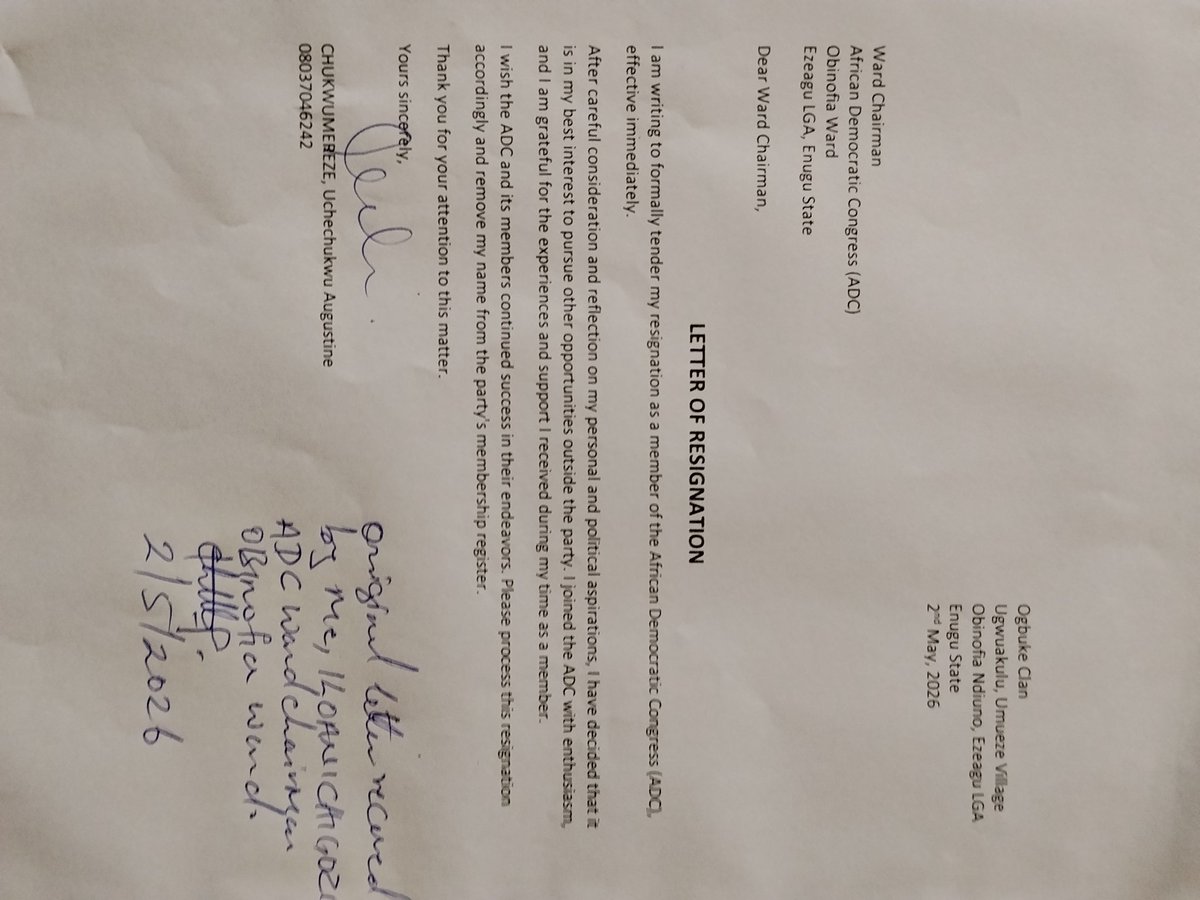
In its affidavit, INEC had affirmed that aside from the court lacking the power to intervene, it had already duly received Nafiu Bala Gombe’s resignation letter as Deputy Chairman even before the case commenced.
The arguments were already concluded in one day, and Justice Emeka Nwite was ready to deliver his ruling.
But just as he prepared to deliver his decision, he received signal that the same matter was already before the Supreme Court. At that moment, he halted everything and declared the proceedings sine die, that is to say he postponed the matter indefinitely.
His reasoning was simple, yet deeply rooted in judicial discipline: it would be disrespectful to proceed with judgment on a matter still pending before the apex court. And more importantly, if the Supreme Court properly disposed of the appeal, his judgment would become unnecessary.
But surprisingly, the Supreme Court chose a different path. Instead of laying the matter to rest, it sent the case right back to Justice Emeka Nwite’s court.
Back to where it started.
What happened today feels less like judicial finality and more like a circle without closure. It is tantamount to a father, fully present and capable, refusing to settle a dispute among his children, only to hand it over to the firstborn to resolve.
That signal is troubling.
.
I am Ekene Aninze Esq.
My One-Term, Four-Year Vow Is Sacrosanct
One of the greatest American Presidents, Abraham Lincoln, served only four years, yet his legacy endures as a model of principled leadership. Another iconic figure, John F. Kennedy, did not even complete a full term, yet his vision and ideals continue to inspire generations. In Africa, Nelson Mandela, revered globally as a symbol of justice and reconciliation, chose to serve only one term as President of South Africa, despite immense public pressure to stay longer. His decision was a deliberate act of leadership, a statement that power must serve the people, not the self. Indeed, history shows that the longer many African leaders remain in power, the more likely they are to be corrupted by it. Longevity in office is not a mark of success; rather, it is purposeful, accountable service - however brief - that defines true statesmanship.
It is within this context that I reiterate my vow: I will serve only one term of four years if elected President. And that vow is sacrosanct.
I am fully aware that the decay in our society has made trust one of the scarcest and most sceptically viewed commodities. Many Nigerians, understandably, no longer take politicians at their word. But even in this climate of cynicism, there are still a few whose actions have matched their words - whose integrity is built on verifiable precedent.
Recently, I became aware of two statements aimed, albeit indirectly, at my vow to serve only a single four-year term. One person remarked that even if I swore by a shrine, I still wouldn’t be believed. Another suggested that anyone talking about doing only one term should undergo psychiatric evaluation.
I understand the basis of their scepticism. They are judging me by their own standards - where political promises are made to be broken. But they forget, or perhaps choose to ignore, that Peter Obi is not cut from that cloth. I have a verifiable track record that speaks louder than speculation.
In my political life, my word is my bond. When I entered politics in Anambra State, I made clear and measurable promises to the people: to improve education and healthcare, to open up rural areas through road construction, and to manage public funds with prudence. I fulfilled each of those promises without deviation. I did not swear by a shrine, nor have I been certified mentally unstable as a result of honouring my word.
My vow to serve only one term of four years is a solemn commitment, rooted in my conviction that purposeful, transparent leadership does not require an eternity.
If making such a promise qualifies me for psychiatric evaluation, then we may as well question the mental fitness of those who framed our Constitution, which clearly stipulates a four-year renewable tenure.
I maintain without equivocation: if elected, I will not spend a day longer than four years in office. In fact, I believe that service should be impactful, not eternal.
We must rebuild trust in our country. I have dedicated my public life to demonstrating that leadership with integrity is not a myth. I have done it before, and I do not intend to betray that trust under any circumstances.
Forty-eight months is enough for any leader who is focused and prepared to make a meaningful difference. In that time, I intend not merely to make an impression, but to deliver on concrete promises to:
sanitise our governance system;
tackle insecurity through effective and accountable use of national resources; prioritise education, healthcare, and poverty alleviation;
catalyse small businesses as engines of growth ; and combat corruption with unflinching resolve.
Above all, I will dedicate myself to transforming Nigeria from a consuming nation into a productive one, where agriculture, technology, and manufacturing replace rent-seeking and waste as our national anchors.
These are not utopian dreams. They are realistic, actionable goals that are achievable within four years.
A new Nigeria is POssible. -PO
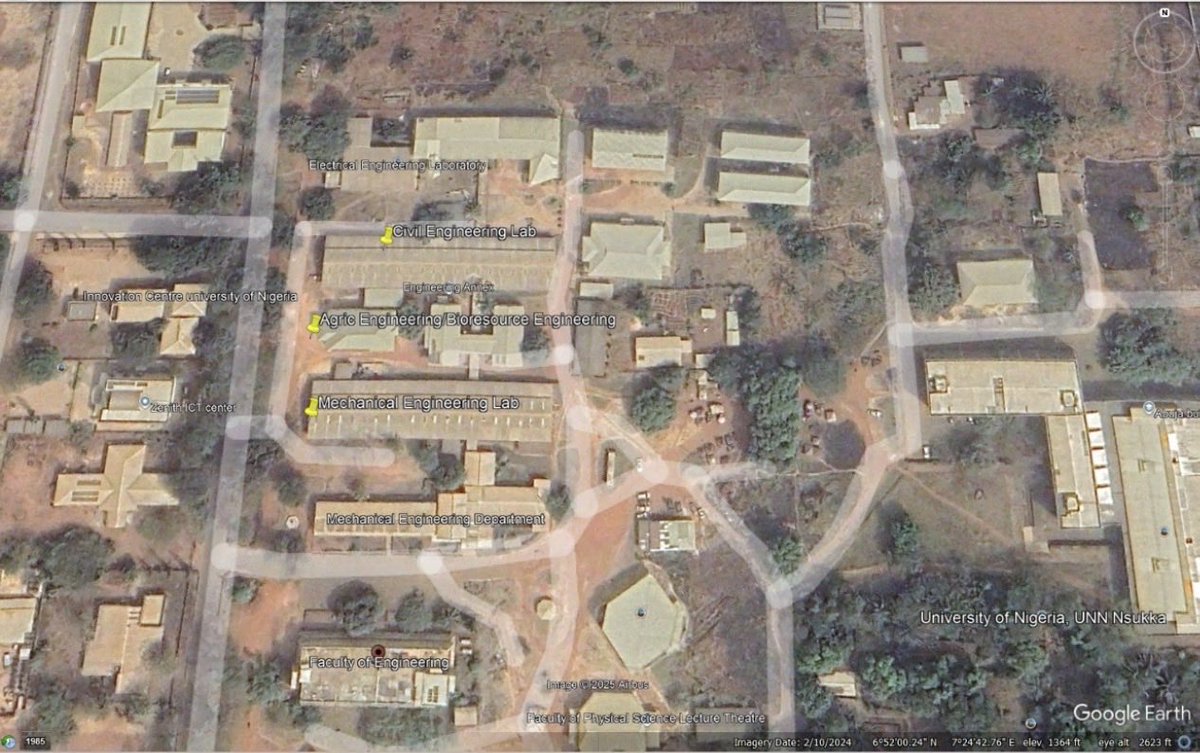
We will be deploying high speed internet at Engineering Faculty in UNN to cover all departments.
This will be for students and staff of the faculty only.
This will enable a new wave of research and learning there.
We will become the greatest workforce in Africa in 10 years.
We started the first phase of installation of this project today.
We are estimating everything to be completed end of May.
With this, all engineering staff and students in UNN will have access to high speed low latency internet for study and research at no cost to them.