CEO @01TEK | Reimagining education with AI & Blockchain 🚀 | Committed to making exceptional learning accessible everywhere | Racing & car enthusiast 🏎️💨 #01
@demishassabis Btw I love the Gemini model I think they’re the best but the mobile app really really need a lot of work!!
Lots of testing too!
Many times it bugs get blocked and doesn’t respond I find myself go out to claude or chatgpt which answer right away first try.. i could debug and fix
Thrilled to announce $5B in funding for @IsomorphicLabs to accelerate our mission to Solve All Disease. We continue to make rapid progress reimagining drug design from first principles with AI to radically cut the time & cost to find new medicines. Gradually, then all at once...
🚀 Cloud thinks. Local Qwen 3.8 27B types.
Atomic Fusion: fairy-tale pop-up book in 11 min for $2.98.
Same job on Fable alone: $15.77 in 21 min.
Caveat: one vendor run. 27B seat wants ~24GB VRAM.
via Atomic Agent 👇
https://t.co/WwJLYlvu2P
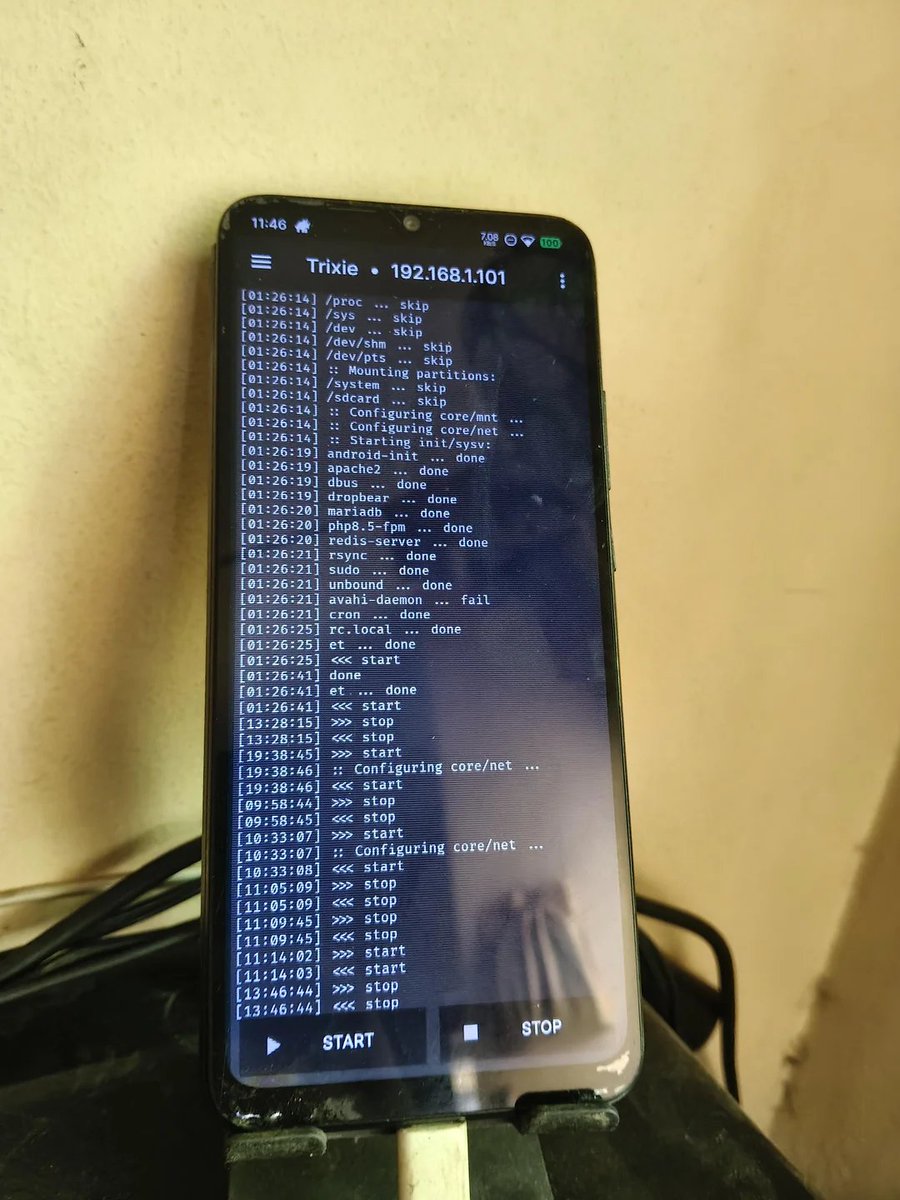
Turned a dusty a cheap older Android Phone into a 24/7 a full home server.
- Nextcloud
- Pi-hole
- Navidrome music streaming
- Live Custom status dashboard
Power draw: 2-3W (runs off battery, screen off).
Debian 13 chroot & Magisk, No extra hardware.
I think at one point in the post we should have had ai model defenders dedicate to protect from rogue ai models , that’s their only purpose or at least audit other models
12 years ago I founded Boom, as a software engineer doing hardware for the first time. I’m probably the least handy founder in hard tech. My 12 y/o son does my soldering and 3D printing for home projects, and I’ve struggled with imposter syndrome the whole way through. What business does a software guy have building supersonic jets and turbines?
More than a decade in, the most insane realization is that software is the key to reaccelerating hardware engineering. But in a way that I don’t think is widely understood or implemented, even in the burgeoning hard tech community.
Most hardware engineering is actually software engineering in disguise. It’s spreadsheet “code,” engineering calculations done as one-offs. Eg wing structural loads in, spar sizing design out. Thermal loads in, air conditioning system sizing out.
Everything is a calculation, and calculation is software. But these calculations are done essentially by hand, as if we are doing arithmetic but have not yet discovered algebra.
Hardware engineers have baby software, built in spreadsheets, the kind of crappy software I wrote as a kid before I understood architecture, unit tests, APIs, version control, and everything else that makes modern software good.
Our airplanes and engines are built with the software sophistication of a script kiddie.
So what we tell our engineers: don’t design the hardware, design the *algorithm* for designing the hardware. And take the algorithm seriously—as an algorithm and as a first-class engineered software system.
Never design a piece of hardware, such that you couldn’t redesign it tomorrow with a different set of assumptions.
This all sounds obvious, yet our experience at Boom is that it changes everything.
Ten years ago we couldn’t afford to build much software. We had a small team—and there were few software engineers with the curiosity, brilliance, and vision required to learn hardware engineering.
But now AI changes the equation. Now everyone can code. The software engineers define the architecture. The hardware people bring the physics and engineering know-how.
We have a turbomachinery design tool that lets one engineer do in realtime what previously took 100 engineers six months. Another tool auto-generates 65% of entire aircraft structure. I’m sure we’ll figure out the other 35% too. Eventually these should not be multiple tools, but one integrated physics model of a complete vehicle, airframe and powertrain.
The results speak for themselves. A boomless supersonic airplane built by 50. A full scale supersonic turbine made by 150. And with this approach, I don’t think we’ll need that many more people to build and certify a supersonic airliner.
You don’t need a big team to build big things—not when everyone on the team is a software engineer.
The Hermes Agent Plugin Hackathon starts now!
It runs for 7 days, with $20,000 in cash prizes and more.
Plugins are the most powerful way to extend Hermes Agent, and we want this hackathon to show what they can do. A plugin can change anything from the model Hermes runs on, where it stores its memory, where it runs commands, which messaging apps it works in and what Hermes Desktop shows. Plugins in the marketplace already let Hermes do things like control a phone or turn a photo into a printable 3D model.
Every kind of plugin is eligible, so build whatever functionality you want Hermes to have. We'll list accepted entries in the new Hermes Marketplace, where every Hermes user can install them.
Prizes
1st: $10,000 + neon sign + merch + $1,000 creds
2nd: $5,000 + neon sign + merch + $1,000 creds
3rd: $2,500 + neon sign + merch + $1,000 creds
4th: $1,500 + merch + $500 creds
5th: $1,000 + merch + $500 creds
Runners up (x5): merch + $250 creds
Submissions are due 5PM EST on Nov 11th. To enter:
1. Open a pull request that adds your plugin to the Hermes plugin catalog: https://t.co/mXvYukJ0mZ
2. Post a demo video on X and tag @NousResearch
3. Submit both links through the form: https://t.co/jlduHHW3dr
Your entry is the plugin itself. Judges score it on usefulness, reliability, polish and creativity, and they favor plugins that do more than a prompt or a skill could. Keep the demo under 90 seconds and show the plugin working.
The developer guide shows how to build and test a plugin: https://t.co/FVGjSgjNoV
When submissions close, we'll open a thread for every entry in the Nous Research Discord, so you can browse all the plugins and talk to the people who built them.
You can submit the form as soon as your pull request is open. The catalog checks run once a maintainer starts them, and we review entries every few days.
If you have any questions stop by the Nous Research Discord: https://t.co/qxek9haYeb
GLHF!
People are finding really creative ways to use EmbeddingGemma 2 beyond search.
Instead of running a full multimodal LLM, this community project trains a lightweight classifier on top of EmbeddingGemma 2 in real time.
Because the model is compact and natively multimodal, it can learn new categories on the fly and classify inputs locally in ~20ms for text and ~100ms for images.