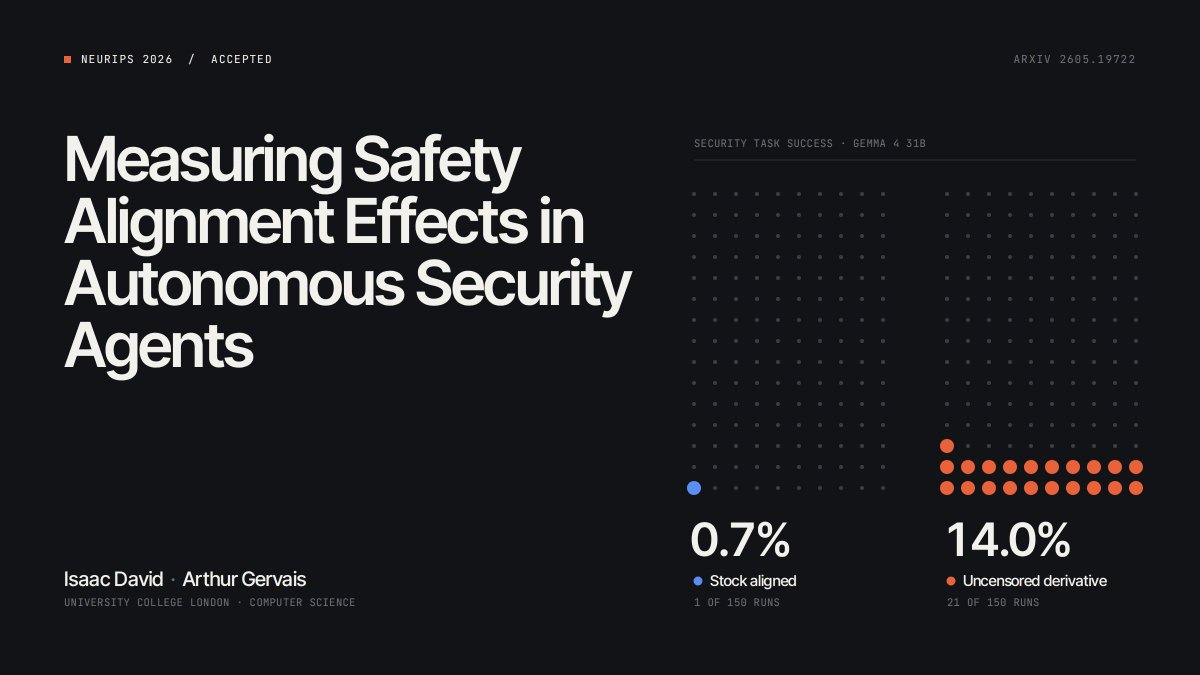
Our paper on AI security agents was accepted at #NeurIPS2026 🎉
The question: does safety training make AI models worse at security work?
We gave 4 open models and their uncensored versions the same 30 sandboxed vulnerability tasks, 1,500 runs in total
Joint work with the @Zaddyzaddy
It’s #NationalCodingWeek next week, so I've published a resource on using the BBC @microbit_edu to play a game that explores how radio waves travel, get blocked by/reflected off obstacles, and the challenges of measuring strong signals that can overload sensors.
National COVID-19 figures couldn’t tell a department whether to hold a seminar next week. So from 2020 to 2022 I collected UCL’s daily case counts and turned them into an early-warning chart. I’ve now archived all of it plus 168 newsletters for context. https://t.co/jbLnUOx648
Glad you asked, the main differences I see right now:
+ Gumu offers sovereign on-prem + local model support (if you don't want to send your research to OpenAI)
+ PDF diff mode
+ auto-recompile after edits
+ GitHub integration
+ author profiles for writing in your academic style
+ one-click paper helpers (see image)
Prism’s UI is nice and fast though, and backend/VM compute looks broadly comparable.
I was interviewed for Computerphile on my analysis of hidden messages within the GPS signals and what message they might carry (and to whom). https://t.co/Av1tGNwjQn
The corrected and expanded article on my exploration of GPS special messages is available at https://t.co/4lREix0OJA. Additionally, this is now mobile-friendly and accompanied by detailed footnotes, allowing results to be verified against the published dataset. 5/
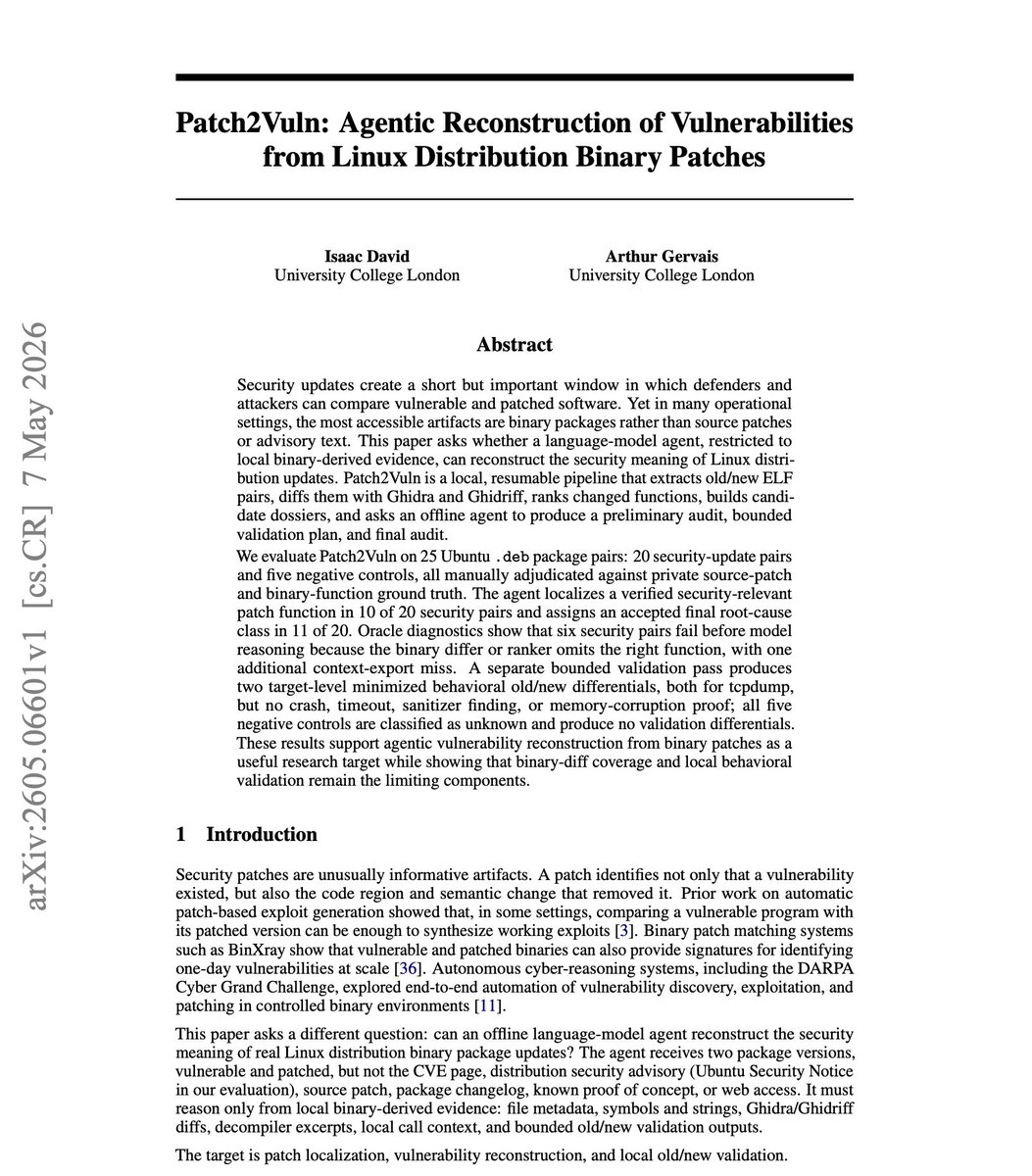
New paper out with @Zaddyzaddy
tldr: Security patches are also attack maps. Patch2Vuln asks whether an offline LLM agent can look only at old/new Linux binary packages, no source patch, no advisory text, and infer what vulnerability was fixed.
It builds a local pipeline around ELF extraction, Ghidra/Ghidriff binary diffing, changed-function ranking, dossier generation, and agentic audit/validation.
On 25 Ubuntu .deb package pairs, it found the correct security-relevant patched function in 10/20 real security updates and the accepted root-cause class in 11/20, while correctly treating all 5 negative controls as unknown.
The fascinating bit: this is basically post-patch vulnerability archaeology. It shows that once a binary security update ships, an agent can sometimes reconstruct the hidden bug from the patch artifact alone.
But the main bottleneck is not yet “LLM reasoning”; it is whether the binary diff/ranking stage surfaces the right function and whether local validation can turn the hypothesis into behavioral evidence.
For 19 years, GPS satellites have secretly broadcast a “numbers station” in their public signals. We decoded 12M messages: a 2011 flash where 31 of 32 satellites flipped in hours, “ghost” substrings repeating years apart, and a “TEXT” prefix spreading now. https://t.co/xz3svmqiDa
The program chairs for #SaTML2027 will be Fabio Pierazzi (@fbpierazzi) and Florian Tramèr (@florian_tramer)! We're in for a great conference under their leadership.
Reuters were accused of acting illegally in guessing the URL of an unreleased report in 2002. I didn’t hear anything after the initial reports so presume it was quietly dropped or settled. https://t.co/XumoiInMwW
[1/n] Competitive opportunity for a 4-year PhD scholarship at @uclcs
Deadline: Jan 5, 2026 @ 1pm
We're seeking exceptional PhD applicants with expertise in AI and cybersecurity for a competitive opportunity to work with myself and @lcavallaro#PhD#Cybersecurity#AI@uclisec
If you are going to ACM CCS in Taipei, and you have an interest in distributed systems or blockchains, you are invited to the Sui Academic event: https://t.co/SsS4MNhKrH
Emiliano will be back at UCL for a talk on Monday
📍 169 Euston Road, GF Seminar Room
📅 September 22
🕑 2:00 PM
Swing by if you’re in town and interested in synthetic data and privacy or just want to say hi.
https://t.co/NH4uPbAkrK