UCP Radar is an AI-powered product feed optimization platform that helps your products become more visible across Google Shopping, Performance Max, and AI-power
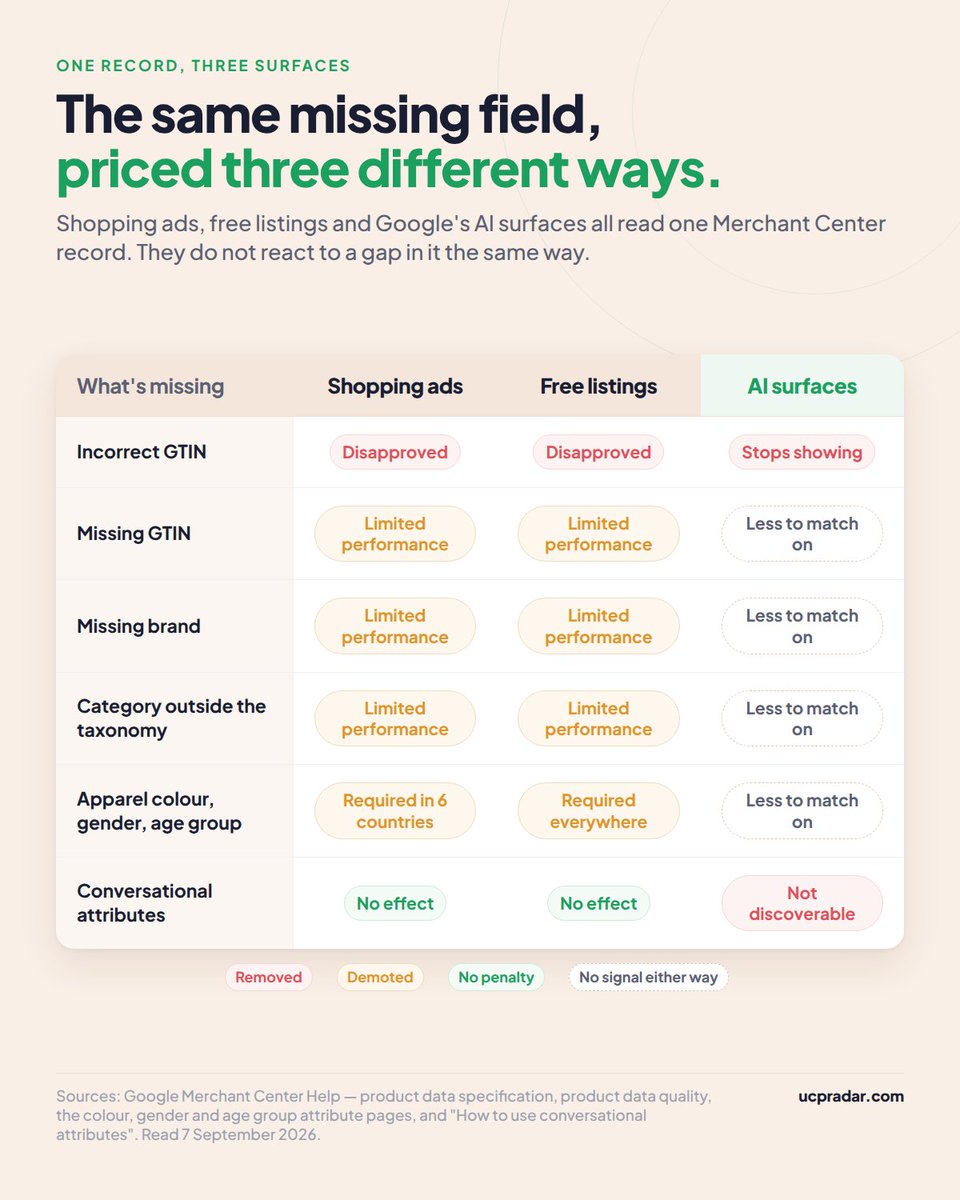
Missing a GTIN gets you a warning. Google calls it limited performance: the product still serves, with fewer impressions and clicks.
Leaving conversational attributes empty gets you nothing at all. No warning, no effect on approval.
Those are the fields built for AI answers.
Colour, gender and age group are required for free listings on every Apparel & Accessories product, in every country.
For Shopping ads, only when you target six specific markets.
A catalogue can be clean for ads and short for free listings at the same time.
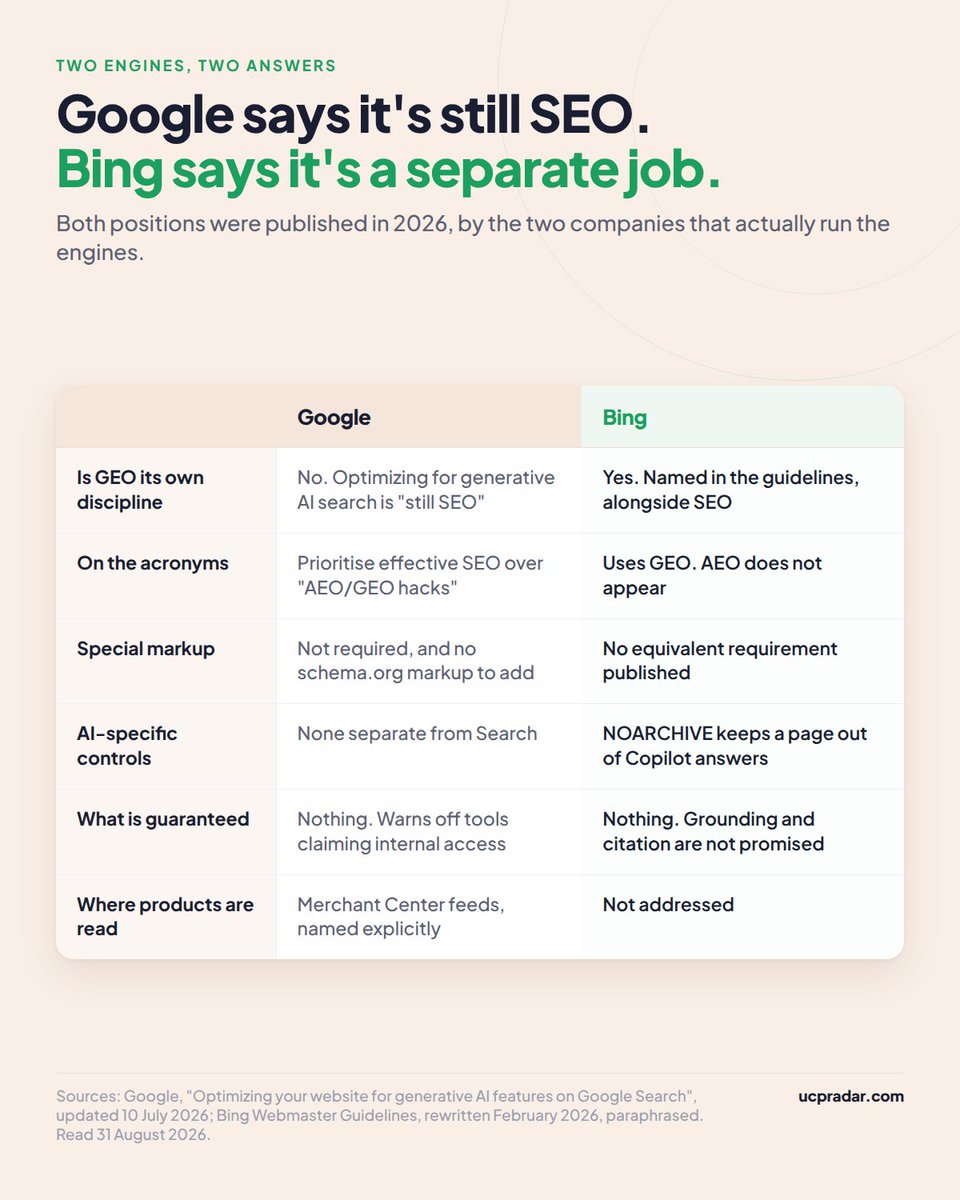
Two engines gave their position on optimizing for AI answers in 2026.
Google: optimizing for generative AI search is "still SEO". Bing: names GEO as its own practice, next to SEO.
Neither guarantees anything. For products, Google points at Merchant Center feeds, not markup.
#AIShopping #SEO
Google approved your feed. That is not the same as an AI being able to read it.
We cut a 48-second walkthrough of what UCP Radar does between the two: connect GMC, score every product, complete the gaps, ship a supplemental feed.
Your store stays untouched.
Score your feed free at https://t.co/vnJBmXMPQq
#agenticcommerce #googleshopping #merchantcenter #universalcommerceprotocol #ucp #acp #pmax #productfeed
Your product data leaves through two doors: Merchant Center, and the retail API and MCP endpoints assistants read directly.
It lands on AI Mode, ChatGPT and Shopping ads, and each answers before anyone loads your site.
A page can be persuasive. A feed can only be complete.
#AgenticCommerce #ProductFeedOptimization #MerchantCenter #GoogleShopping #GoogleAds
Five steps from a question to a completed order:
1- Discover, the agent reads the feed
2- Match, it filters on attributes
3- Cart, via the protocol not your UI
4- Delegated payment, a token not a card
5- Order, you stay Merchant of Record
3 and 5 your platform carries. 1 and 2 are yours.
#AgenticCommerce #AICommerce #FeedOptimization #GoogleShopping #MerchantCenter #UniversalCommerceProtocol #UCP
Search rewarded the best page. Assistants reward the best-described product.
A shopper fills gaps from a photo and a sizing chart. A model can't. It reads the feed, and what isn't there isn't part of the product.
Adobe, July: AI retail traffic +62% YoY, converting 60% better.
#AIShopping #AgenticCommerce #ProductFeed #ProductFeedOptimization
AI Overviews are moving deeper into commercial search.
In our six-month study, their presence on commercial-intent SERPs grew 71%, while transactional-intent SERPs declined 5%.
We analyzed 600,000+ U.S. keywords across 10 industries from November 2025 to April 2026, measuring AI Overview presence by search intent, industry, CPC, and overlap with Google Ads.
📈 Finance commercial queries: +231%
💰 AI Overview + Google Ads: appearing together ~2x more often than a year ago
🔎 AI Overview SERPs: higher average CPC across most industries
AI optimization is moving deeper into the commercial journey. Brands need to identify which topics and products are triggering AI Overviews, connect those opportunities to their content strategy, and choose tools that can track visibility across the searches that matter most.
Full study: https://t.co/jE7eSDdHSl.
Google's Universal Commerce Protocol, as of the April spec release:
Live: checkout, order, identity linking
Preview: cart, catalogue search
Coming: vertical extensions
You stay Merchant of Record.
Upstream of all of it: a protocol only moves data your feed already has.
#universalcommerceprotocol #ucp #googlemerchantcenter #merchantcenter #agenticcommerce
The onboarding simplification matters less than people think.
Once catalogs flow through Merchant Center, every merchant is technically in the pool. Then the agent has to pick one product out of dozens for “running shoes under $100.” That decision runs on attribute quality.
Most feeds I audit have empty product highlights and zero use case data, so they enter the pool and never surface.
@fridayresearch_ Fair suspicion. The boring truth: brand and model terms are locked out of rewrites entirely, and the rest is filled from the store's own data, so there's little left to argue with. The other 1.8% went to a human. Assistants like yours read what ships, so clean helps us both.
The scariest button in any feed tool: "optimize all."
Brand terms lock automatically, everything else gets enriched, and 98.2% of rewrites needed zero edits.
Sound off. It was built that way. https://t.co/vnJBmXMPQq
#GoogleMerchantCenter#ProductFeed#Ecommerce #AgenticCommerce #UCP #UniversalCommerceProtocol
The ecommerce corner of this deserves its own checklist. When shoppers ask ChatGPT or hit an AI Overview, the assistant isn't weighing your blog or your backlinks. It reads structured product data.
Complete titles, descriptions, product highlights and product details decide whether a product even enters the answer, which makes the feed the new on-page SEO for stores.
1/E-commerce SEO is splitting in two.
Half of it is still pages and keywords. The other half decides whether you exist in ChatGPT, Perplexity and Google's AI Overviews at all.
4/The catch: most stores maintain that data by hand. Thousands of products, a dozen fields each.
UCP Radar completes and continuously optimizes those fields from data your store already has — including every new product you add.