@ChrisCamillo@Mr_Derivatives I learned long ago to hedge. Though it has a negative impact at times on the upside I sleep much better knowing I won't be killed due to a world event. Easier with options since that is what I mostly trade.
@ChrisCamillo I have been beating the market averages for decades. One of the reasons I was able to retire early. Still deep in the investment game. Teaching my son now.
The AI supercycle will last 15 years. We're in year 3.
Most investors are still buying Phase 1 names while the real money is already rotating into Phase 3.
I mapped the entire cycle into 4 phases with the tickers that matter at each stage:
The AI supercycle is the biggest investment theme of our generation. Bigger than mobile. Bigger than cloud. A 15 year structural shift that will reshape every sector of the global economy. Hyperscalers just committed $725 billion in capex for 2026, nearly doubling last year. Microsoft, Google, Amazon, and Meta each spending over $100 billion individually.
This is not speculation. I've mapped the entire supercycle into four phases so you know exactly where we are and where the asymmetric opportunities sit.
🔴 Phase 1: Already Ran (2023 to 2025)
The foundation layer is complete. $AMD ran 78% in 2025, $NVDA 39%, and $INTC just posted a blowout Q1 that sent the Philadelphia Semiconductor Index above 10,000 for the first time. Chips still power every phase but the generational entries are gone and risk/reward has compressed.
- $NVDA, $AMD, $ARM, $INTC, $AVGO, $MU, $GLW
- Semiconductors, Memory & Storage,Photonics/Optics
- Foundation complete. Still growing but priced for it.
🟠 Phase 2: Peak Buildout (2025 to 2027)
The phase most investors just woke up to. $CEG acquired Calpine to become the largest U.S. private power producer at 55 GW. $GEV up over 200% in a year. $VRT co engineering cooling for NVIDIA's Rubin architecture. $GLW up 74% YTD on optical fiber demand. Nuclear SMRs are the breakout with $OKLO, $SMR, and $BWXT positioning to power data centers directly. Still upside but the obvious names have moved.
- $CEG, $GEV, $VRT, $VST, $TLN, $ANET, $GLW, $MOD, $EQIX $OKLO, $SMR, $BWXT, $NNE
- Power/Grid, Cooling, Networking, Nuclear/SMR Peak buildout.
- Nuclear SMRs are the sleeper.
🟡 Phase 3: The Positioning Window (2026 to 2028)
Where AI escapes the data center and enters the physical world. Most will be late. Tesla converting Fremont to Optimus production, $25B capex, mass production targeted H2 2026. Rocket Lab posted record $602M revenue with $1.85B backlog. $LUNR up 47% YTD with $943M in contracts. $KTOS Valkyrie drone selected for the Marine Corps. The window to position is open right now.
- $TSLA, $RKLB, $LUNR, $KTOS, $AVAV, $PATH, $ISRG $MP, $FCX, $ALB, $ASTS
- Robotics/Autonomy, Space/Defense/Drones, Rare Earths
- This is where the asymmetric risk/reward lives.
🟢 Phase 4: Final Frontier (2028+)
The endgame. Microsoft capex $190B. Alphabet $190B. Amazon $200B. Meta $145B. Google Cloud backlog past $460B. They're building the rails for AI software dominance and AGI. Quantum still early but $IONQ and D Wave are laying groundwork. The platforms that control the software layer win the entire supercycle.
- $MSFT, $GOOGL, $AMZN, $META, $ORCL, $IONQ
- AI Software Dominance, AGI Infrastructure Decade long thesis.
- Accumulate on weakness.
💊 Key Takeaway
- Phase 2 is confirmed ($725B hyperscaler capex)
- Phase 3 is where the smart money positions nowRobotics, space, defense, nuclear
- SMR are the 2026 to 2028 trades
- Most will rotate into these names 12 months too late
15 year supercycle. Not a trade. Phase 1 ran. Phase 2 is priced. Phase 3 is where you want to be.
Confident that Intel will meet data center CPUs demand in the second half of 2026. 🚀
Why? Because $INTC will have a server CPUs line up that AMD can only dream about.
Supply constraints in China are so severe that Intel is raising server CPU prices by 10%+ with delivery delays up to 6 months. it's a capacity problem. And Intel is fixing it.
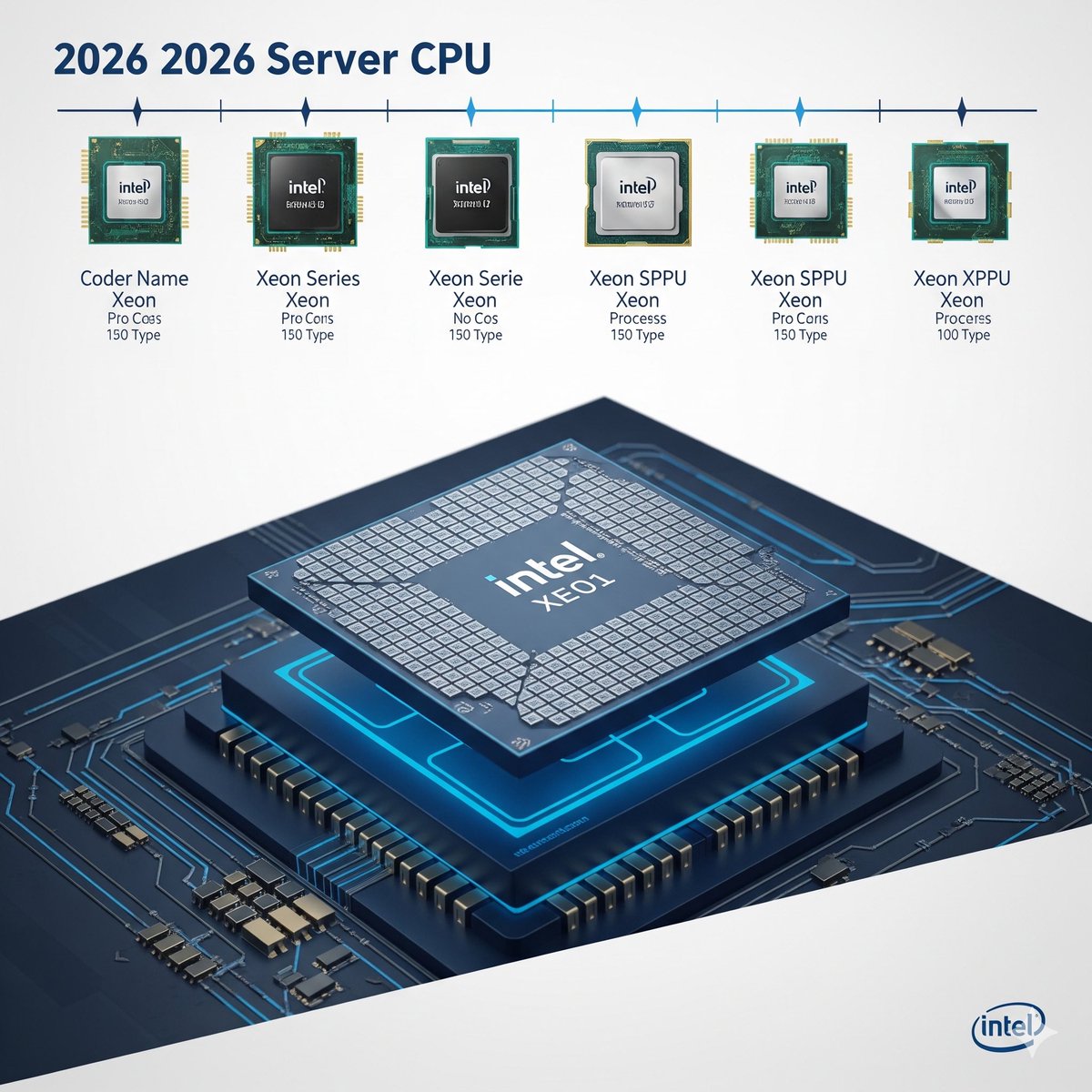
Intel's 2026 Server CPU Lineup:
• **Emerald Rapids** — Xeon 5 | Intel 3 | P-core | Now - mid 2026
• **Granite Rapids** — Xeon 6 | Intel 3 | P-core | Active through 2026
• **Clearwater Forest** — Xeon 6+ | **18A** | E-core | H1 2026
• **Diamond Rapids** — Xeon 7 | **18A** | P-core | H2 2026
• **Coral Rapids** — Xeon 7+ | TBD | P-core + Multi-threading | 2027
When JPMorgan asked if Clearwater Forest was still supported given the roadmap changes, CEO Lip-Bu Tan was unequivocal: _"Yes, we continue to do this and support that... we are laser-focused on providing differentiating competitive products."
18A yields improving 7-8% monthly. Supply constraints will ease in Q2 onward. The hyperscalers still prefer Intel CPUs over AMD and are signing long-term agreements.
The products are coming. 📈
Intel expected to begin shipping Apple’s lowest-end M processor as early as 2027
There have long been market rumors that Intel could become an advanced-node foundry supplier to Apple, but visibility around this had remained low. My latest industry surveys, however, indicate that visibility on Intel becoming an advanced-node supplier to Apple has recently improved significantly.
Apple previously signed an NDA with Intel and obtained the advanced-node 18AP PDK 0.9.1GA. The key simulation and research projects (such as PPA) are tracking in line with expectations, and Apple is now waiting for Intel to release PDK 1.0/1.1, currently scheduled for 1Q26. Apple's plan is for Intel to begin shipping its lowest-end M processor, utilizing the 18AP advanced node, as early as 2Q–3Q27, but the actual timeline remains contingent on development progress following the receipt of PDK 1.0/1.1.
Apple’s lowest-end M processor is currently used in the MacBook Air and iPad Pro mainly, with combined shipments of roughly 20 million units for 2025. As MacBook Air shipments in 2026 may be impacted by a new more-affordable MacBook model using an iPhone-class processor, shipments of lowest-end M processor in both 2026 and 2027 are expected to be 15–20 million units.
In absolute terms, order volumes for the lowest-end M processor are relatively small and virtually no material impact on TSMC’s fundamentals or its technology leadership over the next several years. However, the signaling and trend implications for Apple and Intel are meaningful:
1. For Apple: In addition to showing strong support for the Trump administration’s strongly promoted “Made in USA” policy, Apple, while clearly expected to remain highly dependent on TSMC’s advanced nodes for the foreseeable future, still needs to secure a second source to meet supply-chain management requirements.
2. For Intel: The significance of winning Apple’s advanced-node orders far exceeds the direct revenue and profit contribution from this business. Although Intel will still be unable to compete head-to-head with TSMC over the next several years, this suggests that the worst may soon be over for the IFS business. Looking ahead, the 14A node and beyond could capture more orders from Apple and other tier-one customers, turning Intel’s long-term outlook more positive.
This is something all option sellers should have printed and posted on their wall.
Research indicates that 45 days to expiration (DTE) is the ideal timeframe when selling OTM options.
Though the decay rate accelerates in the final 21 days, you capture 75% of the premium within the first 24 days.
For those unaware, I traded options full-time for 14.5 years to earn a living, enabling me to transition from a 19-year career in law. I achieved great success, consistently earning $5,000 to $8,000 per week by selling options using a reliable, repeatable system.
I've shifted my focus to generating passive income from dividend ETFs and stocks, while still earning thousands weekly, mainly through the options "wheel strategy."
Option selling, when executed properly, can be highly profitable:
$5k account: $75–$200/month
$10k: $150–$400/month
$25k: $400–$1,000/month
$50k: $750–$2,000/month
$100k: $1,500–$4,000/month
$250k: $3,000–$10,000/month
$500k: $7,500–$20,000/month
$1M: $15,000–$40,000/month
Here are the core rules that I follow when selling options:
Rule 1 - Quality Stocks: Sell options on high-quality stocks or ETFs you’d be comfortable owning. Quality is key.
Rule 2 - Sweet Spot: Target Delta 0.15–0.25 for weekly sales. Delta 0.10 is too conservative for the risk-reward, while Delta 0.50 is too risky, likely ending in the money.
Rule 3 - Weekly Options: Prefer weekly options to maximize time decay and monthly income. Always check the liquidity or volume of the options market for your chosen stock or ETF.
Rule 4 - Prioritize Liquidity: Trade options on liquid assets like $SPY, $QQQ, or big tech stocks ($TSLA, $AMZN, $NVDA, $AMD) for easy entry/exit and fair pricing.
It sounds complex, but it’s not! With practice, this system takes just 10–20 minutes a week, potentially generating thousands monthly on a consistent basis.
She was called in to help a woman struggling with anxiety.
What happened next had no place in any textbook.
Instead of revisiting childhood memories, the woman began describing… entirely different lives—complete with vivid details like:
$INTC
Intel’s Clearwater Forest Xeon marks a strategic shift toward extreme core density and energy efficiency, tailored for massively-threaded cloud workloads. 18A process, and modern packaging set the stage for a very compelling server chip—expected to arrive in early 2026.
The era of the influencer. How are these media folks any less corrupt than any other media? Most of there info comes from online sources. They are being manipulated as much as anyone else. I say they aren't any more reliable especially with ad dollars.