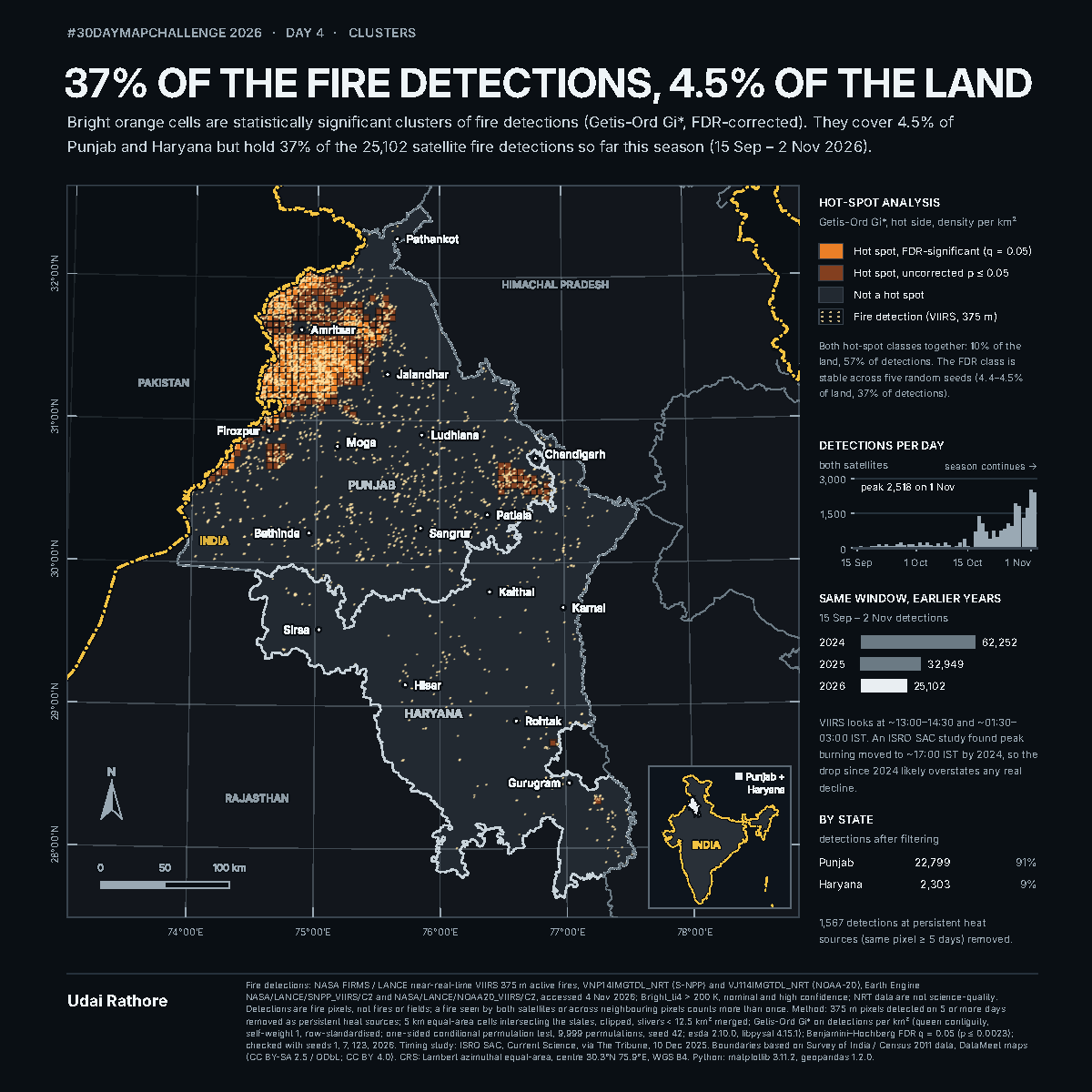
37% of this season's satellite fire detections in Punjab and Haryana came from 4.5% of the land, all in one belt from Amritsar to Firozpur.
Getis-Ord Gi* on a 5 km equal-area grid, FDR-corrected. NASA FIRMS VIIRS, 15 Sep–2 Nov 2026.
#30DayMapChallenge Day 4: Clusters
@bicycle_geek Letting people place bus stops and see slope-weighted coverage change live is a strong use of interaction. In access analysis, slope and walking time change the gap picture a lot. Which walking-speed assumption did you use?
@petrihelo Replacing distance with travel time shows how ferries and air links reshape the Nordic map. Switching scenarios makes the access gaps obvious. Do you weight waiting and transfer time in the ferry and air scenarios?
The Geo Daily | 13 Nov 🛰️ ESA: strong El Niño may put land carbon sinks at risk. MTG-I2 sends first images. CoStar to buy Vexcel for ~$730M. My take: local validation decides how useful forecasts are. #GeoDaily#EarthObservation#RemoteSensing
Stream order turns a tangle of lines into a story. Milan Janosov's animation draws 185,730 African river segments, largest to smallest, ranked by Strahler order. Which basin should be animated next? #Hydrology#GIS#30DayMapChallenge https://t.co/leIrhEhi7h
Resolution decides which questions you can ask. Milan Janosov's Amsterdam canal: 400 pixels at 5 cm, 2 at Sentinel-2's 10 m, under 1 at Landsat's 30 m. Pick the question first, then the pixel size. #RemoteSensing#GIS https://t.co/83P2y86T4N
@ShellyElbazZ Burn scars as inkblots is a clever way to show how irregular real fire footprints are. With every polygon mapped from Sentinel-2, each shape traces back to an actual event. Did you delineate them with a burn index like dNBR?
The Geo Daily | 12 Nov 🛰️ NISAR validated L0–L2 L-band data released 6 Nov. 🌡️ WMO at COP31: 2026 among 4 warmest years, record sea level, El Niño heading to record strength. Which NISAR product will you try first? #GeoDaily#EarthObservation#RemoteSensing
@FerTimJim A clever way to show how ecology is written into place names. Great use of INEGI data and a clear layout with the bar charts alongside the map.
@mepa1363 Great map, Abraham. Turning 165k time zone answers into a clear picture of who skipped the clock change is a smart use of prompting. Did you cross-check the API output against official sources? #30DayMapChallenge
The Geo Daily | 11 Nov 2026 🛰️
EARSC, ESA & IOGP workshop on EO for energy: 11–12 Jan 2027, ESA-ESRIN, Frascati (register by 20 Dec).
EO market: ~$7.68B (2026) → $14.55B (2034).
Sentinel-1D now continues C-band SAR from 1A.
#GeoDaily#EarthObservation#RemoteSensing
📰 The Geo Daily No. 2: ahead of #COP31 in Antalya, UCLA's analysis of Tanager-1 data flags 70 methane plumes over Türkiye's top 10 landfills; Istanbul's Seymen averaged ~7.4 t/h. Also: UK unveils Titania recon satellite. Carbon Mapper data is open. #Methane#RemoteSensing
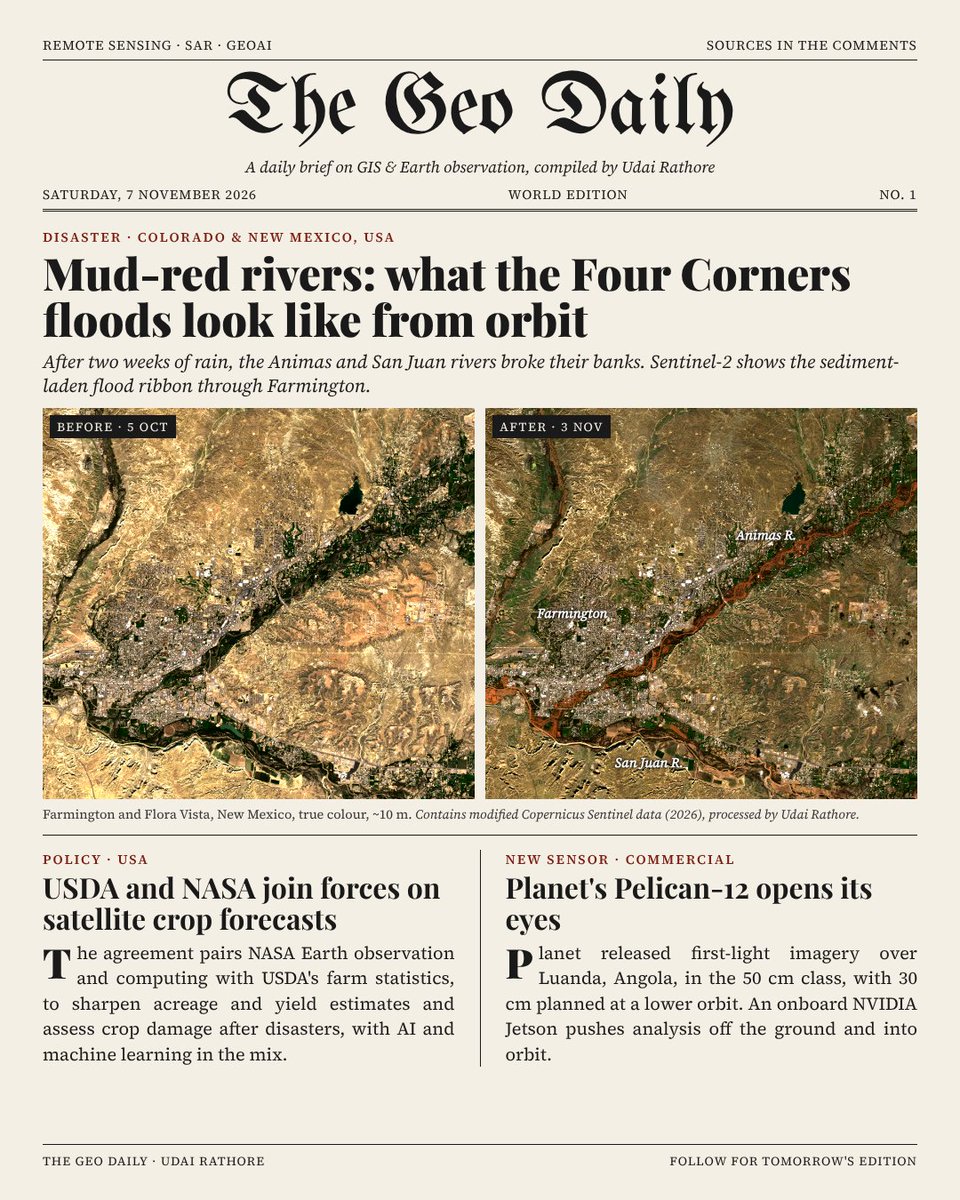
📰 The Geo Daily No. 1: the Four Corners floods from orbit. Sentinel-2, 5 Oct vs 3 Nov: the Animas River runs mud-red through Farmington, NM. Also: USDA × NASA team up on satellite crop forecasts; Planet's Pelican-12 sends 50 cm first light. #RemoteSensing#Sentinel2
@liamreckziegel Pairing the fire edge with lidar terrain is a nice idea. Is the edge from your drone imagery or an agency perimeter? I'm mapping VIIRS fire clusters in Punjab and Haryana this week, so I'm curious how they compare.
@ShellyElbazZ MNDWI is a good choice there, though salt crust on the shoreline can be tricky. Did you use one threshold across 1984, 2004 and 2025, or tune it per scene? The VHS look suits a 40-year comparison.
@brianjbusch Jordan basin still at 98% while the region fell from 47% to 23% is a striking contrast. Do you see that persistence in reservoir storage too, or mainly in the Drought Monitor?
@KaranD93@OvertureMaps@openstreetmap Running HDBSCAN one cuisine at a time is a smart call, since a single run would let the big categories swallow the small ones. How did you handle restaurants that appear in both Overture and OSM?
@fajrunwm Lombok is a nice test of the method, since two thirds of that nest is the 2018 sequence. Did you try declustering aftershocks first (e.g. Gardner-Knopoff)? I'd be curious whether all 50 nests hold up or a few collapse into single sequences.