Shehi, I can understand your frustration, amma we still make do with what we have. Democracy still remains the safest option for us especially in a country like ours with a myriad challenges that need no mention. As the Fiqh scholars will say: "we choose the lesser of two evils where necessary" and continue doing so, election after election, until we gradually get it right.
The truth is that no candidate can guarantee immediate security, prosperity, or good governance. What citizens can do is build a culture where leaders know they can be rewarded for performance and removed for failure, at the very least. The process is slow, but it is necessary.
At the same time, while still very hard in our climate, the youth must continue to hustle, build financial independence, and remain free from external grip. One of our recurring problems is that many people who rise economically or socially are quickly absorbed into the very system they once criticized, and once people begin to benefit from a system, they often lose any incentive to change it. Because, well, why would they?
Beyond elections, we must continue the work of awareness at the deep grassroots level beyond our polished essays, but direct engagement with ordinary people, in languages they understand and within the communities they live.
I remember during the 2023 elections, we organized a community forum and invited a respected political commentator to speak in Hausa about governance, the rights of citizens, and the political climate. Many people attended, they asked questions, and engaged seriously with the issues. They were able to understand things that might have only been abstract to them previously.
So we keep doing it. We keep educating ourselves. We keep expanding access to education and information so our people can develop a broader worldview and begin to see possibilities beyond the limitations we have been conditioned to accept.
Amma, will this solve everything before 2027? maybe not. But we keep trying one day at a time. It is usually slow, repetitive and often unnoticed/unrewarded in the present moment, yet it remains how societies improve. We stay informed, stay engaged, keep building institutions and awareness, and trust that each generation pushes the country a little further than the last.
Thanks a lot, Dakta, for this. I know we’ve had this conversation a number of times, and I completely agree with what you’ve said. My major concern is with points 3 to 5. After we do all that, what exactly do we gain apart from recycling the same people with little or no results?
Like we discussed the other day, exercising our voting rights by voting out anyone who fails to deliver on the mandate we elected them for will achieve two things. First, it affirms that, as citizens, we have the right to decide who governs us and to remove those who do not meet our expectations. Second, it sends a clear message to leaders that they can and will be voted out if they fail to do what is required of them.
Beyond these two points, looking ahead to 2027, what is the practical way forward? If PBAT is voted out, who among the potential candidates can guarantee the protection of lives and property? Who among them has the capacity to improve the standard of living?
I’m asking these questions because people are gradually becoming exhausted, and I think we need to confront our current reality honestly.
"... And in that reflection, my mind kept going back to our beloved father in faith, Ibrāhīm (A.S). I started thinking about what it must have meant for him to leave Hājar and Ismāʿīl (A.S) in such a place. A barren valley with no visible means of life. No farms. No crowd. No city. Nothing that human beings normally associate normal living. But then I thought: what looked like emptiness was not really emptiness. It was preparation. What looked like abandonment was not abandonment. It was trust. And what looked like just a desert was, in the knowledge of Allah, the future center of the final revelation to mankind"
ai consciousness discussions are the perfect nerd-snipe for those with a philosophical inclination. these things are still tools, just the most complicated and most misunderstood humanity has ever built, yet.
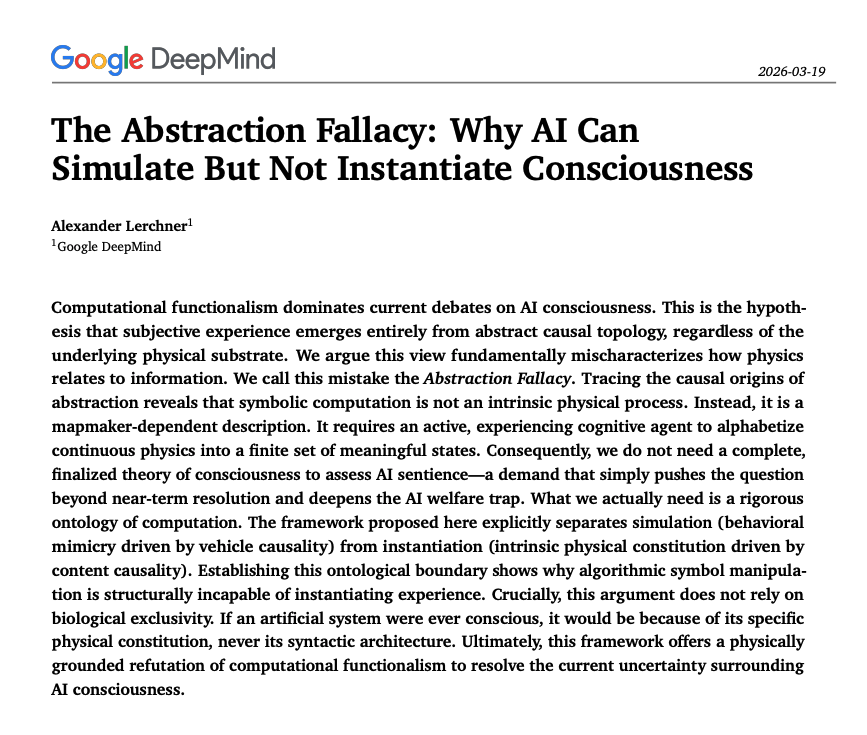
Google DeepMind researcher argues that LLMs can never be conscious, not in 10 years or 100 years.
"Expecting an algorithmic description to instantiate the quality it maps is like expecting the mathematical formula of gravity to physically exert weight."
as someone who works on making LLMs run faster and cheaper every day, i can confidently say the question of whether theyre conscious has exactly zero impact on whether theyre useful. we dont need our inference stack to be conscious, we need it to be correct, fast, and affordable. the consciousness debate is fascinating philosophy but its a distraction from the actual engineering problems that determine whether AI creates value. the gravity formula doesnt need to exert weight to help you build a bridge @Hesamation
yeah. but I also think there'll be new endeavors. what I think is those native with a tech see it simple, but the next generation that comes will see it as a genuine skill to learn and be paid for. maybe I'm being too optimisitic haha.
side note: been following some of your work. dope stuff💯
Hold on to the Quran and Sunnah. Everything else is an approximation. It is the light that never gets quenched. It is the companion that never abandons. Seek the knowlege of the deen. It's not about only becoming a scholar. It is about reconnecting with the most loving at all times. Because in just trying to learn about Him, in His mercy, he lets you know Him and everything else.
The Oasis of Certainty
".... The Qur’an does not merely issue rules. It narrates human behavior across history. Every ummah mentioned is a case study showing a particular human trait taken to its extreme. Allah, out of his mercy, has already run the experiments for us. The arrogance of ‘Ad shows what happens when strength becomes an object of worship. Thamud demonstrates how material brilliance collapses when ethics are abandoned. The people of Lut illustrate what occurs when fitrah is overridden by desires and self-definition. Madyan exposes the rot of economic injustice, while Saba reveals how ingratitude corrodes even the most prosperous societies. Qarun stands as a timeless warning against the delusion of self-made success, the belief that provision comes from one’s own brilliance rather than from Ar-Razzaq."
"...moving from a place where the average temperature was 30 degrees to giving presentations in –26 is not something I would have believed if I hadn’t lived it. Yet within those dark and cold winters of the north lies a culture of incredible resilience and determination; a term referred to as sisu in Finnish."
https://t.co/spMZ2THhDi
If I'll be interviewing someone for high agency:
- discuss a problem completely unrelated to the domains both of us are familiar with
- do not give explicit instructions on what to do/or what not to do
- no specification of rewards/ expected outcomes
watch for:
- willingness to actually care about the domain, research about it and even think about it
- coming up with solutions/proposals even if absurd (due to unfamiliarity with domain)
tools can always be learnt, comfort with ambiguity remains the moat since time immemorial