started a new blog series discussing the fundamentals of architectural work, why it's needed, what it is, etc., things we have forgotten while debating the how only. without understanding them, we run blind, without purpose and direction. enjoy ... ;)
https://t.co/Vp6VkWIYOD
@ylecun@elonmusk you know, it is obviously hard for some people out there to understand the (not so) subtle difference between "national socialism" (a.k.a. "nazism") and "socialism" – or more likely musk knows the difference exactly and just trolls around (also known as "deliberate gaslighting").
You can find the slides of my JAX 2026 talk "Forget technical debt" at https://t.co/8yjGQIpf7C.
The deck discusses why it is not enough to look at technical debt in isolation and discusses some other options to affect it. enjoy if you like ... ;)
You can find the slides of my JAX 2026 talk "The 7 pitfalls of AI" at https://t.co/FlhLYrvU4h.
The deck discusses some questions, we still need to answer if we want to use AI at scale in a sustainable manner. enjoy if you like ... ;)
People keep blaming the users for the growing number of vibe-coded reasoners. Doing so is *half* right.
Users *are*screwing up - by letting vibe coded stuff access their files, without proper backups, without proper monitoring, without adequate sysadmin, etc.
But that’s *exactly why* we still need software engineers — and why what Dario recently said about software engineers disappearing is so absurd.
Skilled coders can use vibe-coded tools, with careful oversight.
But amateurs using vibe-coding tools are asking for trouble.
Using them without a strong prior working knowledge in coding and sysadmin *is* the mistake.
i just released a new blog post discussing two observations that become very apparent in the light of AI about how we make our own lives rather more more painful than needed: https://t.co/4uSZEqML3f
enjoy if you like ... ;)
I released a new blog post discussing two fundamental questions AI asks us in software development, titled "It has never been about code" and "Does it always have to be software?"
Enjoy if you like ... ;)
https://t.co/0oikPZCW3i
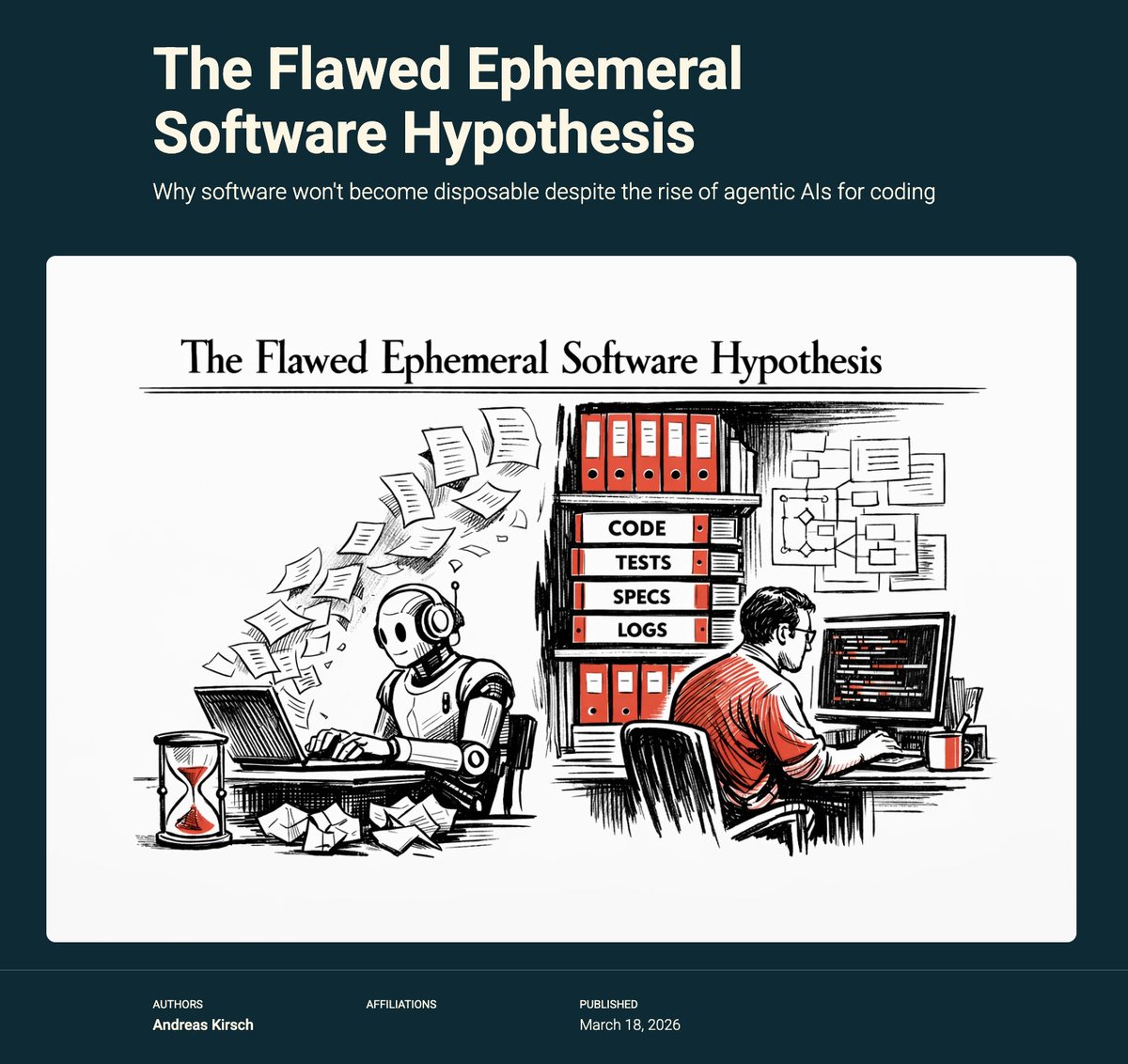
A while back, Andrej Karpathy said the app store will be replaced by generated, disposable software," and Amjad Masad predicted that the value of all application software will go to zero
I think this "ephemeral software hypothesis" is wrong, though, and I want to explain why:
i released a new blog post discussing the increasing importance of resilience as ai taking over software development starts to increase rigidity and fragility in most companies.
enjoy if you like ... ;)
https://t.co/BpCmn3pzjk
There's a toxic culture coming out of the AI industry that keeps trying to get us not to think.
The message is everywhere. Don’t read the code, just vibe-code. Don’t try to understand all the text, just let AI summarize it. Don’t bother educating yourself, it’s too late.
Don’t worry about the errors. Trust that everything will be fixed in the next version.
The theme is the same. Don’t think too hard. Just keep swallowing the slop.
@grafjo yup, as i wrote, at least in software dev the first inflection point already has come, even if the tooling is still immature. the downside of this unusual situation is that many people need to learn stuff today they will not need in the future anymore as tooling will mature.
released a new blog post discussing why you are not "left behind" if you do not become an AI-based software development expert right now, but still need to learn AI-based software development. sounds paradoxical? yes, the world sometimes is ;)
enjoy ;)
https://t.co/4nZlsKBCuT
@MaggieL@scalajos good point :)
i did not look after them for a long time. i am so used to the theme that i basically overlook them.
i will have a look. however, it is a quite old theme (from 2020) - curious, if it offers any more recent social media options :)
thx for the hint!
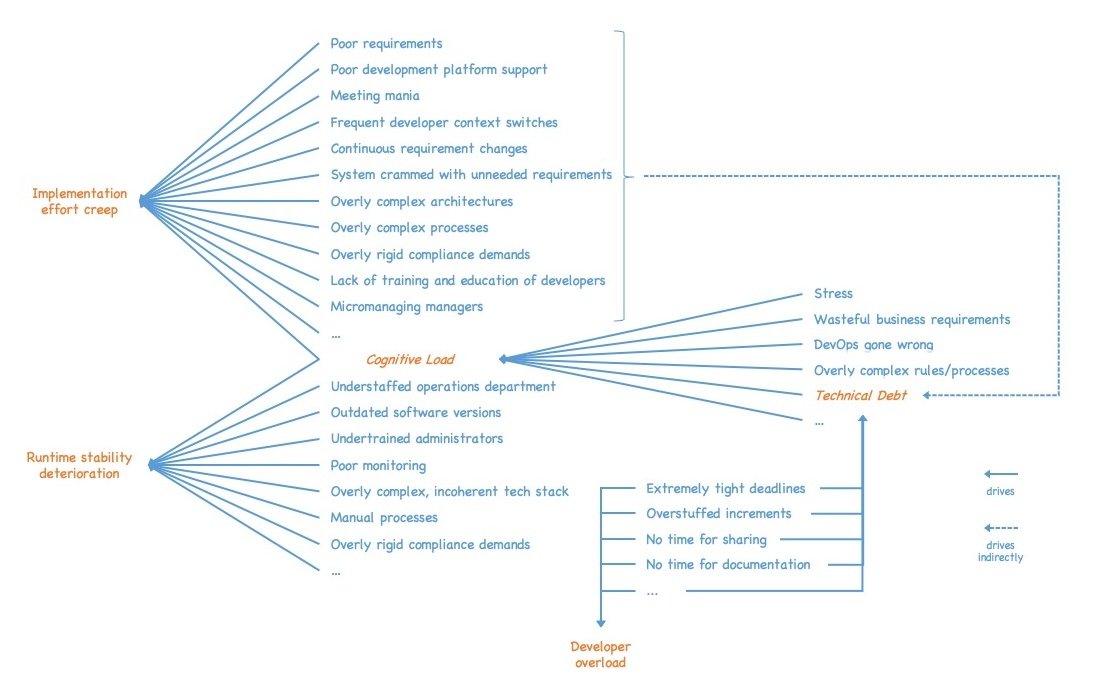
"Thus, if we want to reduce implementation effort creep and runtime stability deterioration, solely looking at technical debt is not enough. Technical debt is just one piece of the puzzle ..." https://t.co/2znpVqCCSe < I really liked the insights from @ufried here
released a new blog post, discussing the concept of "technical debt", how it is about much more than technical debt alone, what we actually try to achieve – resulting in an extensive graph of detrimental drivers we need to consider. enjoy if you like ;)
https://t.co/kE2vqyWDPG
i released a new blog post discussing that based on research we default to add things when solving problems instead of subtracting things, what it means for us and IT in general. enjoy if you like ... ;)
https://t.co/w0X0dg7z2j
Proof is overrated.
This is a brilliant talk by Rory Sutherland: [https://t.co/sg3fVp2bOc] where he makes two essential points. First, it's a huge problem when "rational" people get veto power over creative, innovative, "irrational" people. Second, you excel, not by copying things that somebody does, but by doing the things they don't do—by surprising people in a good way. This observation is true in both marketing and process improvement.
Sutherland looks at bees to demonstrate the problem. When a bee finds pollen, it comes back to the hive and communicates where the food is. The rest of the bees then hare off to that location and start harvesting. About 20% of them, however, don't do that at all. They continue wandering around at random seeing what there is to be seen (and trying things nobody's tried). Without those forragers, the hive dies. Always. No matter how rich the pollen source is, you eventually exhaust the supply. You cannot fix the problem with 10x bees. Improving the route makes no difference. Your pollen-collection metrics are outstanding—improving even—up to the point of collapse. The hive needs innovation to survive.
In other words, any "improvement" strategy that involves continuing to do what you do now with a laser focus on improving the metrics will fail. True improvement comes from that 20% of the hive that's off looking for new things. Without that 20%, the hive dies. Saying "what we do now 'works'" just digs you deeper. Yes, it will work, up to the point of collapse.
Unfortunately, the rational bean counters who control most organizations automatically veto any real improvement, because there are no metrics for a novel approach. Nobody's done it, yet, at least not inside the organization—outside metrics are always discounted by "we can'd do that here"—so there are no numbers. The "proof" they demand is impossible. There is nothing to measure.
Consider the "Drive" (self-determination theory) principles: connectedness, autonmy, mastery, purpose. There are no metrics for those principles, but implementing them improves performance dramatically, vastly more than working on velocity or improving metrics. But try to suggest that we focus on happiness, and you'll be shot down as an irrational dreamer within seconds. Even saying "happiness will improve the metrics" will be discounted with "show me proof."
The fact that the "rational" people have veto power over creative people is a huge problem. Follow the outliers.
@BrianKnoles that sounds very interesting. i will definitely look into it (need to find a few quiet minutes to read the article).
thanks a lot for the hint and the link!
i just released the 2nd blog post discussing the well-known paper "the ironies of automation" and what its findings mean for the current agentic ai automation move (spoiler: some more questions we still need to take care of). enjoy if you like ... ;)
https://t.co/OfH5ujKn5h