Hey #FlareCommunity,
We are part of v2 data provider and validator on @FlareNetworks.
Welcome to delegate with us, and let us know if you need any assistance. Your support keeps us growing stronger together! 💪
Here’s our Node ID:
0xe3a76233885E355cFaF141D7dd3D92705C9db4D5
One thing to REALLY understand is that the FCC allows applications to be built that can hold assets and programmatically take actions with those assets whilst preserving privacy. Inputs over what to do with those assets can come from humans or machines.
The design space (ie the number of things you can do with this) is vast.
A really good early example here is something like an AI administered index token. Whereby an AI defines and periodically updates an index strategy - with the FCC being used to prove both that the AI hasn’t been tampered with and also to execute the investments, index rebalancing and hold the funds.
A major part of financial infrastructure depends on information that cannot be made public.
Institutional reserves, credit data, investment strategies and private financial records.
Flare Confidential Compute (FCC) allows this information to be processed inside secure hardware, producing signed results that smart contracts can verify and use without exposing the underlying data.
Already running on Songbird, FCC is now proposed for Flare mainnet through FIP.17.
This creates a foundation for more sophisticated financial products, including confidential risk assessments, automated asset management and private financial operations.
Read the proposal and participate in governance: https://t.co/DE0uMhCzPk
🗳️ FIP.17 proposes bringing Flare Confidential Compute (FCC) to mainnet.
Flare's data protocols already let smart contracts use external information. FCC extends this infrastructure to confidential computing.
Following its release on Songbird, the proposal introduces:
• Initial approval-based deployment of compute extensions
• Protocol fees supporting validators, stakers and FIRE
• Zellic-audited FCC smart contracts
For onchain instructions, Flare's data providers authorize execution, while attested TEEs run approved code and return signed results that smart contracts can verify.
A new foundation for building applications that need sensitive data without exposing it onchain.
Full proposal: https://t.co/K4CETA9gWW
Bitcoin has sats. Casper has motes.
A mote is the smallest amount of CSPR you can hold: one billionth of a token.
Plot twist: the chain doesn't actually know what a CSPR is. Every balance, fee and transfer is counted in motes. CSPR is the friendly version your wallet shows you.
So when you send 2.5 CSPR, the chain sees 2,500,000,000.
Which raises the obvious question: why not just count in CSPR?
Because computers are great with whole numbers and surprisingly bad with decimals.
Ask most programming languages for 0.1 + 0.2 and you'll get 0.30000000000000004. Errors like that add up fast when you're moving money.
Count in whole motes and every balance and fee adds up exactly, down to the last one.
→ https://t.co/R8g6Ji5ILj
An important part of Flare’s economics is how the network incentivizes data providers.
FTSO rewards accurate price feeds. FDC rewards participation in consensus on external data.
And FLR holders can delegate to the providers running that infrastructure.
Flare’s data protocols are built into the network’s economic model.
Some things in DeFi are priced in dollars on purpose.
Cover premiums on @Firelightfi are one of them, which is why the vault rate responds when the value of the staked XRP moves.
Read more on how it works: https://t.co/e0NZAWhwPr
FXRP is built on Flare, but it is no limited to Flare.
OFT makes it the same asset across chains, so XRP liquidity can enter markets like Morpho without being split into separate wrapped versions.
The next step is giving issuers the option to secure cross-chain messages with Flare’s DVN: stake-weighted consensus from Flare’s independent data providers.
Moving across chains is what lets FXRP reach more markets.
On Ethereum, FXRP is accepted as collateral on @Morpho, where holders borrow $RLUSD against it.
It's one data stack, securing FXRP wherever it goes and making more markets possible.
Most of the internet still can’t sell to an AI agent 🎟️
@mssteuer joined Web3 with Sam Kamani to talk agents, compliance that travels with tokenized assets, and what it’ll take for blockchain to go mainstream.
Full episode → https://t.co/fWc4rU6ny2
Flare now has an MCP server.
AI coding agents get direct access to live network state, docs, and our enshrined protocols.
Building on Flare just got a lot easier.
Connect your IDE: https://t.co/1oLnyk5idb
XRP-collateralized borrowing is live, powered by FAssets.
Post FXRP as collateral on Morpho, and borrow RLUSD from the vault curated by @SentoraHQ.
Overcollateralized. Permissionless. No underwriter, no approval, no minimum.
RLUSD delivered back into your XRPL wallet is next.
Think about this.
ETH, SOL and stables have had onchain yield paths for years.
XRP didn’t.
So taking an asset with hundreds of billions in market value from idle to productive capital onchain is a major shift.
Flare was built around a simple idea: blockchains need reliable access to data beyond their own networks.
That started with powering DeFi. Now the same infrastructure is expanding to cross-chain verification through Flare’s DVN.
Great to see the Flare Japan community spreading the word! 🇯🇵
Flare’s FDC infrastructure is expanding beyond XRPFi to cross-chain message verification through Flare’s DVN.
What if smart contracts could use sensitive financial data without exposing it publicly?
That’s what Flare Confidential Compute (FCC) makes possible.
It uses Trusted Execution Environments (TEEs) to process private data and return signed results that smart contracts can verify onchain.
The data stays private, but the results can be used by dApps and DeFi protocols.
Want to build with FCC?
Start with our developer guide:
https://t.co/zeCGZqwlBZ
How Firelight absorbs a validated claim:
→ First-Loss Buffer: a protocol-owned stablecoin reserve takes the loss first
→ Vault: only engaged if the buffer is exhausted, shared pro-rata across stakers
Learn more.
https://t.co/6FF8ELROLy
Institutions are coming to crypto. Privacy matters to them.
@HugoPhilion tells @thinkingcrypto where Flare fits, from Flare Confidential Compute to broader data use cases.
Full interview: https://t.co/nYYfnYj1jl
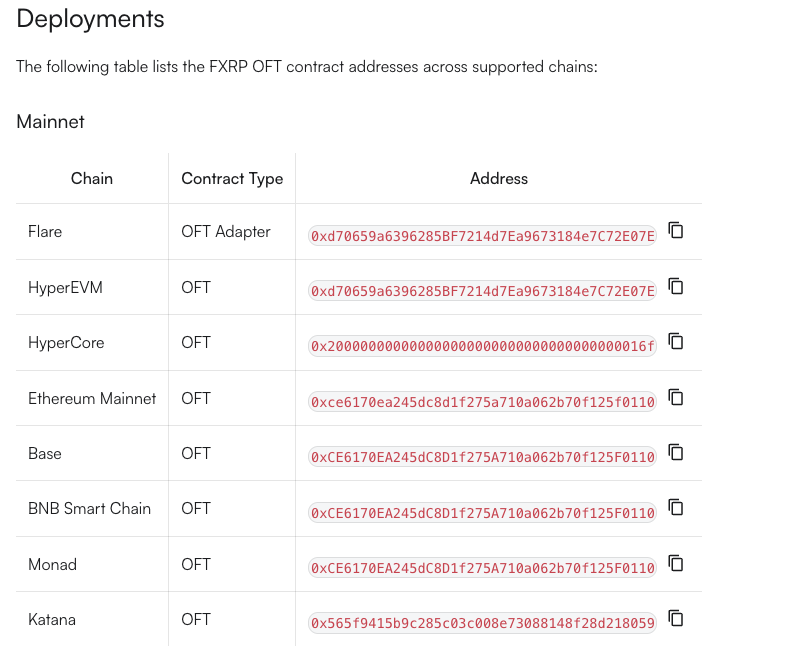
FXRP is already an Omnichain Fungible Token (OFT) on LayerZero, allowing XRP liquidity to reach DeFi across multiple EVM networks.
Here’s how it works:
FXRP is minted on Flare through FAssets, using FDC to verify the underlying XRPL transactions.
When FXRP moves to another chain, the OFT Adapter locks it on Flare and a corresponding amount is minted on the destination chain. The process works in reverse when FXRP returns.
This is how XRPFi can extend beyond Flare without relying on separate wrapped versions of FXRP.
And with Flare now joining LayerZero as a DVN, the same data infrastructure powering XRPFi is expanding to verify cross-chain messages for other assets too.
Explore the FXRP OFT implementation, deployments and guides:
https://t.co/wkNCGVHVB7