@kaiaulumaui@ClayTravis See this is the argument that doesn’t hold water. You can’t cherry pick who they play, clay said “team” so he would cherry pick the team. However you can’t cry about their size, that’s the why the boys would dominate this game, not close
EACH LAYER OF A DATA CENTER AND COMPANIES THAT PROVIDE EACH KEY COMPONENT:
1. SITE & FACILITY - The physical location, power delivery, and cooling infrastructure. Eaton $ETN Schneider Electric $SBGSY Vertiv $VRT Johnson Controls $JCI
2. POWER SYSTEMS - Power delivery, backup, and distribution to keep servers running. Generac $GNRC Vertiv $VRT Eaton $ETN ABB $ABBNY
3. COOLING & ENVIRONMENT - Thermal management and environmental control for optimal performance. nVent $NVT Johnson Controls $JCI Vertiv $VRT Boyd $BYD
4. IT INFRASTRUCTURE - The core hardware that stores, processes, and moves data. Dell Technologies $DELL Super Micro $SMCI Pure Storage $PSTG Arista Networks $ANET
5. DATA CENTER OPERATIONS - Software and systems to monitor, manage, and secure the data center. NVIDIA $NVDA Fortinet $FTNT Datadog $DDOG ServiceNow $NOW
6. HYPERSCALE & CLOUD - The companies that build and operate massive data center environments. Amazon $AMZN Microsoft $MSFT Alphabet $GOOGL Equinix $EQIX
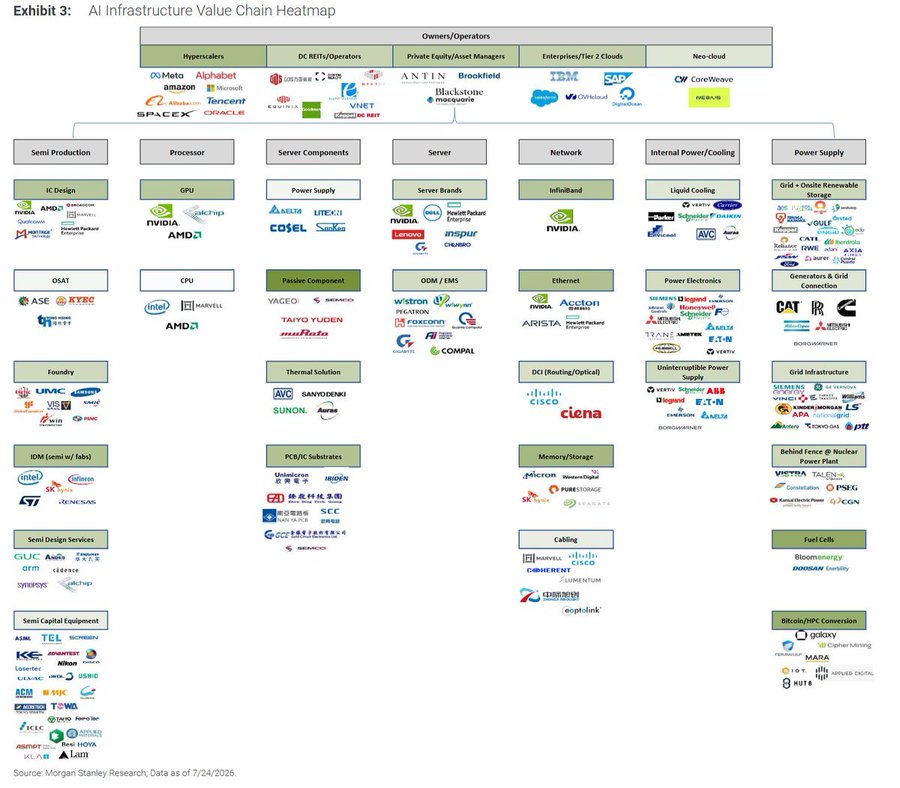
Morgan Stanley just mapped out the entire AI infrastructure supply chain, and it reveals who actually gets paid at every layer of the trillion dollar buildout (Save this).
This heatmap breaks the AI infrastructure value chain into two dimensions those who owns and operates the data centers at the top and what physical and technical components get built underneath to make those data centers function.
At the top sit the owners/operators, the hyperscalers like Meta, Alphabet, Amazon and Microsoft, alongside data center REITs, private equity giants like Blackstone and Brookfield, enterprises and neoclouds including CoreWeave and Nebius.
These are the companies writing the massive capex checks that fund everything below them.
Below that sits the actual build out, split into seven layers, semi production, processors, server components, servers, network, internal power/cooling and power supply.
Semiconductor production is dominated by names your audience already knows well, Nvidia and AMD for GPUs, TSMC adjacent foundries, ASML and Applied Materials for capital equipment, and Micron and SK Hynix under memory/storage.
But the less obvious money is in the physical infrastructure layers most retail investors never look at.
Server components include passive parts from Yageo and Murata, thermal solutions from Sanyo Denki, and PCB substrates from companies like Unimicron.
Network infrastructure includes InfiniBand and Ethernet gear from Nvidia and Arista, plus optical/DCI routing from Cisco and Ciena.
Internal power and cooling is arguably the most underappreciated category here.
It includes liquid cooling specialists like Vertiv and CoolIT, power electronics from Siemens and Eaton, and uninterruptible power supply makers like ABB and Legrand, all companies solving the literal heat and electricity problem created by cramming more GPUs into less space.
So who benefits from all of this?
Everyone in every box benefits in some way but the real insight is that value doesn't concentrate at just the GPU layer anymore.
The hyperscalers at the top are distributing capex across seven distinct physical layers which means the picks and shovels opportunity set has expanded well beyond Nvidia into cooling, grid infrastructure, and power generation.
Milk Road Pro is tracking each one of these layers, come join us for just a dollar using the link below!
Unwritten rules of the stock market:
1. Price drops 10%: Hold.
2. Price drops 20%: Increase position by 10%.
3. Price drops 30%: Increase position by 30%.
4. Price drops 40%: Increase position by 30%.
5. Price drops 50%: Increase position by 50%.
6. Price rises 10%: Hold.
7. Price rises 20%: Still hold.
8. Price rises 30%: Sell 10%.
9. Price rises 40%: Sell 20%.
10. Price rises 50%: Sell 30%.
11. Price rises 60%: Sell 40%.
12. Price rises 100%: Sell everything.
Save this; it will come in handy...
If you are not following us with notifications turned on, you might miss our next alerts.
20 growth stocks in entire market under $10B cap:
Energy
1. $AMPX | High-energy silicon-anode batteries
2. $TE | U.S.-made solar modules and solar cells
3. $OKLO | Advanced nuclear reactors and fuel recycling
Space
1. $FLY | Launch vehicles, lunar landers and orbital spacecraft
2. $SATL | Earth-observation satellites and geospatial intelligence
Semiconductor/Storage
1. $OSS | Rugged edge AI computing systems
2. $NVTS | GaN and silicon-carbide power semiconductors
3. $AEHR | Semiconductor test and burn-in systems
4. $MRAM | Magnetoresistive memory for mission-critical systems
5. $PENG | AI infrastructure and advanced memory solutions
Drones/Defense
1. $ONDS | Autonomous drones, counter-drone systems
2. $AVAV | Autonomous defense systems
3. $UMAC | U.S.-made drone components
Robotics
1. $OUST | LiDAR sensing and perception for robotics
Photonics/Optics
1. $AXTI | Compound semiconductor substrates
2. $AAOI | Optical transceivers for AI data centers
3. $LWLG | Electro-optic polymers for high-speed photonics
AI Infrastructure
1. $WYFI | AI cloud and data-center infrastructure
2. $CIFR | AI/HPC data centers and Bitcoin mining
Software
1. $DOCN | AI-native cloud infrastructure for developers
Industrials
1. $ADUR | Chemical recycling technology for waste plastics
🔍 Ten names under ~$10B, before they go large-cap. The giants get the headlines. The runway lives one tier down.
🖥️ $CIFR → bitcoin-to-AI conversion, $3B+ contracted
🛸 $ONDS → drone autonomy, growing defense backlog
🧠 $PENG → AI memory + infrastructure
👁️ $OUST → lidar perception for everything autonomous
🌊 $KRKNF → subsea defense robotics
🔋 $EOSE → grid-scale zinc storage, Pentagon on the customer list as of this week
📷 $AMBA → edge AI vision silicon
⚡ $AMPX → silicon-anode batteries for drones
🏭 $DGXX → owns its power-to-compute stack
💠 $SIVEF → the lasers inside AI clusters
Color code on the card: anchor, inflecting, early, speculative. That's the honest part → these are not equal bets. Small caps carry binary risk, financing risk, and they de-rate hardest in every flush. The past six weeks were the tuition. 🎓
The trade-off you're paid for: the trillion-dollar names already ran. Asymmetry only lives where certainty doesn't.
DYOR. Not FA.