An important step by National Treasury. Looks like the beginning of consolidation in South Africa's electricity Distribution sector
Treasury 'advises' 15 municipalities to let Eskom take over -%20%40%20-%20by%20%40AntoinetteSlabb https://t.co/OfFYmGE3s7
California is often the US state held up as an example of how to do Renewables..... In reality Texas is a much better example,since they adding RE+BESS without the high electricity prices you find in California....
Other states talk a big game, but Texas builds. Texas is scaling battery storage so fast that it's almost keeping up with the other 49 states… by itself!
@xiaowang1984 I didn't know that anyone needed to say that demand response is not equal to generation🤷🏾♂️. Really.... Demand response is useful and all.... But....
National Treasury's debt relief program had no chance of success because it never addressed the fundamentals of electricity distribution in SA munics.
Municipal arrears to Eskom rocketed by 71 percent in one year https://t.co/zi3Nagkywt
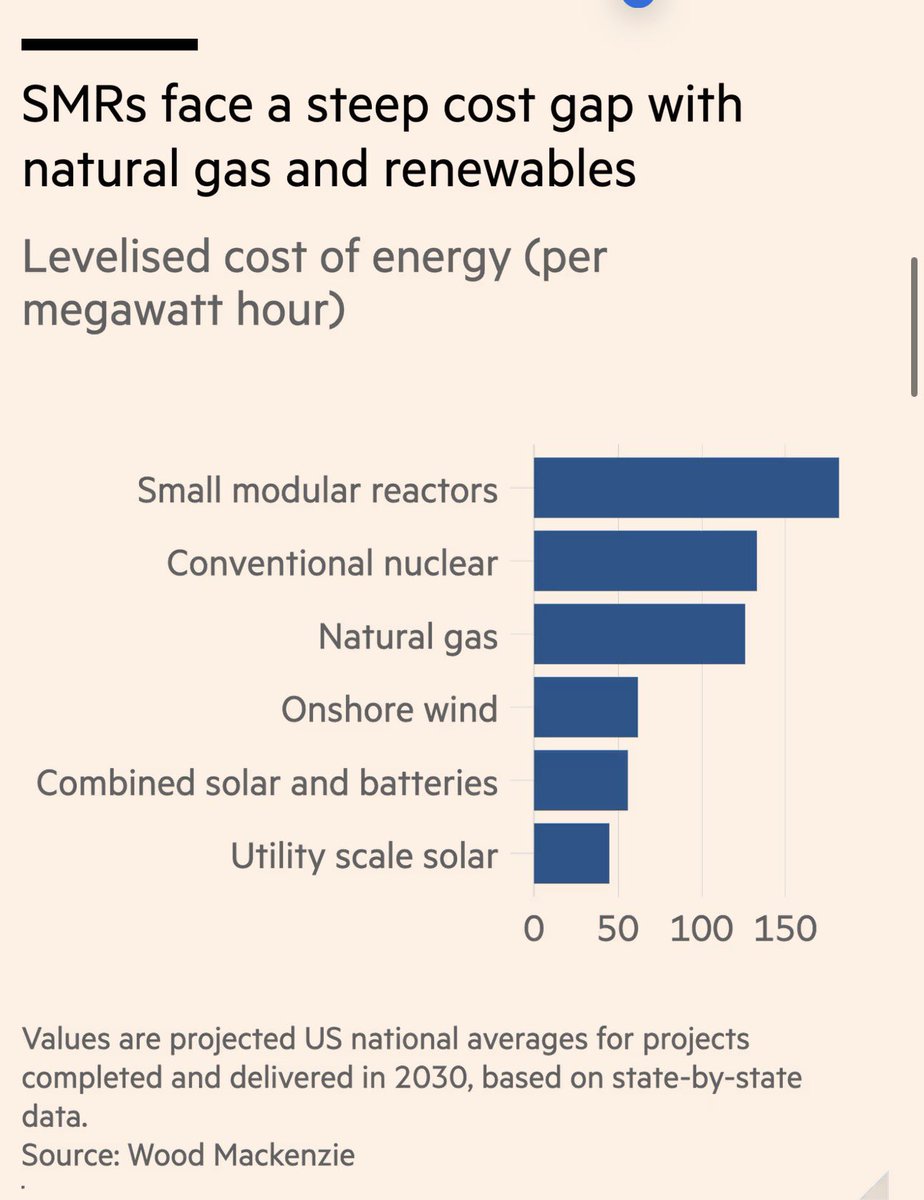
“According to data from Wood Mackenzie, by 2030 SMRs should generate power at $182 per megawatt hour compared with $133 per megawatt hour for conventional nuclear. Natural gas is expected to sit at $126 per megawatt hour, while onshore wind and solar, backed up by battery, are projected to be around one-third less expensive.”
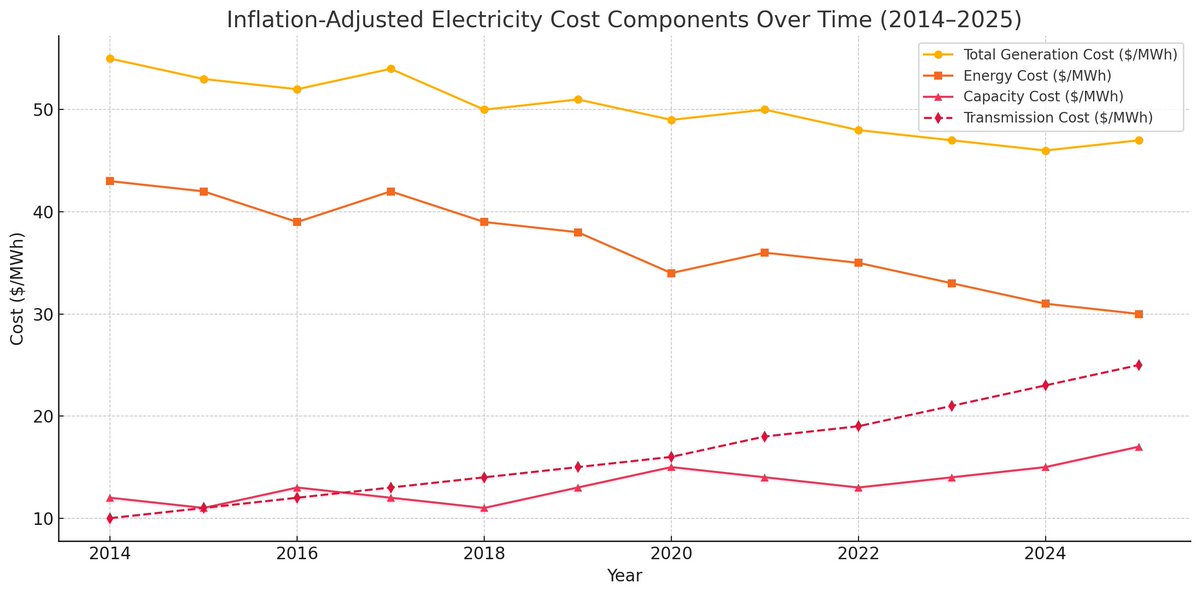
An important chart from @washingtonpost on energy costs – generation has become cheaper, but the cost of delivering energy to consumers across the grid has more than doubled.
@sancrimonious@xiaowang1984 That sounds very low.... Would surprise me. That number might be grid scale BESS. Might be a lot of Behind-the-meter BESS not accounted for.
@xiaowang1984 There is probably an engineer somewhere who wrote that document and recommendations months ago... And it's been parking somewhere getting approval... Never underestimate bureaucracy 🤷🏾♂️🤷🏾♂️. And that setup sounds super bureaucratic
@xiaowang1984 Yup. You have to adapt your operating practice in real time...which AEMO can. That's not happening when you need to ask permission from politicians who have a storyline to sell and don't understand technical or operational realities.
@xiaowang1984 Trying to change settings on 100s/ 1000s of RE plants in a week...Not happening+ plus 100 control centres for a country of Spain's size is interesting. The Spanish system operator does not have license to do what it takes to keep the lights on
If the payback period on a household battery is 14 years in Australia at their electricity prices... What is it in places with much lower electricity prices??🤔🤔. And how do u reduce the payback time?
The Australian Energy Market Commission @the_AEMC just released a puff-piece for household batteries.
Which prove that without subsidies, they definitely don't make any economic sense.
They couldn't be paid back within warranty period. 1/
@lungile_mashele The discussion around electricity prices in SA needs a lot more nuance. I am not convinced the powers that be or many commentators have a good handle on the causes of price increases or whether electricity prices are high (in some cases yes they are).
@lungile_mashele “Over the next few years, we do expect variable costs to come down, but the proportion of costs that are fixed will rise, which, if unchecked, could exacerbate inequalities that we see today,” Brearley said at the time.
A reminder that customer electricity bills can go up even if generation costs stay the same... Transmission + Capacity costs can outstrip energy cost savings.
👋It's worth digging into which parts of energy bills are driving cost increases. Our recent analysis with @nrgytariffxpert over a similar timeframe shows that policy choices and utility investments in transmission and distribution have continued to drive overall bill costs upward while the costs of generation and capacity have remained the same or lower, depending on the utility territory.
The data shows that generation still makes up roughly the same percentage of bills as it did 10 years ago — on average about 45%, with differences among individual utilities.
Leveraging competitive electricity markets is critical to discipline costs and shield consumers from investment risk as demand continues to climb: https://t.co/zgenaxsF4p
@xiaowang1984 I don't think the immediate use case for most utilities is to be on an equal footing with traditional synchronous generators.... TSO/ DSO will pick up some of the functions as they can create products.... that's a great representation though
Transformers are going to crash a lot of transmission rollout ambitions, simply because the people drawing up the plans have no idea about the supply chains that go into building power networks
"On average, customers currently have to wait three years for high-voltage transformers and one year for distribution transformers. About 80% of high-voltage transformers and 40-50% of distribution transformers are imported. Meanwhile, the National Electrical Manufacturers Association predicts 2% annual electricity demand growth through 2050"
The business model of making profits off energy sales is dying. solar PV will do for that and DX companies recovering fixed costs won't help. 30% electricity tariff increase is a reality,says ERASA - By @AntoinetteSlab https://t.co/yKcinHppvO via @Moneyweb