📢 Today!
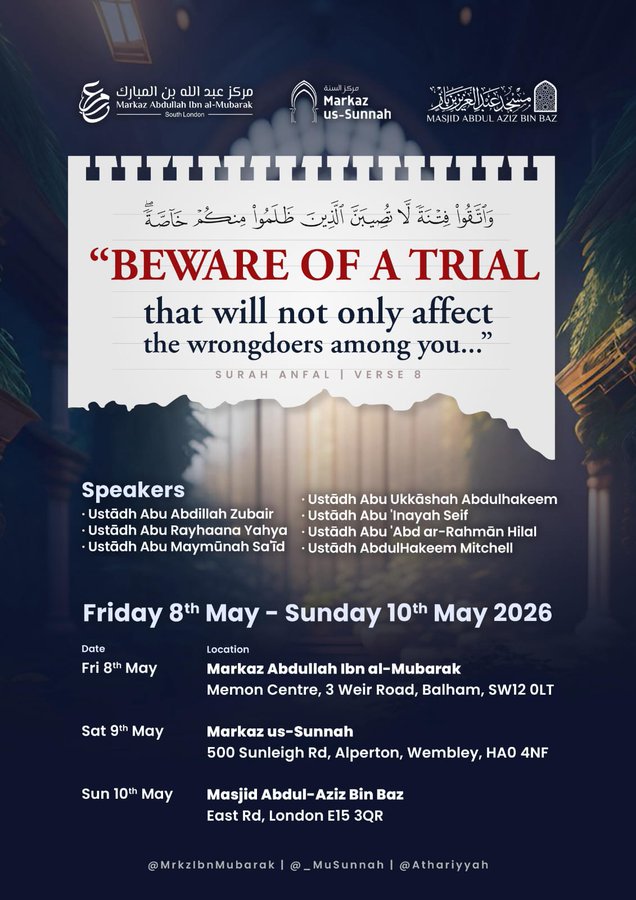
🔊 ‘Beware of a trial that will not only affect the wrongdoers among you…’
📅 Sunday 10th May 2026
🕌 #MasjidBinBaz East Road E15 3QR
🕕 ‘If you feel no shame, then do as you wish’ @AbuRayhaana
🕖 ‘Let those who go against His command beware…’ @Abu_Ukkaashah
🎧 https://t.co/SNbI64ZWDo
📢 This Sunday, our usual classes with Abu Maymūnah Sa'īd are postponed whilst we host the final day of the 3 Day London Conference...
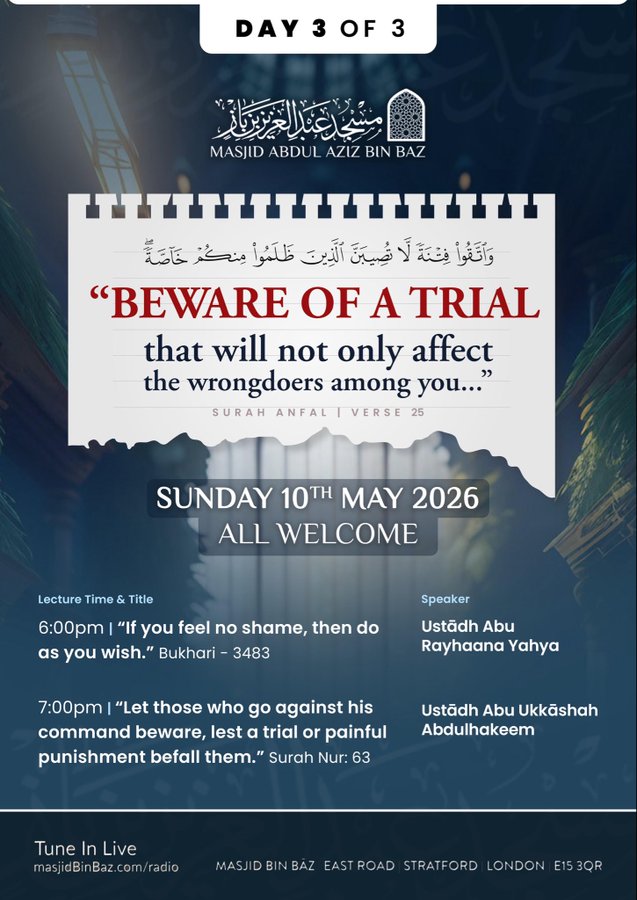
🔊 ‘Beware of a trial that will not only affect the wrongdoers among you…’
📅 Sunday 10 May 2026 ان شاء الله
🕌 #MasjidBinBaz East Road E15 3QR
🕕 ‘If you feel no shame, then do as you wish’ @AbuRayhaana
🕖 ‘Let those who go against His command beware…’ @Abu_Ukkaashah
🎧 https://t.co/SNbI64ZWDo
👥 All Welcome
[Official Announcement]
🤲🏼 May Allāh accept our prayers and fasts. Ameen
• Eid al-Fiṭr: Friday 20th March 2026
• Final Night of Tarāwīḥ Prayers: Wednesday 18th March (Tonight)
• Final Day of Ramaḍān (30th Fast):
Thursday 19th March 2026.
📢 Sisters' Class - This Saturday
🆕 ‘‘Preparing for the month of Ramadān’’
🎙️ Ustādh Abu Rayhānah Yahya @AbuRayhaana
🗓️ Saturday 7th February 2026
🕦 1:45pm UK | 8:45am USA | 4:45pm KSA
📌 The Main Hall will be for sisters only
📍Masjid Bin Bāz East Road London E15 3QR
🫖 Light refreshments available
🎧 https://t.co/SNbI64ZWDo
The 29th Annual Conference in Birmingham, organised by Al-Maktabah As-Salafiyyah: 8th-9th-10th August 2025, inshā'-Allāh.
A Study of the Belief of Ahlus-Sunnah wal-Jamāʿah authored by two Imāms of the early Salaf, Abu Zurʿah (d. 264H) and Abu Hātim (d. 277H).
Read & share!
🔄We will resume “The Book of Softening of the Hearts from Sahih Al Bukhāri” lessons by Shaykh Uways At-Taweel @uwaysT next week Saturday 3rd May 2025.
Previous lessons can be found here
https://t.co/dV6WWltZTU
A List of (some) Instructions, Exhortations, Commands and Prohibitions in the Qur'an
Link below contains a much bigger list than the first 25 shown in the provided screenshot:
https://t.co/g0FpsgXDpT
#quran#holy#book#guidance#revelation#wisdom#mercy#teachings#commands #prohibitions #ramadan
The 'Ulema of Hadith utilise various principles to reconcile between two differing accounts and likewise to reconcile between praise and dispraise when they are both combined in an individual. Sh. Al-Albani and Sh. Muhammad Amān Al-Jāmī have excellent explanations of these principles (see links in reply tweet).
These principles include the following:
1. The one who is affirming something is given precedence over the one negating that thing.
2. The one who knows something is a hujjah (proof) over and above the one who is unaware of that thing.
A basic example of the application of this principle:
One individual states that so-and-so was not present at the Masjid today. A second individual states that he prayed next to the same so-and-so and spoke to him. Both are trustworthy. THERE IS NO CONFUSION HERE. The one affirming saw something that the negator did not - so his testimony is given precedence.
Another example:
Multiple trustworthy Muslims testify that so-and-so has been witnessed performing a blameworthy action. Their testimony is given precedence over others saying "well, I personally haven't ever seen him doing that".
Once again - THERE IS NO CONFUSION HERE. Those affirming the presence of this blameworthy action have knowledge and an awareness that is absent from those who are negating it, and thus the speech of those affirming this blameworthy action is accepted while the speech of those negating it is rejected.
QUR'ANIC VERSE TO REFLECT UPON TODAY (#14)
Allah increases the provision for whom He wills, and straitens (it for whom He wills), and they rejoice in the life of the world, whereas the life of this world as compared with the Hereafter is but a brief passing enjoyment.
[Surah Ar-Ra'd (13):26]
QUR'ANIC VERSE TO REFLECT UPON TODAY (#15)
Say (O Muhammad صلى الله عليه وسلم) to ‘Ibadi (My slaves) who have believed, that they should perform As-Salat (Iqamat-as-Salat), and spend in charity out of the sustenance We have given them, secretly and openly, before the coming of a Day on which there will be neither mutual bargaining nor befriending.
[Surah Ibrahim (14):31]
🔊 Fasting in Ramaḍān: Its Virtues & Rulings.
🎙️ Abu 'Iyād Amjad Rafiq (حفظه الله).
𝕏 @AbuIyaadSP | @IslamTees
▶️ https://t.co/Ek4FC4gcBo
🖊️ Some points covered during this lesson:
Virtues of the month of Ramaḍān.
Twenty points of guidance from the Messenger ﷺ regarding fasting:
1. He would anticipate Ramaḍān and not fast until seeing the ḥilāl (new moon).
2. He would never fast a day or two days before Ramaḍān.
3 He would command the believers to establish their intention on the night of every fast (before Fajr).
4. He would not withhold from eating or drinking until the actual break of dawn.
5. The adhān of imsāk (15-20 minutes before Fajr) is not from his guidance.
6. He would delay the suḥūr and hasten the breaking of the fast.
7. His ifṭār would be something very simple and would consist of fresh, ripe dates.
8. He would encourage making du’ā at the time of breaking the fast.
9. He would never abandon suḥūr.
10. The saḥūr would consist of dates.
11. He would sometimes fast and sometimes not fast when travelling.
12. His striving in worship would be multiplied in Ramaḍān.
13. He would increase in his generosity.
14. He would pray at night and strongly encourage the people to do so.
15. He would encourage his Companions to perform ‘umrah in the month of Ramaḍān.
16. He would be the best of people in his akhlāq and command his ummah with that as well.
17. He would have marital relations with his family and would not abandon or prohibit it.
18. The manifestation of mercy in Allāh’s concessions to many categories of people [regarding the fast].
19. The person who became sick/vomited does not have to make up his fast.
20. He made Zakātul-Fiṭr obligatory at the end of the month of Ramaḍān.
Manifestations of Allāh’s Tawḥīd in the act of worship of fasting:
1. Veneration of the symbol of Allāh (i.e. fasting), and feelings of hope and fear.
2. Allāh alone has the right to legislate.
3. The fasting person is in servitude to Allāh.
4. Fasting inculcates taqwā.
5. There is comprehensive guidance in all of the specific details and rulings.
6. Allāh has made certain concessions in His Sharī’ah regarding fasting.
7. We see a combination between Allāh’s Rubūbiyyah and ‘Ubūdiyyah.
8. Being informed of certain things from the unseen we would not have known except by way of revelation.
9. Our belief in the revelation of the Qur’ān, which is the speech of Allāh.
10. Ramaḍān is a month of making sincere, truthful du’ā to Allāh.
ﻗﺎﻝ ﺍلشيخ ﺍﺑﻦ ﺑﺎﺯ ﺭﺣﻤﻪ ﺍﻟﻠﻪ:
ﺍﻟﻤُﺴﺘﻤِﻊ ﻟﻠﻘُﺮﺁﻥ ﺷَﺮﻳﻚٌ ﻟﻠﻘﺎﺭﺉ في الأجر، في ﻛﻞ ﺣﺮﻑ ﺣﺴﻨﺔ، ﻭﺍﻟﺤﺴﻨﺔ ﺑﻌﺸﺮ ﺃﻣﺜﺎﻟﻬﺎ
ﻧﻮﺭ ﻋﻠﻰ ﺍﻟﺪﺭﺏ-٢٦/٣٥٠
One listening to the Quran will be rewarded similar to the recitor
🆕 Failing to Fast in Ramaḍān Without a Legitimate Reason
Dr. Abū Wāʿil @musashaleem
A brief mention of the severe punishment for those who break their fast illegitimately, with commentary from Imām al-Albānī.
https://t.co/w6yrYygd4j
Dwelling deeply on worries only increases them rather than reducing them. This [in turn] leads to more depression, isolation, and mistakes.
And the first step in treatment of this issue is:
1. Pondering over what you have of Allah's blessings, instead of being preoccupied with other than that.
2. Supplication and seeking forgiveness: It was from the supplication of the Prophet -salla Allahu alaihi wassalam-: “O Allah, I seek refuge in You from worry and sorrow“, and supplication is one of the greatest means of alleviating distress and worries.
3. [Having] certainty that every problem has [either] a solution or a reward: If you did not find a solution for your problem, then a believer knows that he is rewarded for his patience.
4. Focusing on the present moment without being burdened by future worries, as the Prophet -salla Allahu alaihi wassalam- said: “Be diligent regarding what benefits you, seek aid from Allah, and do not weaken and give up”.
5. Taking the right and beneficial means, for that is at the core of reliance upon Allah the Almighty.
6. Having good opinions of Allah and that He did not afflict you except with an affair that has good consequences for you. Allah the Almighty says: “I am as my slave thinks of Me”.
7. Looking at those who has been more severely afflicted and are more worried, for that is a beneficial and powerful remedy.
8. Worshipping Allah through patience, for patience has praiseworthy consequences; Allah the Almighty said: “And give glad tidings to the patient“.
9. Seeking the company of those who increase your certainty and reliance upon Allah. The Prophet -salla Allahu alaihi wassalam- said: “The example of the good companion and the bad companion is like that of the seller of musk and the blacksmith“.
10. Helping those in need, for that is one of the greatest means to alleviate sorrow and worries. The Prophet -salla Allahu alaihi wassalam- said: “The most beloved people to Allah are those who benefit others the most, and the most beloved of actions to Allah is bringing joy to a Muslim.“