I originally bagged $HYPE and $LIT for their onchain perp exposure, but their recent moves toward the US market are giving me a whole new reason to hold.
Turns out their regulatory strategies might be just as important as their tech and liquidity.
And whoever builds the stronger regulatory moat could have a serious edge going into 2027.
> @HyperliquidX is taking what I think is the smarter shortcut.
Instead of chasing its own exchange licenses, it's turning HIP-3 into infrastructure that already-regulated operators can build on.
Basically let Wall Street handle KYC, clearing and compliance while Hyperliquid runs the matching engine underneath.
Look who's getting involved.
– Payward, Kraken's parent, working with Bitnomial, which already has CFTC DCM/DCO registrations
– NinjaTrader Clearing handling customer accounts through its registered FCM structure
– ICE signing a deal with @tradexyz to build regulated perp markets on HIP-3
– potential markets covering crypto, stocks, indices, commodities and forex
Kinda wild that @standuquesne is backing Tradexyz as it works with ICE to bring regulated perps onto Hyperliquid.
Hyperliquid's biggest edge is that it already has ~10x Lighter's OI, with liquidity that keeps attracting more traders and market makers.
That flywheel is hard to replicate, especially when everyone wants to trade where the deepest books are.
Worth remembering that HIP-3 deployers need to stake 500k $HYPE, and trading fees are already flowing into buybacks.
US traders might never touch the token directly, but the activity underneath could still benefit holders.
> @Lighter_xyz wants to own the whole thing.
The team plans to apply for both DCM and DCO registrations this Nov, meaning it could eventually control its own trading venue and clearing.
Harder route, longer timeline, but potentially a stronger regulatory moat if they pull it off.
They've already spent ~11 months engaging with the CFTC, and founder @vnovakovski sits on its Innovation Advisory Committee.
Robinhood is def the real wildcard here.
Lighter already has a non-US integration with Robinhood, running on a 50/50 revenue split and contributing ~13% of Q3 volume.
Imagine that distribution getting access to the US market.
The catch is the CFTC review could take 180–280 days after a complete application. So we're realistically looking at 2027 at the earliest, assuming things go smoothly.
But the market already front-ran the catalyst, with $LIT ripping 20%+ on the licensing news.
Meanwhile, $HYPE had a more sustained ~13–20% move around the ICE deal.
One is getting bid on actual institutional partnerships, the other on what could happen if the licensing play works.
I find it hard to fade either side of this trade just yet.
Hyperliquid could become the rails Wall Street uses to launch regulated onchain markets.
Lighter could become a regulated onchain exchange with its own clearing, zk-backed execution and Robinhood distribution.
Different moats, same massive opportunity if US onshore perps really take off.
Just sizing them differently.
> $HYPE is my core bet with clearer token value accrual and partnerships that already put it closer to the US market.
> $LIT is the higher-beta play with more upside if licensing and Robinhood click, but also more ways for the trade to get chopped up along the way.
Fine with letting both bags cook into next year.
NYSE, Goldman Sachs, BlackRock: Avalanche is gradually becoming a destination for Wall Street giants.
i've been following @avax since the last cycle and i've always found its updates interesting. Recently, there's been quite a bit of notable news, especially involving major financial institutions.
> NYSE: On Nov 9, Avalanche announced that it had been selected as the core ledger for the clearing infrastructure of a tokenized securities trading platform under development. The platform is not live yet.
> Goldman Sachs: Its ~$100B FTIXX fund is available through Lynq, an institutional settlement network built on an Avalanche L1. This doesn't mean the entire $100B has moved onchain.
> BlackRock: Its BUIDL fund on Avalanche reached approximately $486.5M by the end of Q3 2026, up 21% during the quarter.
and these aren't just partnership announcements.
According to Blockworks' Q3 report:
- $1.22B in tokenized RWAs on Avalanche.
- $529M in settlement volume processed through Axyim in Q3.
- $9M in tokenized stock and ETF purchases through Dinari during the quarter.
as you can see, Avalanche is showing up across different parts of the financial market, from asset issuance and trading to settlement.
i think this is a direction worth watching closely.
Avalanche L1 allows institutions to build their own chains based on their needs while staying connected to the broader ecosystem.
as Avalanche continues to grow, how much will $AVAX actually benefit?
DYOR.
ETH treasury companies accumulated while spot ETF balances fell. Tokenized cash products expanded while DeFi credit contracted.
H1 2026 showed how fragmented institutional crypto demand really was, with different pools of capital seeking different exposures.
Lumping ETFs, DATs, and onchain Treasuries together as institutional adoption glosses over what that capital is actually buying.
1/ ETFs gave crypto a distribution channel. The ETH data shows how easily that channel can run in reverse.
Spot ETH ETF holdings fell from 6M+ ETH to 5.2M during the first half.
An accessible investment wrapper makes it easier to enter a position and easier to exit it. Its existence doesn’t make the underlying allocation permanent.
Also, ETF balances aren’t a clean measure of institutional ownership. They describe assets held through a product that serves different types of investors.
The ETH ETF complex was cutting exposure over this stretch. Institutions getting access didn’t mean demand would keep coming.
2/ DATs were taking the other side.
Digital asset treasury companies increased their ETH holdings from 6M to 7.7M over the same period, overtaking spot ETFs.
By the end of H1:
– Spot ETFs held 5.2M ETH.
– DATs held 7.7M ETH.
– Together, they held close to 11% of ETH supply.
That changes who matters at the margin. Corporate treasury decisions became a larger part of ETH’s ownership structure, with @BitMNR a major driver of the accumulation.
But these figures don’t establish that ETF sellers directly funded DAT purchases. They show two ownership channels moving in opposite directions.
I separate DAT demand from Ethereum activity. Building a corporate ETH treasury adds demand for ETH, but there’s no automatic link to more borrowing, trading, or fees on the network.
ETH fell 47% during H1 even as DAT holdings grew. A growing buyer base can absorb supply without overpowering the rest of the market.
3/ Onchain Treasuries represent a different allocation altogether.
Here, the underlying exposure is dollar yield through tokenized Treasury and money-market products.
Distributed tokenized RWA value grew from ~$22B in Jan to $34B by mid-July. Cash-like products supplied a substantial part of that expansion.
– @BNBCHAIN’s tokenized RWA market cap rose from $1.9B to $3.8B during H1. Treasury products accounted for 82% of the increase, mostly through Circle’s USYC.
– @ethereum hosted major products such as BUIDL and OUSG, even as its percentage growth lagged faster-growing chains.
– @solana and @avax also recorded notable RWA growth. Their broader RWA totals need to be separated by asset class before treating that growth as Treasury adoption.
– On @StellarOrg, close to all RWA market-cap growth came from tokenized money-market funds.
That distinction matters for anyone buying an L1 token on the institutional adoption thesis.
The yield can accrue to the fund investor while the chain earns very little from holding and transferring the asset.
4/ DeFi now has to compete with the cash products arriving on its own rails.
During H1, the market-size-weighted median base yield for major stablecoins across the largest EVM lending markets was 3.24%. Three-month U.S. Treasury bills yielded 3.60%.
That’s a 36 bp shortfall before asking whether the lending yield adequately compensates for protocol and operational risk.
I’m not giving tokenized Treasuries a free pass on fees, access restrictions, or structural risk. Still, generic stablecoin lending has a tough sell when it asks me to take on additional risk for less base yield.
The broader numbers show how selective capital had become:
– DeFi TVL fell 38.7%, from $114.4B to $70.1B.
– Active loans fell 38.0%, from $33.2B to $20.6B.
– Risk-curator TVL grew 36.1%, from $5.46B to $7.43B.
Part of the TVL drop came from lower asset prices, so it doesn’t all represent capital leaving.
Meanwhile, loans shrank and curator assets grew, meaning delegated allocation gained traction even as borrowing demand cooled.
More assets under management can coexist with less productive credit activity. Deposits still need borrowers.
Feels like the institutional opportunity has moved past the broad idea of more money coming into crypto.
– ETFs distribute crypto exposure.
– DATs concentrate crypto on corporate balance sheets.
– Tokenized Treasuries bring dollar-yield products onto blockchain infrastructure.
Each creates a different business opportunity, and each has a different path to token value.
Tokenized cash gets more useful when you can post it as collateral across venues, move it when you need to, and have enough liquidity to switch between saving, borrowing, and trading.
That puts the strongest position with businesses that control distribution, collateral access, and execution and can charge for those services.
Tokenized Treasuries are bringing TradFi’s competition straight into DeFi. Some protocols are about to discover that institutional adoption makes their business harder.
my highest-conviction narrative this cycle is Bitcoin of AI
@prlnet . @opentensor . @nockchain
i want exposure to scarce assets that could become economically important as AI usage grows
why?
i keep looking at the demand for compute
- AWS grew 37% YoY in Q2, reaching a $169B annualized revenue run rate
- businesses are already spending serious money on this infra
my bet is that open networks can compete for some of that demand by rewarding people who supply useful work
that’s where these 3 become interesting to me
1/ @prlnet | pearl-2:native
Pearl’s design allows mining to happen alongside the matrix calculations used in AI
an inference provider could earn customer revenue and PRL rewards from overlapping computation
together AI announced a Pearl-powered inference endpoint in May with pricing over 25% lower
all supported by the expected value of token emissions
it literally connects the mechanism to an actual commercial offering
the economics exciting since. a mining reward could help an independent provider compete on price
- Pearl can accept matrix work without proving that someone needed the result
- cheaper inference funded by emissions also creates potential selling pressure on PEARL
2/ @opentensor | bittensor:native
TAO has a 21M supply cap, and its Dec 2025 halving reduced issuance to ~3,600 TAO per day
its subnet markets pair their own tokens with TAO
giving TAO a direct role in allocating capital across the ecosystem
if useful AI businesses attract more capital into these markets, TAO could benefit from demand across many businesses
@stillcorecap's recent thesis estimates $50-65M in annualized external customer revenue across Bittensor as of Sept 30
those are estimates, largely involving offchain payments
but they give me something concrete to investigate
3/ @nockchain | base:0x9b5e262cf9bb04869ab40b19af91d2dc85761722
it makes verifiable computation central to its design
its activated Logos upgrade added AI proof of work alongside ZK proof of work
the official roadmap lists useful inference routing as the current Q4 milestone
connecting the mining infra to actual compute demand
i can see why customers might pay for computation they can verify
i want evidence that this demand develops into recurring activity with a meaningful role for NOCK
my conviction comes from the possibility that crypto can finance open AI infra + coordinate its suppliers at scale
i’m excited enough to keep doing the hard research
if paying demand grows, the work stays competitive and value reaches the token
Bitcoin of AI could become one of the defining investment narratives of this cycle
that is the opportunity i also believe you want exposure to
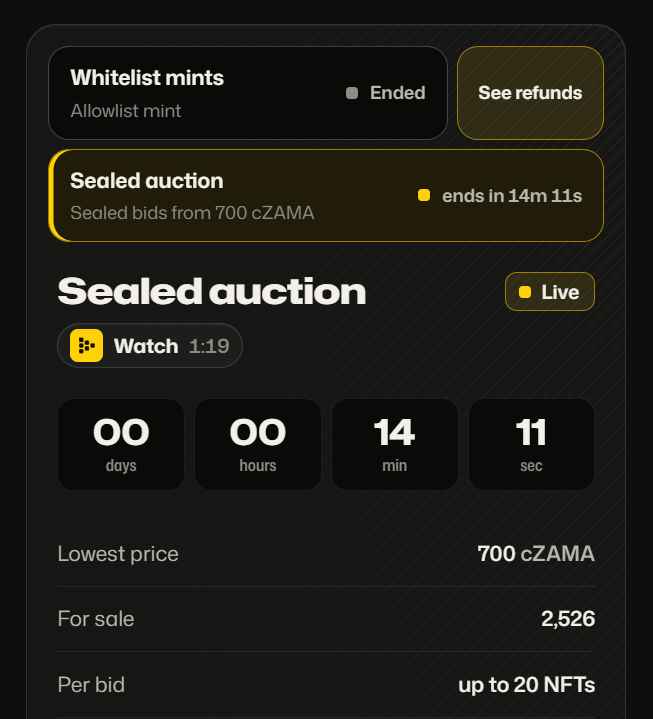
Last 15 mins to lock in $FUNGO ⏰
2 things left to do:
- Bid on NFTs with cZAMA (have $ZAMA on ETH > shield it on @FungoLabs)
- Submit posts to the X camp
FYI: They confirmed a launchpad could be coming soon, with many pjs applying.
And ofc, NFT holders may benefit most 👀
been thinking about open models more than i should rn.
the weights can be public, but if one company is the only one serving them, that company can still change the model, change the price, or just switch it off.
that's only half open imo.
that's the problem @LightchainAI is built around, so i wanted to walk thru what it actually is.
@LightchainAI is its own blockchain for AI. $LCAI is the native token, used for inference fees and gas.
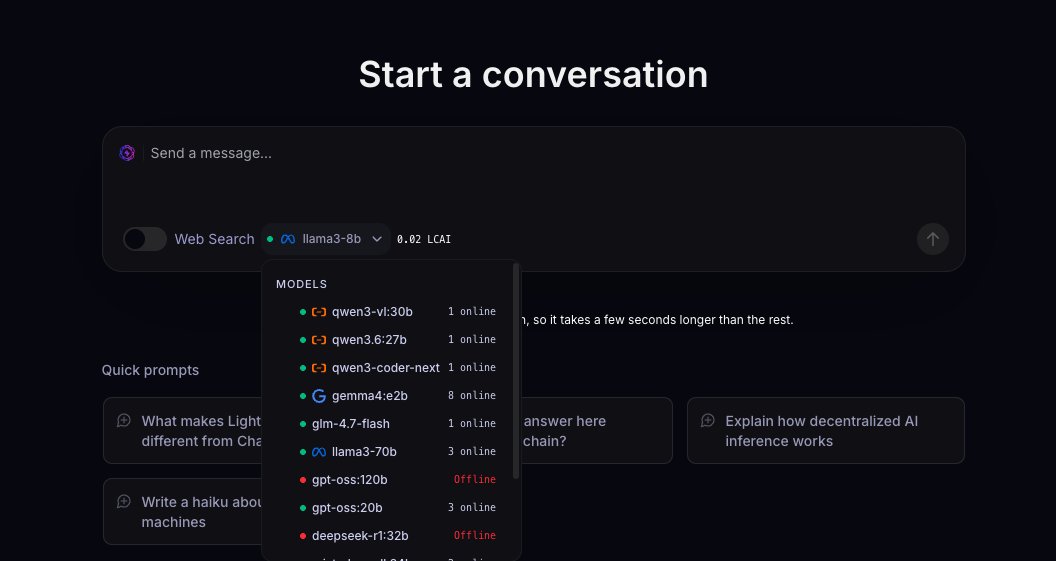
independent operators run open models like gpt-oss, Qwen3 and Llama on their own GPUs. the chain picks which operator serves each job. every job leaves a public record.
you can look that up on https://t.co/5S16aolUrq:
– the job ID
– the transaction
– the worker
no need to take anyone's word for who served it.
your prompt is encrypted before it touches the chain. observers on the explorer see ciphertext, not the raw prompt sitting in the open.
each answer costs a small fee in $LCAI, from 0.02 LCAI on the small models. larger ones cost more.
if you want to look around, chat is at https://t.co/Z1hS6zgirp and jobs are on https://t.co/5S16aolUrq.
i think it's worth a look if that actually beats just using a hosted endpoint when you want an answer.
underrated AI protocols i’m interested in
first thing first, a very simple thesis keep me in touch
useful AI needs cheaper compute, systems that learn from experience, agents that can operate real markets
i’m interested in the protocols building those layers and how their tokens capture the resulting demand
$VVV, $NEAR, $TAO offer useful precedents and they all outperforming
- VVV has subscription-funded buybacks
- NEAR connects staking to AI credits
- TAO subnets supply useful AI workloads
that’s why these 3 caught my attention:
[1] @rei_labs | $REI
adaptive AI that learns from measured outcomes
its robotics simulation research shows improvement on unseen layouts
[2] @dphnAI | $POD
cheap decentralized AI inference powered by idle GPUs
from the team that co-developed Venice’s uncensored model
commitment to use inference revenue for POD buybacks
[3] @Moshdottrade | $BUN
AI market makers managing permanently locked launch capital
opening-bundle backers earn trading fees, changing their incentive from selling an allocation to supporting an active market
all eyes on ‘em if you missed VVV
$350T+ in global debt, but onchain lending is still tiny.
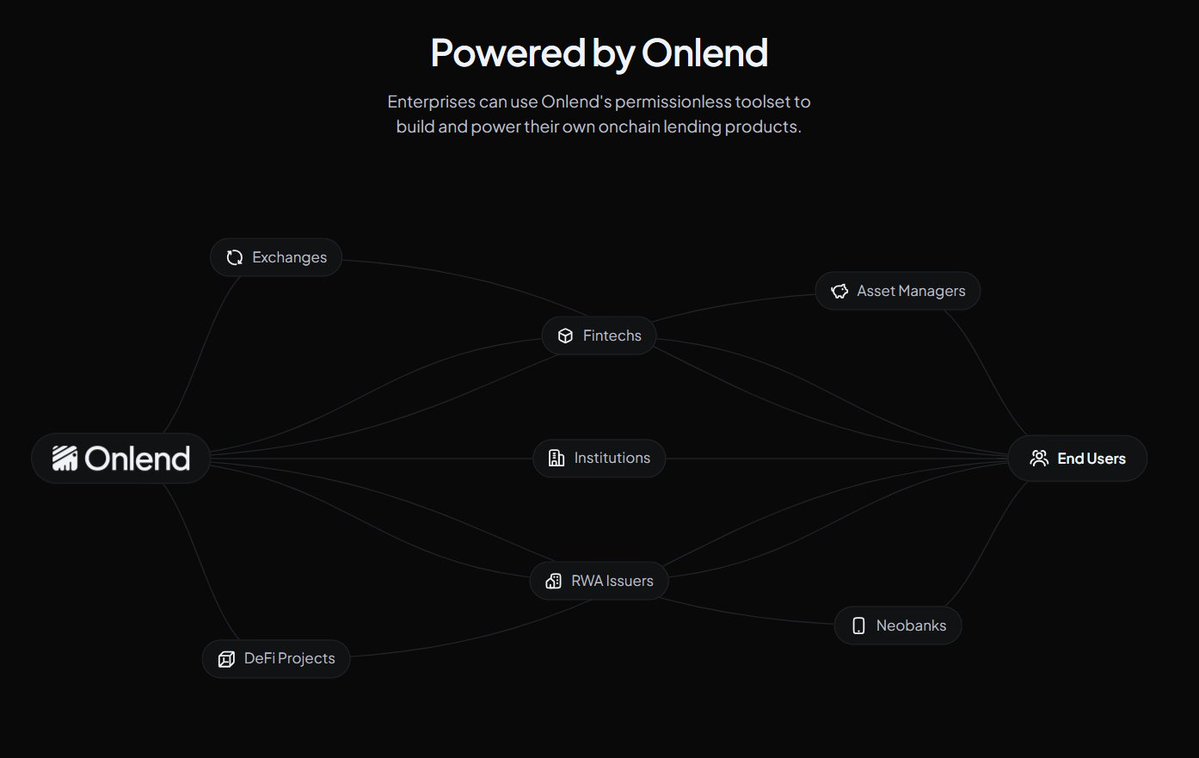
Instead of competing with Aave or Morpho for deposits, @Onlend_ is building no-code, white-label infra so fintechs, banks, and asset managers can launch lending markets.
An infra bet I'm gonna watch as RWAs grow 💎