How do you actually avoid bundles, rug pulls, and scams in memecoins?
There’s no reason to get rugged anymore.
So here are 9 ways to spot a rug coin.
🧵👇
Orangie asks Cupsey what his advice would be for anyone starting out trading memecoins.
Everyone needs to hear this because once you do it will unlock doors you never knew were possible in crypto.
Learn from the people who made it.
A teenager with zero properties made $997 in a week from Airbnb hosts.
He copies photos from luxury listings, feeds them to Claude through one MCP connector, and generates cinematic first person walkthrough videos in minutes.
No camera. No drone. No editing skills.
Hosts pay $200 per video because walkthroughs lift bookings and a real videographer charges $500 a visit.
The workflow is stupid simple.
Find a listing. Copy the photos. Paste into Claude with the secret prompt. Export. Deliver. Repeat.
One client a day covers rent. Five a week is a salary. And every city has thousands of listings waiting.
The tools went from $10k production budgets to one prompt.
Most people will scroll past this. The rest will send their first pitch tonight.
Palantir sells governments a war room that costs millions a year.
So, a guy named Elie just rebuilt it, put it on GitHub, and gave it away.
It's called World Monitor.
Open it and you get a live 3D globe with 500+ news feeds pouring in across 15 categories, all summarized by AI as they land.
> Military movements.
> Economic shocks.
> Natural disasters.
> Cyber incidents.
> Flight paths.
> Shipping lanes.
+ 56 different map layers you can stack on top of each other.
It scores 31 countries on a stress index and updates the number as things happen.
It watches 29 stock exchanges, commodities, and crypto in one panel.
It runs local AI through Ollama, so you can use the whole thing without a single API key.
Native desktop app for Windows, macOS, and Linux. 25 languages. Works out of the box after one clone.
@orangie Hope you have an amazing sir! I'm quite far from Lagos, so I probably won't be able to make it, but I'd genuinely be happy to meet you if our paths ever cross. Safe travels and enjoy your time in Nigeria!
THIS DEVELOPER JUST KILLED THE VOICE CLONING INDUSTRY WITH ONE GITHUB REPO.
Claude can now speak in your own voice across 23 languages through a single MCP call.
Free. Local. Offline.
What used to cost $22 to $330/month with ElevenLabs is now open source under the MIT license.
Jamie Pine just dropped voicebox on GitHub, and it already has over 41k stars.
It clones any voice from just 10 seconds of audio, lets you choose from seven different TTS engines, and runs entirely on your own machine, so your voice and recordings never leave your computer.
Connect it to Claude Code, Cursor, Cline, or any MCP compatible agent with a single voicebox.speak call, and your AI can start replying in your cloned voice.
It also adds global voice dictation that works in any app with one hotkey and can generate speech in 23 languages, including Arabic, Japanese, and Polish.
One open source app now replaces both ElevenLabs and Wispr Flow.
If you’ve been waiting to give your AI agent a voice, this is it.
Repo below 👇
Good morning, hustlers!
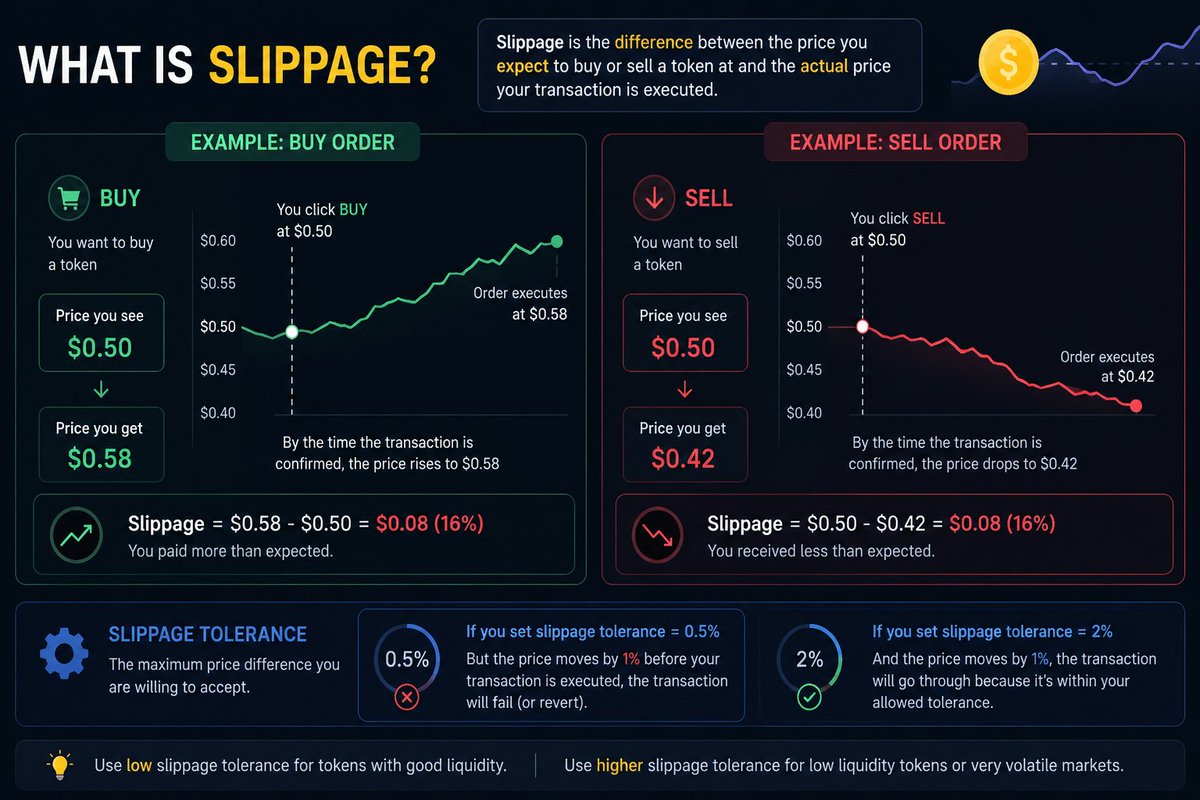
Today, let's break down what slippage is and how to avoid it when trading.
Slippage is the difference between the price you expect to buy or sell a token at and the actual price your trade is executed.
For example, imagine a token is trading at 0.50 and you decide to buy it. By the time your transaction is processed, the price has moved up to 0.58, so your order is filled at 0.58 instead of 0.50. That difference in price is called slippage.
The same thing can happen when you're selling. If the token's price drops before your transaction is confirmed, your order may be executed at a lower price than you expected.
To manage this, traders use something called slippage tolerance. This is the maximum amount of price movement you're willing to accept before your transaction is canceled.
For instance, if you set your slippage tolerance to 0.5% and the price moves by 1% before your trade is confirmed, the transaction won't go through because the price has moved beyond the limit you allowed.
In general, it's best to keep your slippage tolerance as low as possible when trading tokens with strong liquidity. However, if you're trading a low liquidity token or the market is moving rapidly, you may need to increase your slippage tolerance slightly to give your transaction a better chance of being completed.
Most people are still using AI the hard way.
Ask a question.
Wait for the answer.
Make corrections.
Repeat.
There's a better approach: AI loops.
Instead of guiding the AI through every single step, give it a clear goal and let it work. It can plan the task, complete it, review its own output, improve what needs fixing, and keep iterating until it meets the standard you've set.
This works especially well for repetitive tasks like coding, writing, research, and workflow automation where success can be clearly measured.
That said, loops aren't magic. If they're poorly designed, they can burn through tokens, increase costs, and still produce mediocre results.
The real shift is this: stop using AI like a search engine. Start using it like an assistant that can take ownership of a task and work toward the finish line with minimal input from you.
How to set up Claude Code completely in 1 hour:
(copy my exact settings, prompt & design files)
1. Claude Code is not for coders anymore. It's just a tab.
2. Download the Claude desktop app.
3. Click the Code tab at the top.
4. You need a Pro plan ($20/mo). Worth it.
-----
→ 0-5 min: Turn on the setting nobody knows.
Settings → Claude Code → "Bypass permissions."
Off = you click "allow" 30 times per session.
On = Claude just works while you're gone.
(The most important step, don't skip it)
→ 5-15 min: Connect your plumbing.
Settings → Connectors → add Netlify + Supabase.
Netlify = your site goes live.
Supabase = data + logins.
Both free. Sign in once. Done forever.
(Your plumbing runs itself from now on)
→ 15-25 min: Folder, model, credits.
Create one empty folder, just for this.
Point Claude at it. Pick Opus 4.8 (High).
Fresh chat per task. Type /usage to check credits.
(Claude Code eats credits faster than normal chat)
→ 25-40 min: Paste the mega prompt.
"You're my CTO. I don't read code. Just build it...."
Give it one goal, in plain English.
It interviews you. You just click your answers.
To download my prompt, go to https://t.co/psB7XxAv8w
(Open the welcome email. Prompt is in the Notion)
→ 40-50 min: Run the loop.
List what's wrong in plain English. Paste it back.
You'll go 5-6 rounds per page.
Bug? Screenshot it → "fix this."
(Never take longer to build it than to use it)
→ 50-60 min: Steal a brand's taste.
Go to getdesign .md to download any brand's branding in a DESIGN .md folder.
Your site now looks like Stripe, Notion, or Linear.
(This one file separates your site from every AI site)
Pro tip: Always add "Use AskUserQuestion" to every prompt. Claude prompts you instead.
To copy my mega prompt:
Step 1. Go to https://t.co/psB7XxAv8w.
Step 2. Open my welcome email (most skip this).
Step 3. Go to the Notion library link.
Step 4. Open the "Claude Cowork" Folder.
Step 5. Scroll to find the "PROMPTS" toggle list.
Bonus. Enjoy my best copy-paste prompts, too.
The $Sunusi token launched just yesterday, and I’m genuinely impressed by how it's performing already.
What stands out to me isn't just the early momentum it's the fact that the creator is a Nigerian from the North. Seeing projects like this emerge from our region is something to be proud of.
By the grace of God, $Sunusi is already gaining traction, and if this momentum continues, reaching a $5 million market cap could become a real milestone worth celebrating.
Wishing the project, the team, and the entire community continued growth and success.