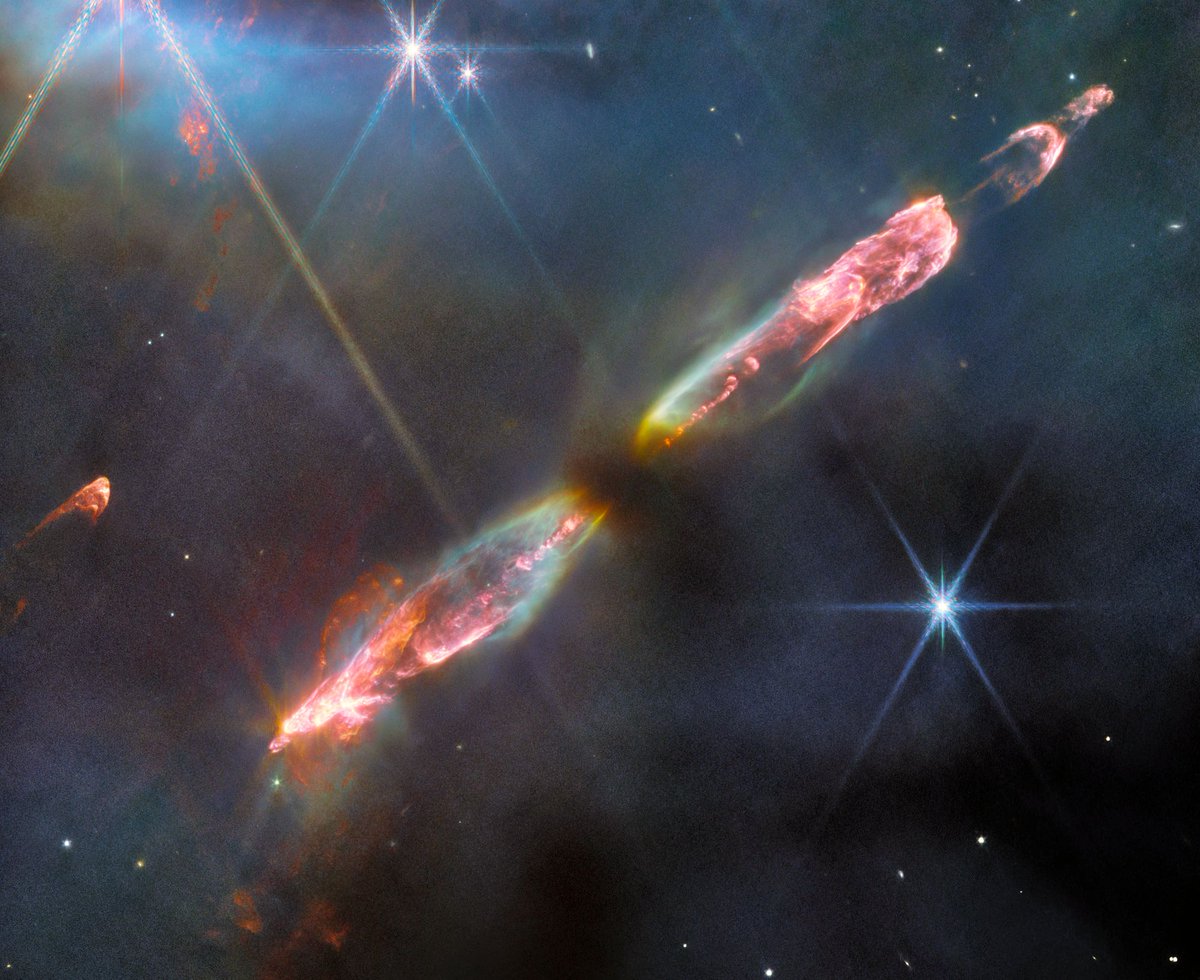
A Gorgeous image of HH 211, a bright region surrounding a young star, unveiling intricate details of its outflows.
The observations suggest the protostar may be part of a binary system
Credit: ESA/Webb, NASA, CSA, T. Ray (Dublin Institute for Advanced Studies)
This breathtaking image from NASA’s Juno spacecraft reveals the colourful, intricate patterns of Jet N3, a jet stream in Jupiter’s northern hemisphere.
(Credit: NASA/JPL-Caltech/SwRI/MSSS)
Enthralling: The Eagle Nebula (M16), a star-forming haven in Serpens, features the awe-inspiring Pillars of Creation and a celestial crowd of stars in all stages of life.
Credit: ESO/M.McCaughrean & M.Andersen (AIP)
An amazing view of the wonderous Dun Briste sea stack...
Dun Briste provides us with a rare glimpse of the Carboniferous. (A 60-million-year-long period lasting from about 359 million to 299 million years ago)
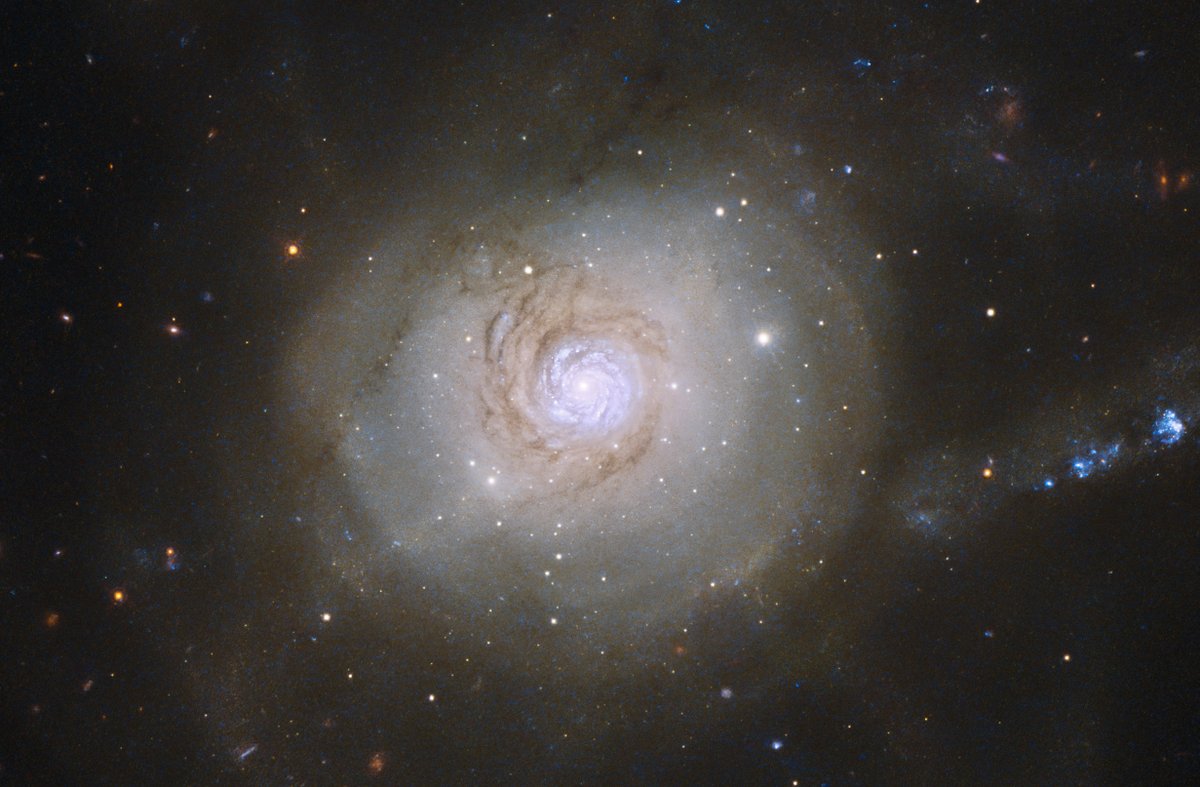
Captured in remarkable detail, NGC 4941 lies 67 million light-years away, its structure driven by star-forming regions and the energetic influence of a central black hole.
(Credit: ESA/Hubble & NASA, D. Thilker)
NGC 6334, better known as the Cat’s Paw Nebula, resides in Scorpius.
It looks close to the Milky Way’s center, yet sits only about 5,500 light-years from us.
(Credit: ESO/R. Gendler & R.M. Hannahoe)
Stunning: One of the Milky Way's nearby neighbours, NGC 346!
Thanks to its proximity, it is one of only a few galaxies that can be seen from Earth without a telescope from the the southern hemisphere.
Credit: ESA/Hubble & NASA, C. Murray, N. Bartmann (ESA/Hubble)
Fascinating: In the dense Hydra I cluster, spiral galaxy NGC 3312 is undergoing ram pressure stripping - its gas peeled away by hot intergalactic winds, trailing behind like the tendrils of a jellyfish
(Credit: ESO/INAF/M. Spavone, E. Iodice)
NGC 1651, a luminous star cluster in the Large Magellanic Cloud, lies 162,000 light-years away and stretches 120 light-years across this cosmic canvas.
(Credit: ESA/Hubble & NASA, L. Girardi, F. Niederhofer)
Despite its peaceful name, the Atoms for Peace galaxy (NGC 7252) is the product of a massive cosmic clash - two galaxies merging in a violent event roughly one billion years in the past.
Credit: NASA & ESA, Acknowledgement: Judy Schmidt (Geckzilla)
Once believed to be a nebula, Messier 77—now recognized as the Squid Galaxy—was later confirmed to be a distant galaxy 45 million light-years away, its tendril-like filaments giving rise to its distinctive nickname.
(Credit: ESA/Hubble & NASA, L. C. Ho, D. Thilker)
This stunning James Webb Space Telescope image captures a rare Einstein ring, where two galaxies align so perfectly that the light from one bends into a glowing circle around the other.
(Credit: ESA/Webb, NASA & CSA, G. Mahler - Acknowledgement: M. A. McDonald)
Gorgeous: Sh 2‑106, a compact nebular cradle in Cygnus, owes its hourglass form to a freshly minted star buried deep in dust.
(Credit: NASA, ESA, the Hubble Heritage Team (STScI/AURA) and NAOJ)
Through the Webb Telescope, the star-forming processes of spiral galaxy NGC 2090, 40 million light-years out, are laid bare. The image details the elegant choreography of cosmic materials resulting in the birth of stars.
(Credit: SA/Webb, NASA & CSA, A. Leroy)