Namaste, Kit Walker Ji. The only Israeli aerostats India ever bought were tethered radar balloons, in 2007, flying at 15K feet. They underperformed and that failure is what pushed DRDO to build its own line, starting with Akashdeep in 2010.
What flew on 6 October was a free flying platform to 21 km, a different class of machine altogether. If you have a source showing an Israeli platform, please post it, I will be more than happy to correct myself.
On fabric part: IIT Delhi's textile department lists SITEX fabrics built for aerostat hulls and high-altitude airships, and a private firm, GB Texcoat, unveiled a stratospheric-grade fabric from IIT-D research with DRDO this July.
And you are right, sir, high barrier film has been a known import gap, which is why DRDO is now funding Indian replacements. 🙏
Kind request every law maker in India to click the attached "BRICS News" post and read the thousands of disgusting comments degrading India and dehumanizing Indians.
Can we please talk about it for once in the parliament? And discuss as a nation what steps can be taken to counter this extreme genocidal hatred spread against India and Indians?
This is a multi-state sponsored, organized anti-India operation going on for too long that's affecting our exports, inbound tourism, economy, job opportunities for migrants, mental health of Indians, and physically putting them at risk of violence.
This is an issue that is beyond partisan politics affecting everyone of us and the country. IMO, this is a war that's being waged on India as serious as cross border terrorism and insurgency. So I humbly request law makers to start addressing this.
To those reading this, please repost tagging your known MP/MLAs requesting them to address this serious issue.
@PMOIndia@MEAIndia@HMOIndia@narendramodi@AmitShah@DrSJaishankar@nsitharaman@AshwiniVaishnaw@ShashiTharoor@Tejasvi_Surya
@Fintech03 Kani tribe holds Agastya muni as their deity for year and generations and it’s said Agastya muni himself has expounded and taught them siddha and ayurveda 🙏🏻
Their is a 5 ft Agastya muni statue inside the Agastyamalai biosphere reverse called agastyakoodam. 🙏🏻
December 1987, deep in the Agasthyamalai hills of the Western Ghats.
A team of scientists on an ethnobotanical expedition was collapsing. Hours of brutal terrain had left them exhausted, but their Kani tribal guides kept walking, fresh as the morning.
The scientists noticed the guides constantly munching small black fruits.
Offered a few, the exhausted scientists felt, in their own words, immediately full of energy.
What is that plant? they asked.
The guides fell silent.
Among the Kani, medicinal knowledge belongs only to the Plathi, the tribe's hereditary physicians, and sharing it with outsiders was forbidden.
It took, the team admitted, a great deal of pressure before the guides relented and led them to the plant.
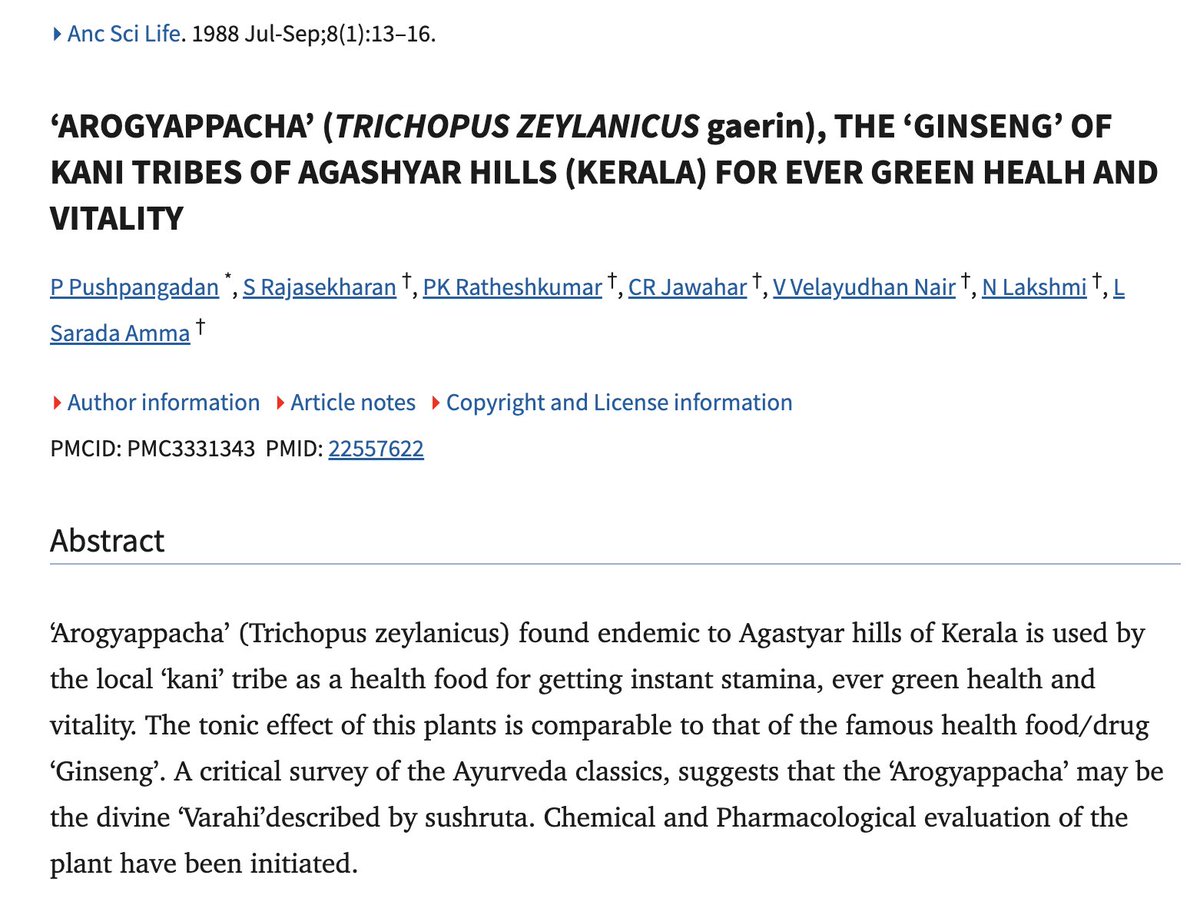
Its Kani name: arogyapacha - "green health and vitality".
For generations, the Kani had eaten it to walk for days without food and still do hard physical work.
The expedition's leader, Dr Palpu Pushpangadan, published the 1st scientific report in 1988.
Lab studies later backed the tribal claim: the fruit showed adaptogenic and anti-fatigue activity, boosted immune cells in test animals, and in one study fully protected 60% of mice from an aggressive tumour.
A formulation built on it, "Jeevani", passed toxicology and clinical studies, and has been in use since 1996.
The knowledge was not taken for free. The research institute signed a benefit-sharing agreement with the Kani: the tribe receives a share of the drug's revenue.
It was one of the world's 1st benefit-sharing agreements for indigenous knowledge, and it became a model cited by the WIPO and the UN's Convention on Biological Diversity.
A forest tribe guarded a fruit for generations. Science confirmed what the Plathi already knew. And then, for the 1st time, the law said the tribe must be paid - the follow-through was imperfect, but the precedent stuck
P.S. "Adaptogenic" means a substance that helps the body resist physical stress and fatigue. Most of the lab findings come from animal studies at one institute, promising, and consistent with the tribal claim, though not a clinical guarantee.
London, September 1930.
A 24 year old from Udaipur, Daulat Singh Kothari, arrives in England with one dream, to work under Rutherford at the Cavendish. At India House, the British officer in charge of admissions tells him the Cavendish is "totally out of question". He can try Oxford.
He was not a rich man's son. His father, a headmaster, had died in the plague of 1918.
The Mewar State staked on him anyway, an interest-free loan of Rs 3,500 for England. He would repay every rupee, at Rs 60 a month, after his return.
The next Sunday, Kothari goes to Cambridge with a friend, just to look at the building.
The Cavendish is open. A lady at the entrance hears the name Rutherford and takes them straight to the library, where Rutherford himself sits, reading a journal.
"Sir! My teacher Professor M.N. Saha had written to you about me. My name is Daulat Singh Kothari."
Rutherford looks up: "Oh, Mr Kothari, I am reading your paper right now. It is very interesting. Have you finished all admission formalities? If not, please complete them soon. My secretary will help you."
And so the boy who was told the Cavendish was out of the question was admitted to the Cavendish.
The President of Clare College, in his report to the High Commissioner for India, wrote that his examiners - Rutherford and Lennard-Jones, "spoke very warmly indeed of the excellent quality and character of his thesis."
His big idea there, pressure ionization, said matter squeezed hard enough ionizes even at absolute zero.
Eddington later wrote: "I think the first man to state this explicitly was D.S. Kothari."
Then the payoff....
In 1948, the man the India House office had turned away became Scientific Adviser to the Defence Minister of a free India and stayed 13 years.
He built the Defence Science Organisation, 40 senior scientists in a hutment, into the science base that is today's DRDO.
In 1961 he became UGC chairman. His Education Commission's 1966 report opened with the line every Indian student now inherits: "The destiny of India is now being shaped in her classrooms."
One more thing. The same office gave the same answer to S. Chandrasekhar. The two rejected students met at Cambridge and stayed friends for life.
P.S. "Pressure ionization" - squeeze matter hard enough and its atoms ionize even without heat. One consequence Kothari worked out: no cold body can be larger than about Jupiter. Beyond that, adding mass only shrinks it.
Sources: INSA Biographical Memoir, Vol 21, Defence Science Journal profile (1994)
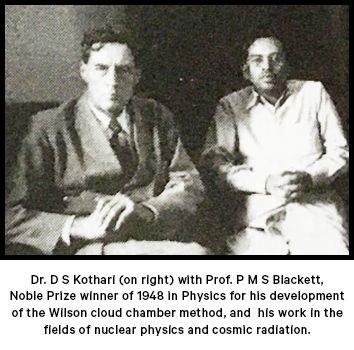
Photo: A young D.S. Kothari (right) with P.M.S. Blackett - his Cavendish contemporary, 1948 Nobel laureate in Physics, later invited to advise India on defence science.
Amidst all the noise on our timelines last week, something quietly happened on 6 October that deserved the front page.
An airship built in Agra climbed 21 kilometres into the sky, about 2x the cruising altitude of an airliner, held station at 20 km for over half an hour, streamed live video and flight data the whole way, and then came back.
Commanded descent. Recovered intact.
This is DRDO's High-Altitude Platform, and it matters far more than the silence around it suggests.
What it is...
- A lighter than air ship designed to park itself in the stratosphere, above weather, above air traffic, far below satellites.
- It floats, so it burns no fuel to stay up and at 20 km, its horizon is about 500 kms in every direction.
- A satellite passes overhead in minutes and costs a rocket. A platform like this is being built to linger for weeks, the Air Force's own ask to industry is months.
What that buys Bharat...
- A persistent eye that launch costs cannot give us today.
- Border surveillance that does not blink.
- Communications relay into mountains and remote terrain.
- Disaster watch when ground networks fail.
This is not fantasy planning, the Defence Ministry has already opened a Make-I project for airship-based pseudo-satellites, and a Rs 15,000 crore approval for the programme was reported earlier this year.
The lab behind it, ADRDE Agra, is India's parachute lab. The people who taught payloads to fall safely from the sky have now taught one to live in it.
P.S. I am not claiming, we are the 1st here. China flew its Yuanmeng airship in 2015, and a private American ship stayed up 12 days this year. But with this flight, 17 km in May 2025, 21 km now, India joins the small club of nations building their own. The Raksha Mantri's own words after the maiden flight: one of the few countries in the world with such indigenous capability.
Photo 1: The envelope on the ground
Photo 2: The ship aloft (grainy, but that is the real thing at altitude)
Bangalore, around October 1935.
In this photograph, Max Born, one of the founders of quantum mechanics, and a future Nobel laureate, stands with his wife Hedi at the home of an Indian mathematician.
At the back, holding his young son, is the man of the house: Bangalore Srinivasarao Madhava Rao (Madhava Rao Circle in Basavanagudi is named after him), professor of mathematics at Central College.
Born had just fled Nazi Germany, stripped of his professorship for his Jewish heritage. After a stopgap at Cambridge, he came to Bangalore because C.V. Raman invited him.
Born and Hedi arrived on 28 September 1935. Prof. Born gave 30+ lectures, including one titled "The Mysterious Number 137". Raman fought to keep him permanently. The university Senate blocked it. Born left in the spring of 1936, bitter.
But something stayed behind.
In September 1936, the year Born left, Madhava Rao's 1st paper on Born's field theory appeared in the Proceedings of the Indian Academy of Sciences. Six more followed by 1938.
In 1938, eight papers became his doctoral thesis, "Contributions to Born's Field Theory", submitted to the University of Calcutta. The external examiner, writing from Princeton, was Hermann Weyl.
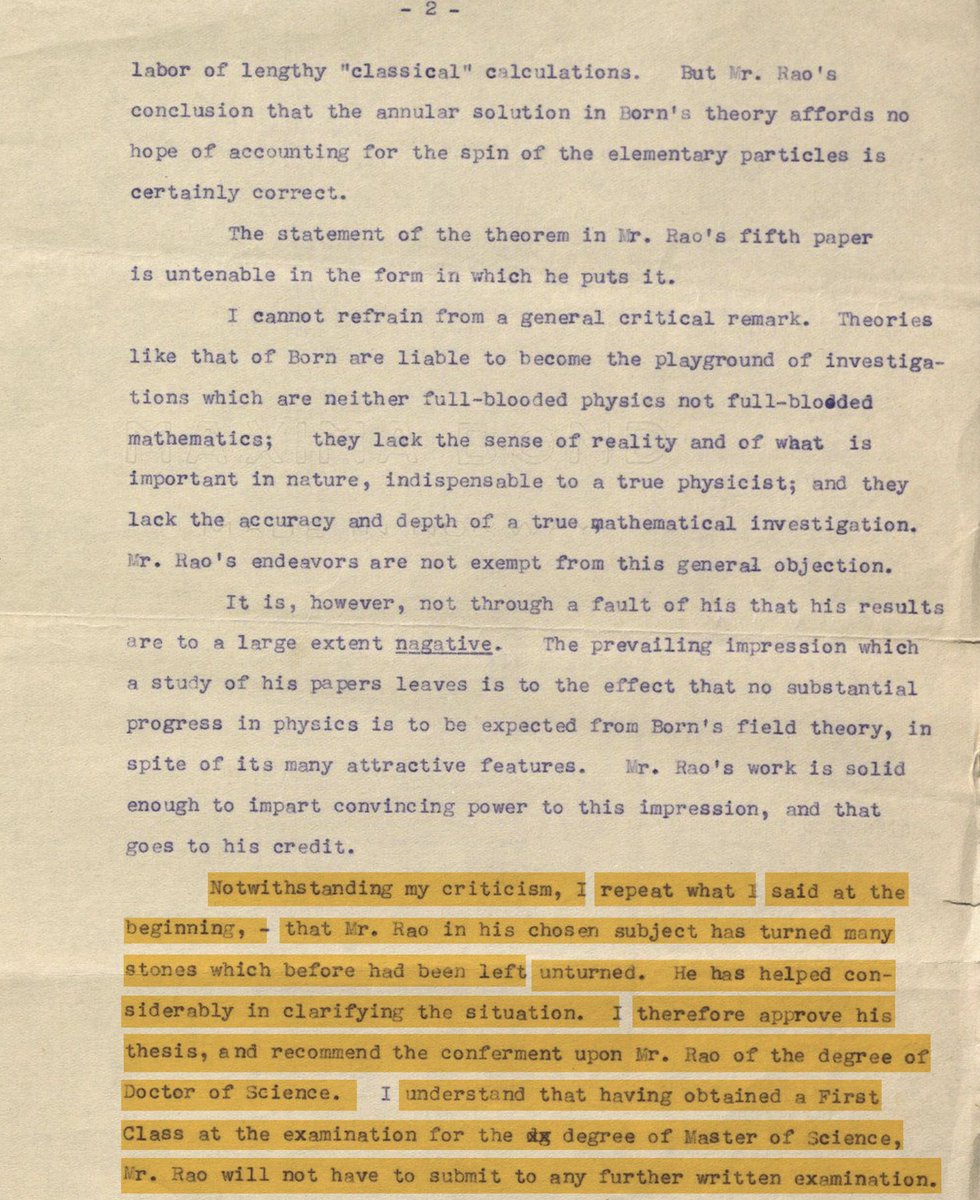
Weyl's report, dated 26 January 1938, survives in the family archive.
He called the eight papers "an impressive whole", praised the author's "versatile and imaginative mind", and wrote that Madhava Rao "has turned many stones which before had been left unturned". And then: "I therefore approve his thesis, and recommend the conferment upon Mr. Rao of the degree Doctor of Science."
Photo 1: B.S. Madhava Rao family archive, via Wikimedia Commons
Photo 2: Page 2 of examination report by Prof. Hermann weyl, Institute for Advanced Study, Princeton (B.S. Madhava Rao family archive, via Internet Archive)
Baghdad, sometime between 786 CE and 809 CE.
The caliph Harun al-Rashid cried over his dying cousin, Ibrahim ibn Salih. His personal physician, Jibril ibn Bukhtishu, trained in the Greek tradition had given up.
Then the vizier Ja'far ibn Yahya spoke up. Jibril, he said, practices Greek medicine. But there is a man at this court just as learned in the doctrines of the Indians: Salih ibn Bahlah al-Hindi.
The Indian examined Ibrahim and felt his pulse. Then he did what no court physician does. He refused to give his verdict to anyone but the caliph and he staked his entire life on it.
If Ibrahim died, he declared, his slaves would be freed, his property given to the poor, his wives divorced.
That night, a letter arrived. Ibrahim was dead. Harun cursed the Indians and their medicine.
The next morning, the household had gathered to mourn. The body was perfumed, the shroud laid out. And Salih ibn Bahlah fought his way in, shouting that the Commander of the Faithful was about to bury his cousin alive.
Alone with the body and the caliph, he took a needle and pricked it between Ibrahim's left thumbnail and the flesh. The "corpse" pulled its hand away.
Salih ordered the burial perfume and shroud removed at once, so the man would not die of shock on waking.
Then he loaded a bellows with sneezewort and blew it up Ibrahim's nose. For a 6th of an hour, the court of the Abbasids stared at a dead man's face.
And then Ibrahim sneezed, sat up, and kissed the caliph's hand.
His first words? He had dreamed a dog bit his left thumb.
Ibrahim ibn Salih lived on. He married the caliph's own sister, and went on to govern Egypt and Palestine.
The story survives in Ibn Abi Usaybi'a's History of Physicians, a 13th-century Arabic chronicle, preserved through a chain of named witnesses going back to a translator of Harun's own court.
Read it as the chronicler's fact / as the court's favourite legend, either way, it tells us what Baghdad believed about Indian medicine: that in the greatest city on earth, an Indian's reading of a pulse could outweigh a death certificate.
P.S. Sneezewort (Achillea ptarmica) is a real medicinal plant whose powder induces violent sneezing, historically used to rouse the unconscious. And pulse diagnosis is the signature technique of the Indian medical tradition, the very tradition the Barmakid viziers of that court were paying to have translated from Sanskrit, in that very generation.
Source: Ibn Abi Usaybi'a, History of Physicians, ch. 12.6 (Brill, open access)
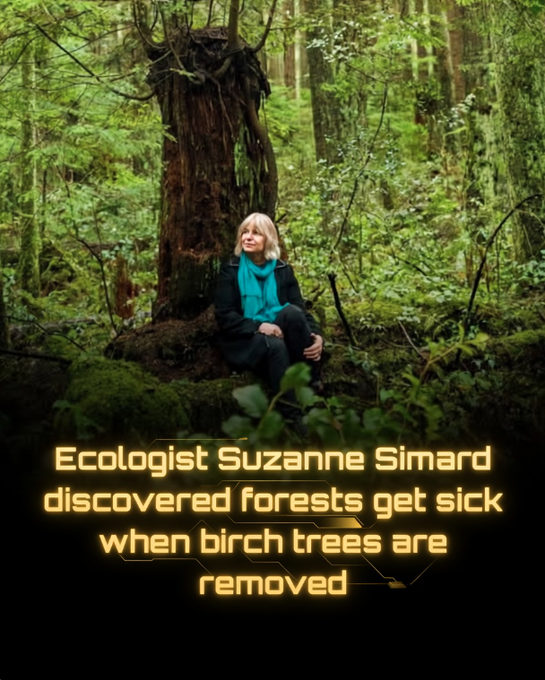
In the 1990s, Canadian ecologist Suzanne Simard made a groundbreaking discovery that challenged everything we thought we knew about how forests work. While studying managed forests in British Columbia, she noticed something puzzling: when birch trees were removed to promote the growth of valuable Douglas firs, the firs did not flourish as expected, they actually struggled and grew more slowly.
Determined to understand why, Simard traced the movement of nutrients using radioactive carbon isotopes. What she found was astonishing. Trees were actively sharing resources through vast underground fungal networks known as mycorrhizae. These delicate, thread-like fungi connect the roots of different trees across the forest floor, forming a complex web that allows the exchange of carbon, water, nutrients, and even chemical signals, sometimes between entirely different species.
She discovered that older, larger trees often serve as central "hubs" or "mother trees," supporting younger saplings by redistributing vital resources and helping the entire ecosystem remain resilient. When these key trees are removed, the underground network weakens, and the health of the remaining forest declines.
Simard’s research overturned the traditional Darwinian view of forests as battlegrounds of ruthless competition. Instead, she revealed a far more sophisticated reality: forests operate as highly cooperative systems where trees communicate, support one another, and even warn neighboring trees about threats like drought, disease, or insect attacks.
What appears to the human eye as a silent, still forest is, in truth, a vibrant, interconnected living network, built not on isolation and rivalry, but on deep connection and mutual aid.
The oldest map we may ever have had is a 14-metre elephant carved into the ground near Ratnagiri. c. 12,000 BCE.
It has no fence, no signage, no monitoring. Yet my analysis of it is the lead article in a London map journal this month.
My analysis arguing it is a map of the subcontinent's known world, older than Çatalhöyük by six millennia, is the lead article in the IMCoS Map Journal, No. 186, Sept 2026.
The International Map Collectors' Society put it on page 4.
The Ancient Monuments Act of 1958 has no category for it. A carving that is the ground itself cannot be fenced, ticketed, or given an asset value. So the central inventory never recorded it.
Inside the outline there are six species, each placed where it actually lived: tiger in the east, langur in the Himalayan north, rhino on the Ganga-Yamuna doab, pangolin in the south.
The width-to-height ratio of 1.167 matches the walkable world at 12,000 BCE, when the Sunda Shelf was dry.
It is a hypothesis. It needs direct dating and a proper statistical test, and I say so in print.
But a hypothesis about 14,000 years of human geography is being argued over in London, while at home the monsoon erodes the incisions every year, with no 3D record of them.
We paid to protect the monuments that sell tickets.
The oldest map we may ever have had sells none.
Who is documenting it before the next monsoon?
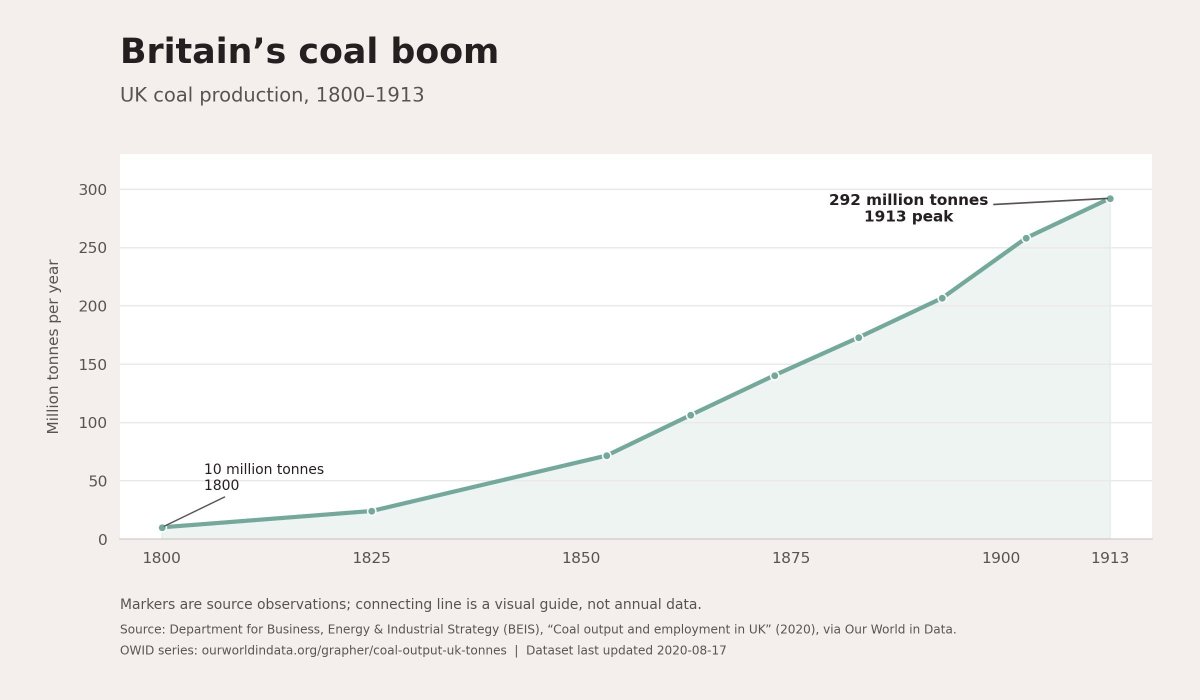
In 1865, a young economist named William Stanley Jevons looked at the steam engine and noticed something nobody wanted to hear.
Watt's engine burned a fraction of the coal that Newcomen's did. Logic said England's coal consumption should collapse.
It exploded...
Jevons figured out why: efficiency did not reduce the appetite for coal. It reduced the price of using coal and every use that was previously too expensive suddenly made sense.
Factories that could not afford steam now could. Railways. Ships. Mills.
England found a 1,000 new things to burn it on.
This is Jevons Paradox: making a resource cheaper to use does not reduce its consumption. It multiplies it.
Now watch it happen again.
Cost per FLOP has fallen over a million-fold since 1990. Did total compute spending fall? It went up.
We did not do the same computing cheaper, we invented entire industries that only exist because computing became nearly free.
And now AI: inference costs are falling 10x every year / two. Everyone says the AI bill will shrink.
It will not.
Every 10x drop in the price of a token creates 100x of new demand. Cheaper AI will not reduce AI usage any more than efficient steam reduced coal usage.
Jevons wrote it 160 years ago, about coal.
Looks like, he was really writing about us.
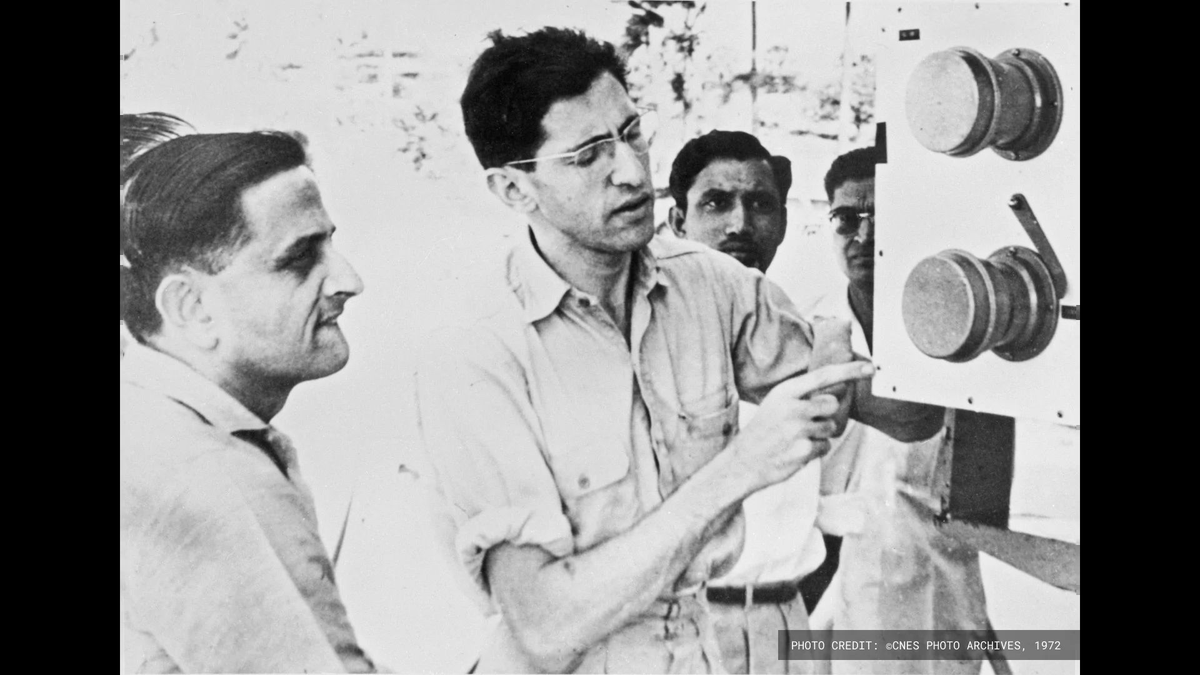
Vikram Sarabhai with French space agency founder Jacques Blamont at Thumba. Blamont's sodium-vapour payload flew on India's 1st sounding rocket launch (Nike-Apache, 21 November 1963).
That launch nearly did not happen. Per Amrita Shah's biography of Sarabhai:
- The truck carrying NASA's rocket from Delhi to Cochin broke down on the way.
- The French payload did not fit the American rocket. Welding was impossible, the payload was pyrotechnic. So PRL mechanic Ratilal Panchal was flown in from Ahmedabad to scrape the fitting down by hand.
- On the pad, the crane's hydraulics leaked, so the rocket was shifted manually. The remote elevation control failed, so a man operated it standing at the launcher. After the alarm to clear the area, student Pramod Kale spotted a worker still at the controls and dragged him away.
- The rocket had no radar and no telemetry. The range director, who had threatened to cancel, fixed a launch angle calculated to miss people and buildings.
At 6:25 pm, into dusk, the rocket rose. The sodium cloud bloomed orange in the setting sun. Sarabhai telegrammed home: "Gee whiz wonderful rocket shot."
Blamont said it 40 years later: "An infant was born at Thumba. It had a loving father - Vikram Sarabhai."
Photo: CNES Photo Archives
I know the Nobel Committee does not reveal its list of contenders, so we cannot know who was seriously considered.
But how likely is it that Athawale Ji missed the Literature Prize because of bias against India?