Today, assets are fragmented across dozens of #blockchains, each with its own rules and risks.
Quant Fusion creates a single interoperable layer where #digitalassets can move seamlessly, without wrapped tokens or fragile bridges. Institutions gain direct access to deeper liquidity, tighter spreads, and more efficient trading across markets.
#QuantFusion
Tokenised deposits and real-world assets have crossed $100 billion. For banks and capital markets firms, operationalising tokenisation without dismantling what already works is now the defining challenge.
Our partnership with Murex addresses that directly. Integrating Quant's programmable money infrastructure into MX.3 means institutions can issue, settle and manage tokenised deposits and digital bonds within their existing operational framework, with the same risk management, compliance and post-trade processes they already rely on.
As @gverdian puts it: 'The next generation of capital markets infrastructure will not replace what works. It will make what works programmable.'
Read the full piece in @ATeamInsight: https://t.co/Kka7OUk1JC
#Tokenisation #DigitalAssets #ProgrammableMoney #CapitalMarkets
87% of women-owned micro-enterprises in India are locked out of formal credit.
The latest episode of Solutions That Scale features @MannDeshiOrg, using @Algorand to change that with an on-chain credit score.
600 onboarded, 500+ loans issued. 👇
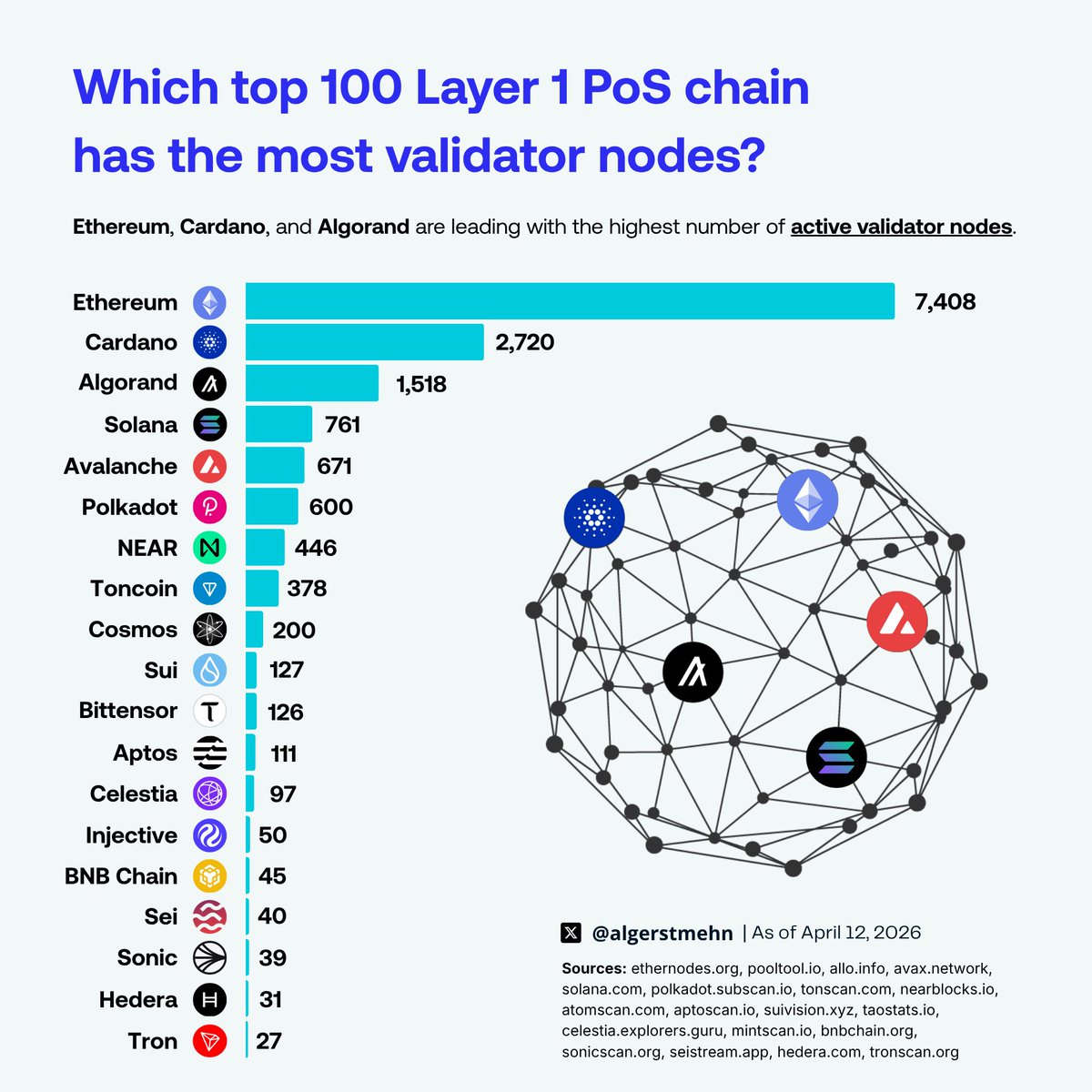
Yes, when you're building or using @Algorand, you're actually doing it on a highly decentralized L1!
And that matters! 🫡
In terms of validator nodes and geographic distribution (79 countries), very few chains surpass $ALGO.
Over 80% of the stake securing the network is now community-held, while any protocol upgrade requires 90% stake approval.
IMO, the core value of public blockchains is trust minimization through resilient and permissionless systems.
Without decentralization, their value quickly fades!
What's the point if only a very small handful of actors can fully control what happens, while the vast majority of users have no say?
The whole premise breaks down.
As blockchains reach mass adoption and higher activity, they need to be as robust, resilient, and permissionless as possible in the long run!
The beauty of Algorand is that, thanks to PPoS, anyone can run a node with minimal hardware, even on a standard computer, and be randomly selected via VRF to propose blocks, with as little as 0.1 $ALGO to participate (30k to start earning rewards).
Basically, this means any user can easily get involved and directly contribute to consensus!
I feel that's definitely the kind of openness Algorand enables, and a big reason why many people here believe in it.
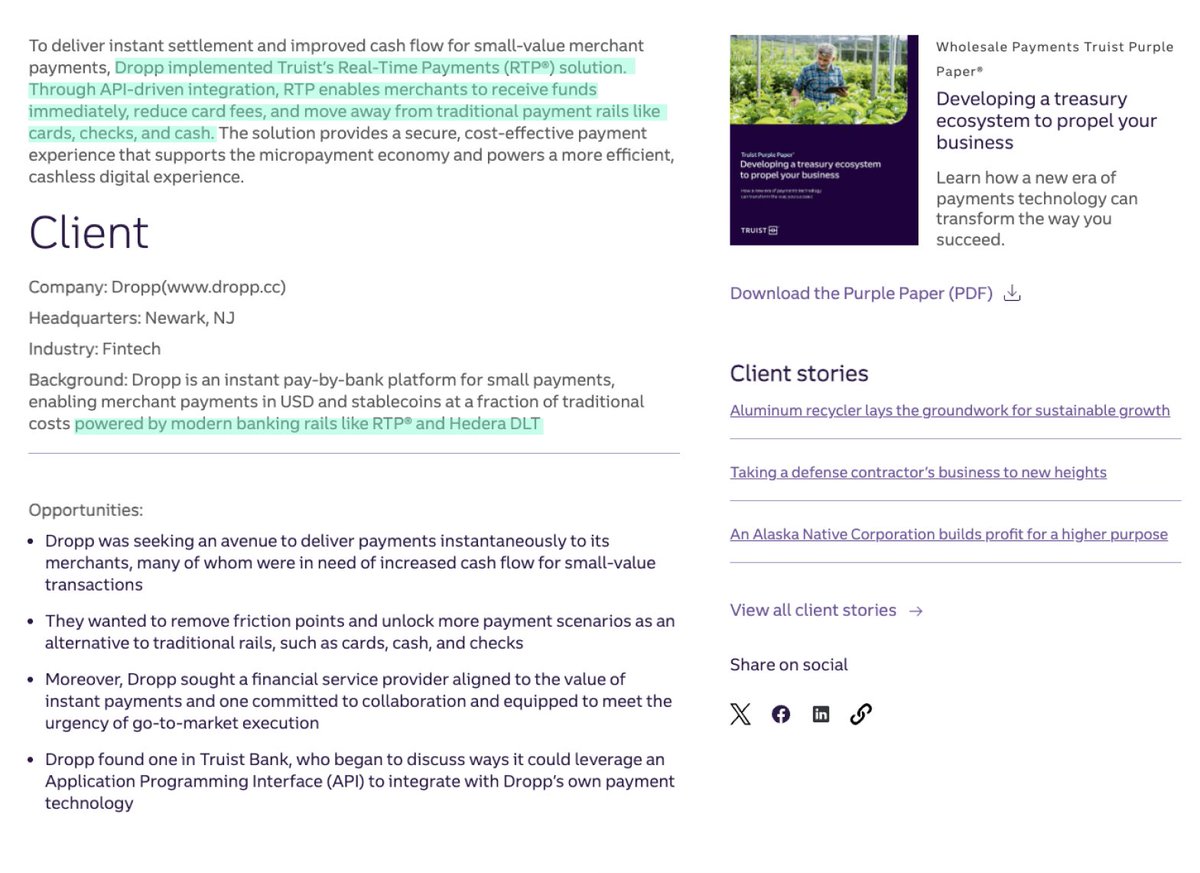
🚨HUGE news Dropp for the $HBAR ecosystem
As we know Dropp's partnered with Truist Bank, a top 10 bank across the US.
In the latest update, it seems Dropp & Truist have now built a solution for real-time payments rails.
This is through using both the Hedera DLT itself & Truist's Real Time Payment solution integrated via API
This directly plays into Dropp's overall utility and vision.
The US Federal Reserve's ISO20022 system FedNow has already integrated Dropp for micropayments.
And now looking at Truist & Dropp?
The two are establishing the foundation for a micropayments railways.
We're watching the future of payment rails establishing.
Not just speculative theory, but through collaborating with one of the biggest banks in the US.
And of course... It's happening on Hedera.
The HederaCon 2026 agenda is now live 💥
On May 4, the conversation shifts from possibility to reality. From global finance & policy to enterprise technology & digital assets, this year’s agenda marks a turning point. Trust is no longer experimental. It is becoming infrastructure. 🧵
Discover the agenda & register for free: https://t.co/FRmWWVq0iM
Africa's digital asset moment is here, and regulation is leading the way → https://t.co/6lFdJiB8CQ
$205B+ in onchain value.
52% YoY growth.
South Africa, Nigeria, Kenya, and Mauritius are all moving towards comprehensive crypto frameworks.
Clear regulation enables innovation. 🌍
Algorand just hit 60 million blocks.
Less than one week after hitting 3.5 billion transactions.
Zero downtime since launch in 2019, a new block every 2.8 seconds, and every transaction finalized instantly.
The chain keeps running.
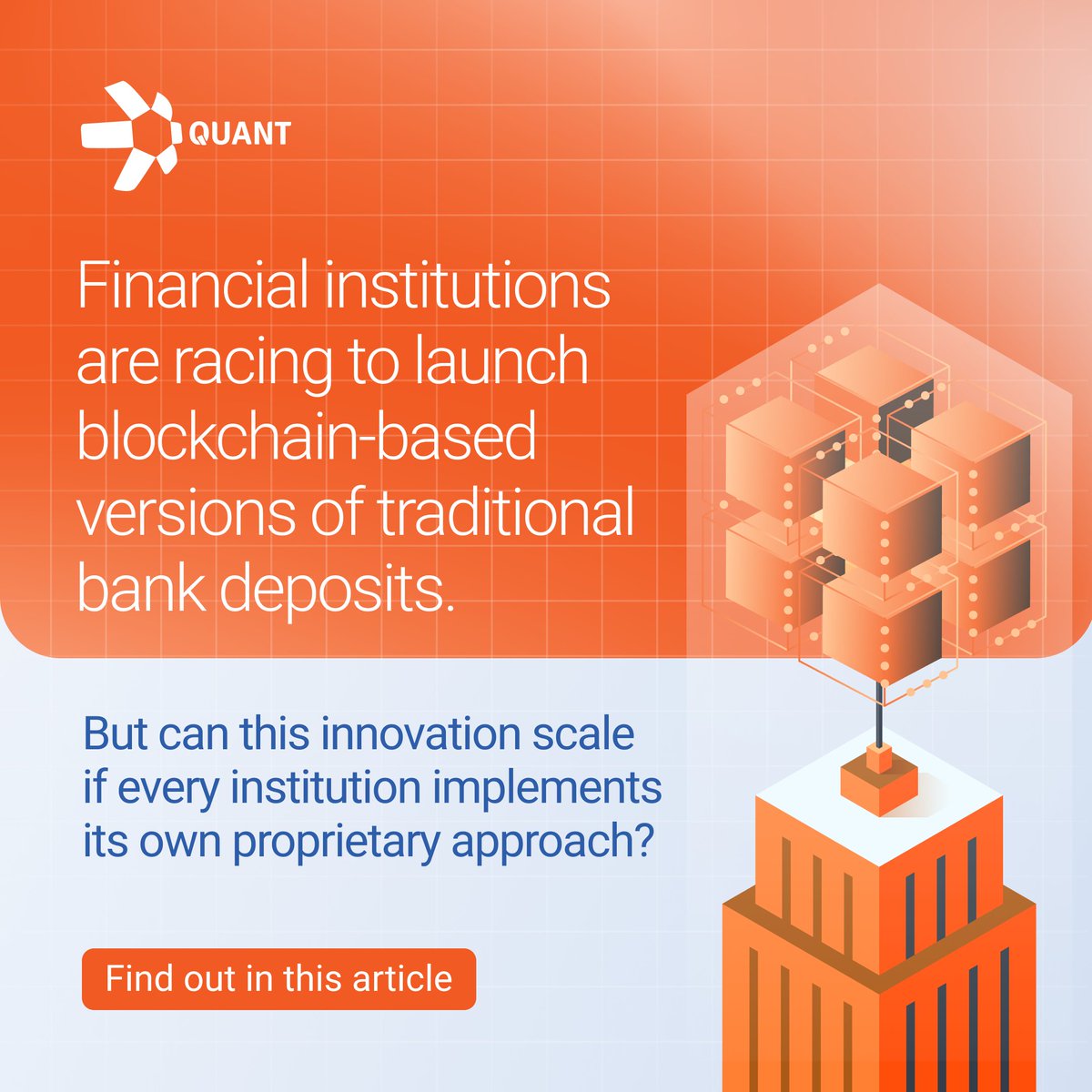
Tokenised deposits are coming. But can they actually scale?
Every major bank is racing to launch its own version. The problem is that without universal standards, we're just rebuilding the same fragmented system on a new rail.
When Lloyds issues a tokenised pound and JP Morgan issues a deposit token, those assets may be technically incompatible, despite representing the same currency.
The technology has real promise. But the standards to make it work across institutions don't yet exist.
Read this article to understand the standards gap holding back #tokeniseddeposits, why it matters, and what history tells us about how this plays out: https://t.co/ArSH9Naz6p
#Blockchain #FinancialInfrastructure #DigitalAssets
Google Quantum AI's new paper surveys quantum vulnerabilities across the entire cryptocurrency landscape.
Algorand is documented as having deployed post-quantum cryptography across multiple protocol layers — FALCON signatures, state proofs, native key rotation, and TEAL primitives for quantum-safe smart contracts.
For builders and institutions evaluating quantum readiness, the record speaks for itself.
Read the full paper from @Google: https://t.co/l5U8Uyy07f
On 21st April, @InnFin's Global Summit returns to London's Guildhall.
Our Founder and CEO, @gverdian, will be joining a panel titled: 'Building A "Multi-Moneyverse", Are We There Yet?' covering progress since the National Payments Vision, what still needs to happen, and how interoperability can connect the financial system in practice.
Learn more and register here: https://t.co/WksuLPE7gO
#IFGS #InnovateFinance #Payments #Interoperability
Google Quantum AI just published a landmark paper on quantum threats to every major blockchain.
Beyond Bitcoin and Ethereum, no blockchain receives more coverage than Algorand, cited for live post-quantum deployments across signatures, state proofs, key rotation, and smart contracts.
The alarm has been sounded. @Algorand has been answering it for years.
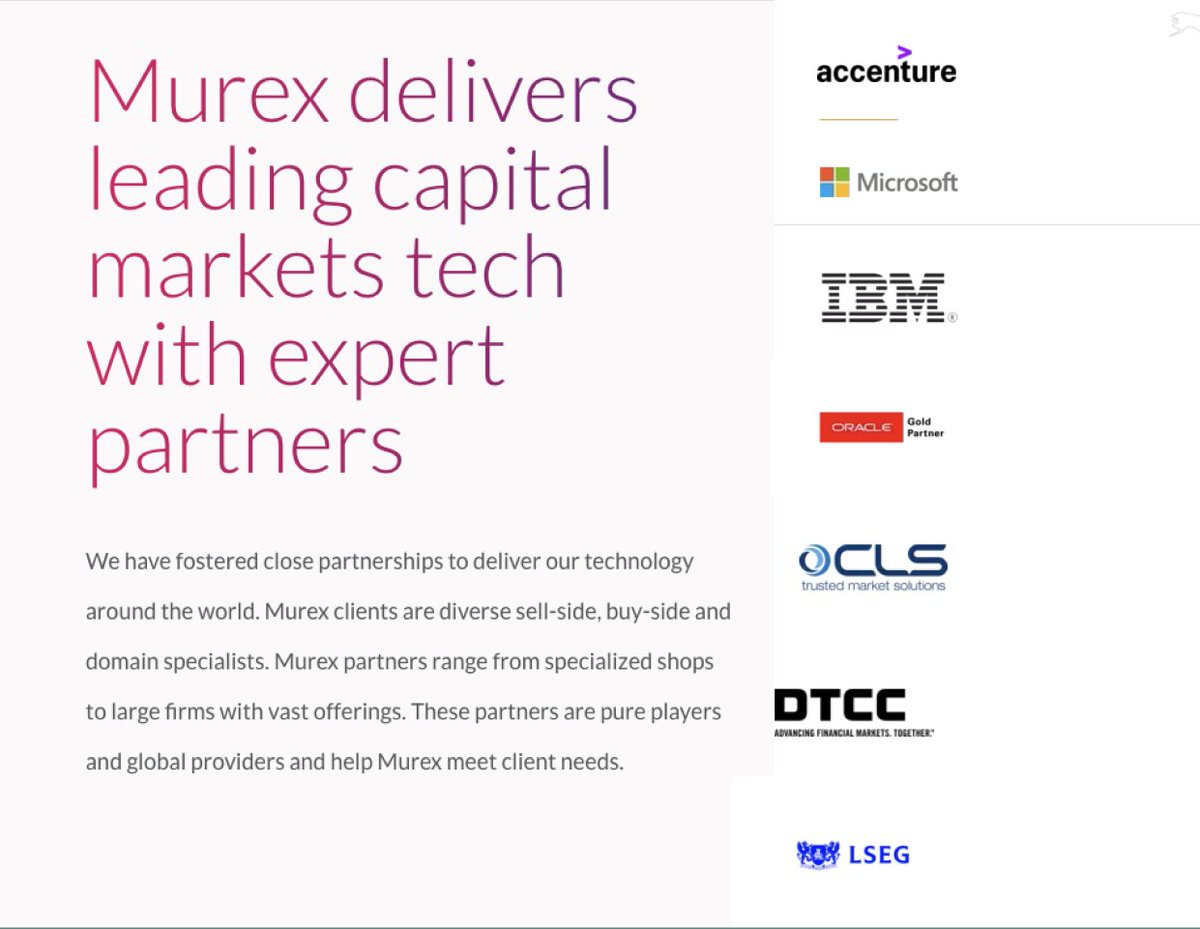
Safe to say $QNT bagged a financial giant via the Murex partnership
Just look at the partners/integrations
• Accenture
• Microsoft
• IBM
• Oracle‼️
• CLS
• DTCC
• LSEG
Most of retail probably hasn't heard of Murex
And there's a reason to that.
They operate in the backend as critical financial infrastructure for capital markets.
They're not meant for retail use or knowledge.
Exactly like how Overledger is positioned🧠
INSIGHTS:
🇪🇺 Quant is now powering the European Central Bank's digital euro.
2027 pilot. 2029 full launch.
440 million potential users. One infrastructure layer.
BlackRock chose Ethereum.
Ripple won Singapore's central bank.
Quant won the ECB.
Institutions are not experimenting anymore.
They're choosing winners.
Are you positioned in the right projects?
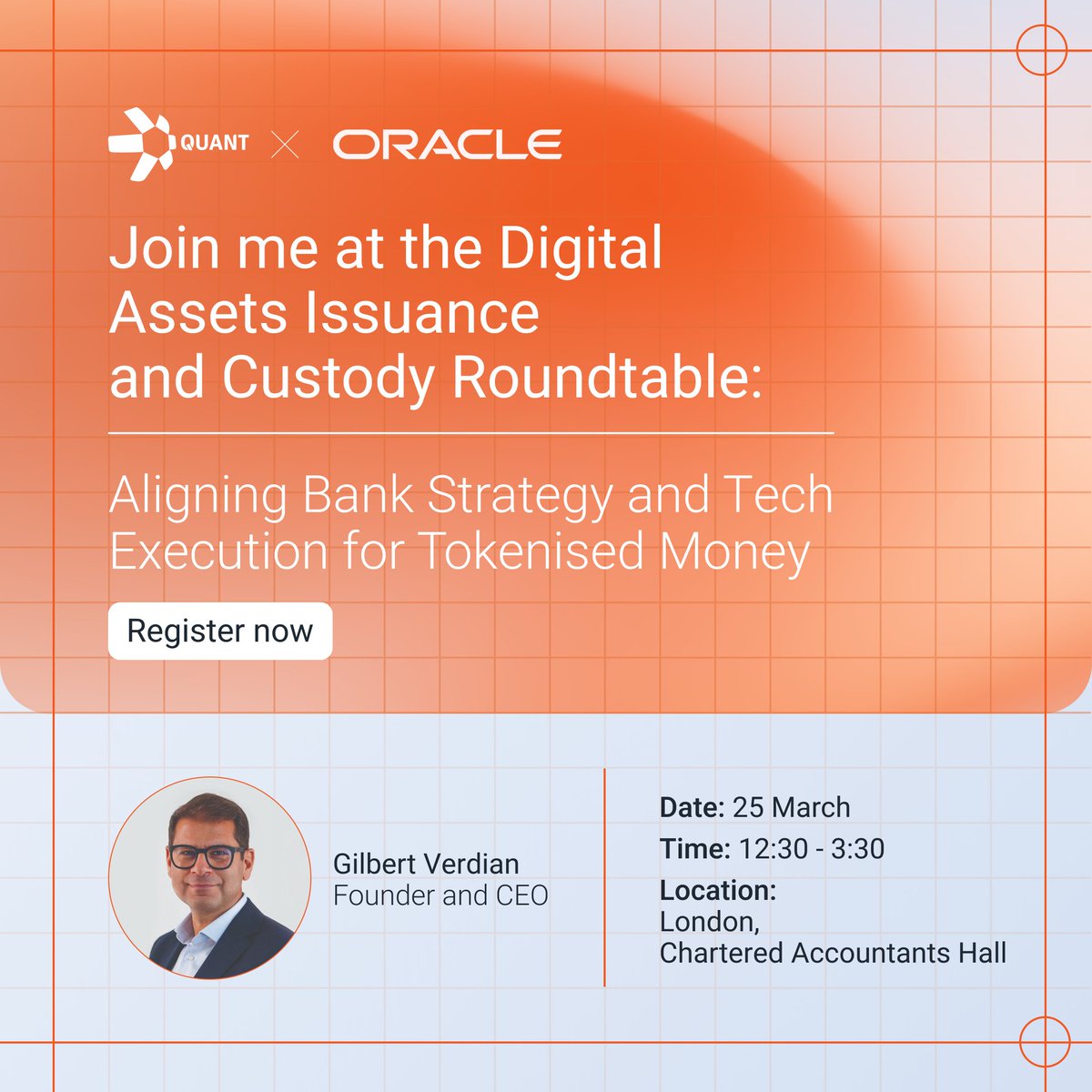
Next Wednesday, our Founder and CEO, @gverdian, will be speaking at the @Oracle AI World Tour London Executive Roundtable on Digital Assets Issuance and Custody, sharing insights from the UK Tokenised Sterling Deposits Pilot.
📍 Chartered Accountants Hall, London
🗓️ 25 March 2026, 12:30 - 3:30PM
The event will explore how #banks, asset managers, #capitalmarkets, and global financial institutions are exploring the expanding role of #digitalassets - specifically #tokeniseddeposits and #stablecoins - and seeking optimal strategies for integrating them into the financial product and services ecosystem through digital asset platforms.
Register here: https://t.co/9w6lI0o0ey #GBTD #TokenisedMoney
Slowly but surely, the ties between $QNT & Project Agora become more clear
🇯🇵Japan- Quant partner w Dentsu Soken
🇬🇧England- Sync Lab/Rosalind/UK RLN/GBTD
🇫🇷France- Representing EU, Quant in Digital Euro
🇺🇸USA- SATP Gateways in Cedar x Ubin
🇰🇷Korea- BIS x Bank of Korea paper reference SATP
The hints are revealing themselves over time
Tokenised deposits promise to transform #bankinginfrastructure, but fragmentation could undermine the entire project.
Every major institution is building its own protocols and compliance controls in isolation, reproducing the very inefficiencies they were supposed to solve. History is clear: every payment innovation that achieved scale got there through neutral clearing infrastructure, not proprietary networks.
The technology is not the bottleneck. The collective will to prioritise #interoperability over proprietary advantage is. Learn more: https://t.co/ArSH9Naz6p
#TokenisedDeposits #Blockchain
A decade in the making, we have published an ISO standard for blockchain interoperability.
This is a milestone I've been working towards since 2015, Remitt was founded with the conviction that blockchains could transform financial services but only if the industry solved interoperability and harmonised around global standards. Without that, blockchain would remain fragmented, siloed, and locked out of mainstream institutional adoption.
In April 2016, we published what was the world's first proposal for a blockchain standard (https://t.co/SL83Yl4Ejr) a bold move at a time when the industry was still largely focused on proofs of concept and competing protocol narratives, not standardisation.
The idea was simple but ambitious: if blockchains were going to serve global markets, they needed a common framework that transcended any single protocol or vendor.
Central to this thinking from the very beginning was the concept of a multi-gateway architecture, leveraging the know-how of 20 years of experience in cybersecurity to frame the principle that interoperability shouldn't depend on a single bridge or point-to-point connection, but on a layered gateway model that could abstract away the differences between underlying DLTs and connect them through a common interface. This was the architectural foundation of what would become Overledger, and it was also the design philosophy we brought to the standards process.
The belief was that a viable international standard for blockchain interoperability had to be protocol-agnostic and gateway-driven, enabling any DLT to communicate with any other DLT (any-to-any) and with existing networks, without requiring those ledgers to change how they operate. The standard and the technology were born from the same insight.
That same year, I worked closely with the team from @standardsaus (Standards Australia), who had the foresight in 2015 to champion the initiative at the international level. Together, we pushed for ISO to establish a dedicated Technical Committee for blockchain and not to be absorbed into an existing committee, but to stand on its own as a recognition that this technology warranted its own global standards programme. The industry demand was there, the use cases were multiplying, and the fragmentation was becoming a real barrier.
In September 2016, the New Work Item Proposal (NWIP) received global approval, and ISO formally gave the green light to establish a new Technical Committee (https://t.co/7biJjvHRk9). TC 307 — Blockchain and Electronic Distributed Ledger Technologies — was born (https://t.co/5SsFPIw0HH). The inaugural meeting was held in Sydney in April 2017, and from that moment the real work began.
As the standards work progressed internationally, the mission at Remitt was evolving too. What started as an effort to use blockchains for financial services and solve interoperability grew into something far larger, a full enterprise infrastructure platform for connecting any blockchain to any network. Remitt became Quant, and we built Overledger, the world's first blockchain operating system to deliver on that original vision. The multi-gateway architecture that informed the standards thinking became the core of Overledger's design: a technology layer that sits above all blockchains, providing institutions with a single integration point to access any DLT, any network, and any existing system. The interoperability challenge that drove the standards work was the same challenge we set out to solve commercially and the two efforts reinforced each other throughout.
For close to a decade since TC 307's formation, subject matter experts across the world have contributed their time and expertise to Working Group 7 — Interoperability is the committee I chair.
International standards are not built quickly they are built through consensus, technical debate, and relentless refinement. The same methodology and rigour that created the Internet, through publishing standards. The result is a published international standard for blockchain interoperability.
🔗 https://t.co/GRoR7fXNLQ
A huge thank you to @isostandards as the international standards developing organisation, to the team at @standardsaus who started the initiative in 2015 and worked tirelessly to get TC 307 approved and established globally, and to every subject matter expert who contributed to Working Group 7 over the years. This would not exist without that collective effort.
From a blog post proposing the world's first blockchain standard in 2016, to a published ISO standard in 2026 and from Remitt to Quant, from an architectural concept of multi-gateway interoperability to Overledger and a global standard, this has been a decade-long journey of building both the standards and the technology to make blockchain interoperability a reality for institutions worldwide.
There is still much more work ahead. More standards to develop, more to evolve, and more to build. But today, we mark a significant milestone.
#Blockchain #ISO #Interoperability #Standards #TC307 #DLT #Quant #Overledger
In brief... Hedera is built for builders.
Build with the stacks and SDKs you already know, integrate without re-architecting everything, and deploy on infrastructure designed for scale.
And with Hiero, a @lfdecentralized project, everything is open.
👉 https://t.co/SqrI27tzwv
👉 https://t.co/225rholrp0
🇯🇵The news release on Dentsu Soken's side of the $QNT partnership gives some key details.
First we see just how important DS is.
They've built a payment management system to integrate with Bank of Japan RTGS.
On top of this look at how they describe Quant.
"Proven track record in demonstration projects with central banks and regulators"
Praise doesn't get much better than that.
Reminder that DS is no small firm.
They're critical towards payments infrastructure for banks across all of Japan.
To see them give Quant this level of praise is definitely something to pay attention towards.
And we see the greater overarching purpose of this partnership beyond building architecture.
The architecture is important yes,
But the goal here isn't just establishing infrastructure.
After that's established the two are actively building a roadmap for institutions in Japan to begin adopting digital currencies and programmable payments.
This is a National Level Operation.
Just like the UK RLN/GBTD & just like LACChain
And don't forget the recent patent approval + DCJPY.
Another nation in the books for Quant coming together